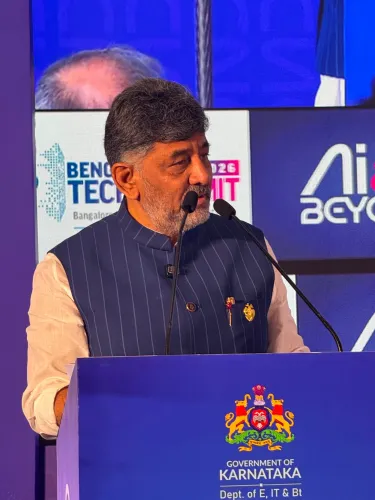
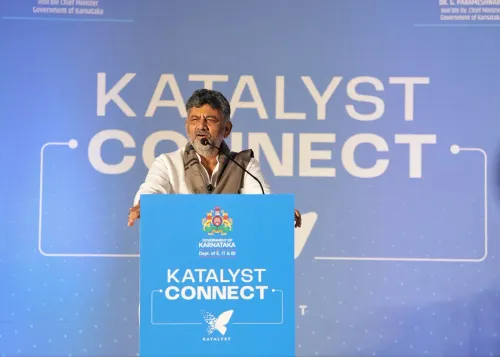
CM Shivakumar Chairs KATALYST CONNECT GCC Summit in Bengaluru

Synopsis
Chief Minister D. K. Shivakumar chaired the KATALYST CONNECT strategic conclave in Bengaluru on 8 July 2026, engaging top executives from Google, Intel, IBM and Bosch to advance Karnataka's GCC Policy 2024-2029 — targeting 500 new centres, 3.5 lakh jobs and ₹4.76 lakh crore in economic output by 2029.
Key Takeaways
Shivakumar chaired the KATALYST CONNECT high-level strategic conclave in Bengaluru on 8 July 2026 .
The session was attended by senior executives from Google , Intel , IBM , Bosch and other multinationals, alongside Minister Priyank Kharge and MLA Sharath Bachegowda .
Bengaluru currently hosts over 1,100 GCCs , making it one of the world's densest clusters of global technology R&D operations.
The Karnataka government reaffirmed targets of 500 new GCCs , 3.5 lakh jobs , and ₹4.76 lakh crore ($50 billion) in economic output by 2029 .
Key policy instruments — Karnataka GCC Policy 2024-2029 , KATALYST , LEAP , and NIPUN — will be used to deepen industry-government partnerships and spread GCC investment beyond Bengaluru.
CM Shivakumar also visited the Target India Bengaluru campus to discuss AI, data science, and product development capabilities being scaled globally from the state.
The Chief Minister's Office of Karnataka announced on Wednesday, 8 July 2026 that Chief Minister D. K. Shivakumar chaired a high-level strategic conclave titled KATALYST CONNECT in Bengaluru, aimed at consolidating the state's position as the foremost destination for Global Capability Centres (GCCs) worldwide.
The meeting was attended by Minister Priyank Kharge and legislator Sharath Bachegowda, alongside senior executives from major multinationals including Google, Intel, IBM, and Bosch, as well as senior government officials. Prior to the conclave, CM Shivakumar visited the Bengaluru campus of Target India, where discussions centred on capabilities being scaled globally in artificial intelligence, data science, and product development.
Context
Karnataka, long recognised as India's information technology capital, is now doubling down on the next phase of that identity. The state's post hosts over 1,100 GCCs, making Bengaluru one of the densest concentrations of global technology R&D operations outside the United States and Europe. The KATALYST CONNECT forum was convened specifically to shape the innovation-led growth trajectory for GCCs operating from the state.
The CMO's post, originally in Kannada, stated: 'ವಿಶ್ವ ಭೂಪಟದಲ್ಲಿ ಮಾಹಿತಿ ತಂತ್ರಜ್ಞಾನದ ರಾಜಧಾನಿಯಾಗಿ ಗುರುತಿಸಿಕೊಂಡಿರುವ ಕರ್ನಾಟಕ' — 'Karnataka, recognised on the world map as the capital of information technology' — is now cementing its position as the leading hub for GCCs globally.
Policy Backdrop
The conclave drew directly from the Karnataka GCC Policy 2024-2029, a framework designed to attract new centres, deepen AI and skilling ecosystems, and spread investment beyond Bengaluru to other parts of the state. Complementing this are flagship initiatives — KATALYST, LEAP, and NIPUN — each targeting distinct aspects of the industry-government partnership: investment facilitation, expansion support, and workforce upskilling respectively.
Karnataka's emergence as a technology hub traces back to economic liberalisation in the early 1990s, when Bengaluru became India's software export nerve centre. Over the past decade, the state has pivoted from lower-value business process outsourcing toward higher-value R&D and AI functions, a shift now being pursued more aggressively by competing states including Telangana, Maharashtra, and Tamil Nadu.
Stakeholders and Impact
Industry leaders at the KATALYST CONNECT session provided recommendations on AI, enterprise transformation, skilling, digital and urban infrastructure, and the geographic expansion of GCC investments beyond Bengaluru. The government reiterated its commitment to providing an innovation ecosystem that enables businesses to operate with greater confidence and attract global-standard talent.
The state government reaffirmed three headline targets under its GCC Policy 2024-2029: attracting 500 new GCCs by 2029, creating 3.5 lakh quality jobs for youth, and generating economic output worth ₹4.76 lakh crore ($50 billion). These targets underscore the scale of ambition Karnataka is bringing to what has become an intensely competitive national race for GCC mandates.
What's Next
The immediate focus will be on translating the recommendations from KATALYST CONNECT into actionable policy updates and investment commitments under the Karnataka GCC Policy 2024-2029. Quarterly tracking of new GCC registrations, job creation numbers, and investment inflows will be the key metrics to watch as the state moves toward its 2029 milestones.
With global multinationals increasingly treating their India GCCs as strategic innovation centres rather than cost arbitrage outposts, Karnataka's ability to deliver on infrastructure, talent, and regulatory ease will determine whether it widens its lead or cedes ground to rival state capitals.
Point of View
Maharashtra and Tamil Nadu sharpen their own pitches. By convening the Chief Minister alongside multinational C-suite leaders and codifying it through a post-2024 policy framework, the Siddaramaiah-Shivakumar government is attempting to institutionalise what has historically been relationship-driven investment attraction. The emphasis on spreading GCC footprints beyond Bengaluru also reflects a politically astute move to distribute the technology economy's benefits to constituencies outside the capital. Whether the 2029 targets — ambitious even by Karnataka's own historical trajectory — can be met will hinge on how quickly the state resolves longstanding concerns around urban infrastructure, talent supply, and regulatory friction.
NationPress
7 Oct 2026
Frequently Asked Questions
What is KATALYST CONNECT in Karnataka?
KATALYST CONNECT is a high-level strategic conclave organised by the Karnataka government to engage global industry leaders on expanding Global Capability Centres (GCCs) in the state. The meeting was chaired by Chief Minister D. K. Shivakumar on 8 July 2026 in Bengaluru.
How many GCCs are in Bengaluru?
Bengaluru currently hosts over 1,100 GCCs, making it one of the largest concentrations of global technology and R&D centres in the world.
What are Karnataka's GCC targets for 2029?
Under the Karnataka GCC Policy 2024-2029, the state government has set targets to attract 500 new GCCs, create 3.5 lakh quality jobs for youth, and generate economic output worth ₹4.76 lakh crore ($50 billion) by 2029.
What is the Karnataka GCC Policy 2024-2029?
The Karnataka GCC Policy 2024-2029 is a state government framework aimed at attracting new Global Capability Centres, deepening AI and skilling ecosystems, and expanding GCC investments beyond Bengaluru to other parts of Karnataka.
Which companies attended the KATALYST CONNECT summit?
Senior executives from major multinationals including Google, Intel, IBM, and Bosch were among the participants at the KATALYST CONNECT conclave held in Bengaluru on 8 July 2026.