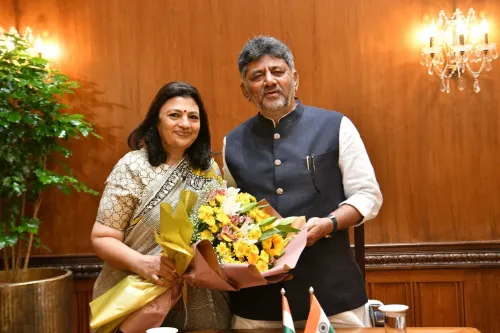
CM Shivakumar meets Ruthu Taare ambassador Ramya at Krishna
Synopsis
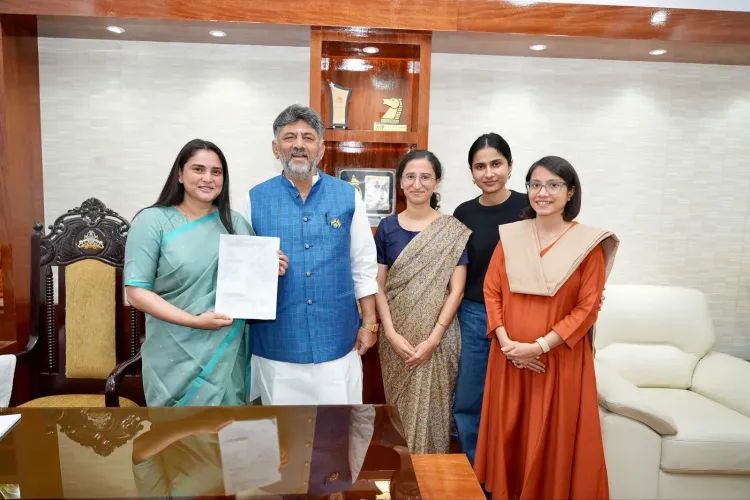
Actor and former MP Ramya met Karnataka CM D.K. Shivakumar at home office Krishna on 18 November 2026 to discuss Ruthu Taare — the state's flagship initiative billed as India's first dedicated menopause policy, targeting physical and mental health of women above 35.
Key Takeaways
Actor and former Lok Sabha MP Ramya is the brand ambassador of Karnataka's Ruthu Taare scheme.
She met Chief Minister D.K.
Shivakumar at home office Krishna in Bengaluru on 18 November 2026 .
Ruthu Taare is positioned as India's first dedicated menopause policy , focusing on women above 35 years .
The scheme addresses physical and mental health, with a special focus on menopause awareness, support and care .
Nethra and several other dignitaries attended the meeting.
Specific rollout details — counselling centres, budgetary allocations — are yet to be publicly announced.
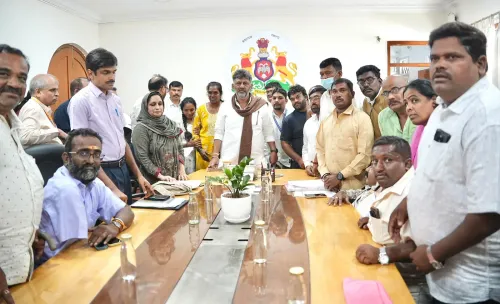
A Kannada actress-turned-parliamentarian walked into Karnataka's seat of power with a mission rooted in a health reality millions of Indian women navigate largely in silence. On Wednesday, 18 November 2026, actor and former Lok Sabha MP Ramya — brand ambassador of the Karnataka government's flagship Ruthu Taare initiative — met Chief Minister D.K. Shivakumar at his home office, Krishna, in Bengaluru to discuss the scheme's vision and way forward.
The Chief Minister's Office confirmed the meeting, noting that several dignitaries, including Prof. Nethra, were also present. The discussions centred on the scheme's objectives and broader implementation strategy, though specific programmatic details were not disclosed publicly.
What Ruthu Taare sets out to do
Positioned as India's first dedicated menopause policy, Ruthu Taare targets the physical and mental health of women above 35 years of age, with a particular focus on menopause awareness, support, and care. It is a deliberate pivot — most public health schemes in India have historically concentrated on maternal and child health, leaving mid-life and post-reproductive women's wellness largely outside the policy frame.
Menopause-specific public policy remains rare across Indian states, making Karnataka's framing of this initiative distinctive. By centering the experience of women navigating perimenopause and menopause — from hormonal shifts to mental health strain — the scheme acknowledges a life stage that medical professionals say affects nearly every woman yet receives disproportionately little institutional attention.
Why Ramya as the face of the scheme
Ramya, who represented the Mandya constituency in the Lok Sabha and remains a prominent public figure in Karnataka, brings both celebrity reach and political credibility to the role. Karnataka has a track record of leveraging celebrity ambassadors to amplify state welfare schemes — a strategy designed to push messaging past bureaucratic channels and into households. Her appointment as Ruthu Taare's ambassador signals the government's intent to run a high-visibility awareness campaign, not a quiet administrative exercise.
What comes next — dedicated counselling centres, awareness drives, budget allocations in the next state health department order — will determine whether Ruthu Taare translates into infrastructure on the ground. Today's meeting at Krishna was, at minimum, a public signal that the scheme remains live at the highest level of the state government.
For the millions of Karnataka women above 35 navigating their health largely without institutional support, that signal is a start — but the architecture still has to be built.
Point of View
A gap long flagged by public health advocates. The decision to appoint a celebrity-politician as ambassador rather than route the scheme solely through the health bureaucracy signals an intent to generate public demand, not just supply services. Whether the scheme is formally notified and backed by budgetary muscle will be the real test of its ambition. If Karnataka succeeds in building a replicable model, it could nudge other states to extend their women's health frameworks in a similar direction.
NationPress
18 Nov 2026
Frequently Asked Questions
What is the Ruthu Taare scheme in Karnataka?
Ruthu Taare is a Karnataka government initiative described as India's first dedicated menopause policy. It aims to address the physical and mental health needs of women above 35, with a special focus on menopause awareness, support, and care.
Who is the brand ambassador of Ruthu Taare?
Kannada actor and former Lok Sabha MP Ramya has been appointed as the brand ambassador of the Ruthu Taare scheme by the Karnataka state government.
Why did Ramya meet CM D.K. Shivakumar?
Ramya, in her capacity as brand ambassador of the Ruthu Taare initiative, met Chief Minister D.K. Shivakumar at home office Krishna on 18 November 2026 to discuss the scheme's vision and implementation.
Is India's first menopause policy from Karnataka?
Karnataka's Ruthu Taare has been framed by the state government as India's first dedicated menopause policy. Menopause-specific public health policies remain rare across Indian states, making this initiative distinctive in its scope.
Which women does Ruthu Taare target?
Ruthu Taare targets women above 35 years of age, focusing on their physical and mental health with particular emphasis on perimenopause and menopause care and awareness.