CM Shivakumar Rides Namma Metro Pink Line, Backs Bengaluru Expansion

Synopsis
Karnataka Chief Minister D.K. Shivakumar rode the Namma Metro Pink Line's elevated Kalena Agrahara–SG Palya stretch on 14 November 2026, interacting with commuters and highlighting the corridor's role in easing Bengaluru's chronic traffic congestion as Phase 2 expansion continues.
Key Takeaways
Shivakumar travelled on the Namma Metro Pink Line on 14 November 2026 , riding the elevated stretch between Kalena Agrahara and SG Palya .
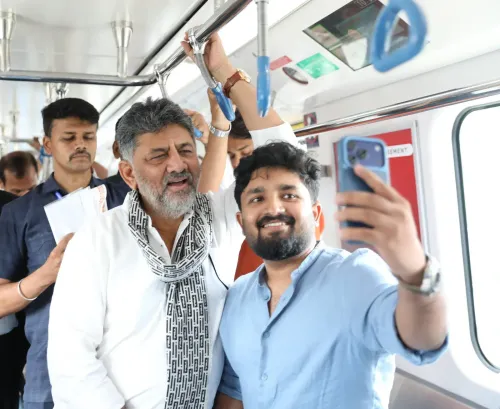
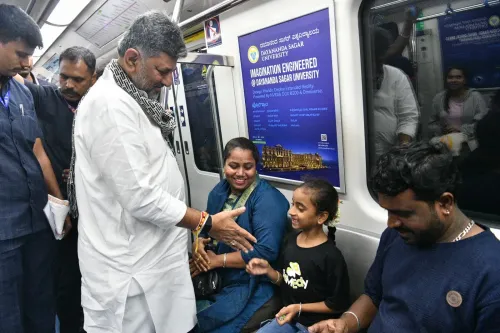
He interacted directly with fellow passengers during the journey, signalling a ground-level review of commuter experience.
The Pink Line is part of Namma Metro Phase 2 , which received central government sanction in 2017 , expanding on Phase 1 operations that began in 2011 .
The corridor is expected to ease traffic congestion and improve daily travel for lakhs of commuters in south and east Bengaluru.
Namma Metro is operated by the Bangalore Metro Rail Corporation Limited (BMRCL) , funded through state, central, and external sources.
Last-mile connectivity and completion of remaining Phase 2 sections remain the key challenges ahead for the network.
Bengaluru's metro network got a high-profile endorsement on Saturday, 14 November 2026, when Karnataka Chief Minister D.K. Shivakumar boarded the Namma Metro Pink Line and rode the newly elevated stretch between Kalena Agrahara and SG Palya — stopping to chat with ordinary commuters along the way. The Chief Minister's Office of Karnataka shared the visit on X, framing the corridor as a turning point for daily mobility in a city that has long groaned under some of India's worst traffic.
The Pink Line stretch Shivakumar just tested
The elevated section running from Kalena Agrahara in south Bengaluru to SG Palya forms part of the Namma Metro Phase 2 Pink Line — a corridor that has been years in the making. Phase 2 received central government sanction in 2017, building on the foundation of Phase 1 commercial operations that began in 2011 with the Purple and Green Lines. The Pink Line is designed to knit together Bengaluru's southern and eastern zones, areas that have seen explosive residential and commercial growth but remained poorly served by rapid transit.
Shivakumar's decision to travel as a passenger — not in a ceremonial inaugural convoy but alongside regular commuters — was a deliberate signal. The CMO's post noted that he 'interacted with fellow passengers,' underscoring a ground-level audit of the experience rather than a ribbon-cutting from a distance.
Why Bengaluru's traffic crisis makes this corridor count
Bengaluru, India's IT capital, has added millions of residents and vehicles over the past two decades, pushing its road network to chronic gridlock. The CMO stated the new stretch will 'ease traffic congestion and make daily travel more convenient for lakhs of commuters' — a claim that carries real weight given how densely populated the south Bengaluru catchment area has become.
Metro expansion is one of the few structural interventions capable of shifting significant volumes of car and two-wheeler trips onto fixed-rail transit. Every kilometre of elevated line that opens reduces the pressure on parallel arterial roads, and the Kalena Agrahara–SG Palya segment adds a meaningful link to a network still being assembled section by section.
Namma Metro's long Phase 2 journey — and what still lies ahead
Operated by the Bangalore Metro Rail Corporation Limited (BMRCL), Namma Metro's Phase 2 has been built in tranches, with funding drawn from state government allocations, central government support, and external assistance. Progress on remaining Pink Line sections — and integration with the existing Purple and Green Lines — will determine how much of Bengaluru's commuter population can actually benefit from the expanded network.
Last-mile connectivity remains the perennial challenge: a metro station is only as useful as the ease with which passengers can reach it from home and exit it to their destination. That is the next frontier BMRCL and the state government will need to address as the network grows.
A Chief Minister riding his own city's metro sends a message that transit investment is a political priority — not just a line item. Whether the remaining Phase 2 corridors open on schedule will be the real measure of that commitment.
Point of View
Where IT-sector voters and middle-class commuters are a critical constituency. The Pink Line's progress fits into a broader national pattern of state governments using metro expansion as a proof-of-governance metric. How quickly the remaining Phase 2 corridors open will determine whether the symbolism translates into sustained electoral and policy credibility.
NationPress
14 Nov 2026
Frequently Asked Questions
What is the Namma Metro Pink Line in Bengaluru?
The Namma Metro Pink Line is an elevated and underground metro corridor under Phase 2 of Bengaluru's metro network, operated by BMRCL, designed to connect southern and eastern parts of the city.
Which stretch did CM Shivakumar travel on the Pink Line?
CM D.K. Shivakumar travelled the elevated stretch between Kalena Agrahara in south Bengaluru and SG Palya on 14 November 2026.
When did Namma Metro Phase 2 get approved?
Namma Metro Phase 2, which includes the Pink Line, received central government sanction in 2017, building on Phase 1 operations that began in 2011.
How will the Pink Line help Bengaluru commuters?
The Pink Line's Kalena Agrahara–SG Palya corridor is expected to strengthen metro connectivity, reduce traffic congestion, and make daily travel more convenient for lakhs of commuters in south and east Bengaluru.
Who operates Namma Metro in Bengaluru?
Namma Metro is operated by the Bangalore Metro Rail Corporation Limited (BMRCL), with funding from state government, central government, and external sources.