CM Siddaramaiah Marks World Environment Day with Green Pledge

Synopsis
Karnataka Chief Minister Siddaramaiah marked World Environment Day on June 5, 2026, urging citizens to plant trees and fight all forms of pollution. He called on people to make environmental conservation a part of daily life rather than a single-day gesture, extending greetings to the people of Karnataka.
Key Takeaways
Karnataka Chief Minister Siddaramaiah posted a World Environment Day message on June 5, 2026 .
He called for a pledge to grow trees and protect the environment from all forms of pollution .
The message was written in Kannada and addressed citizens as naadabandhugalu — 'fellow citizens of the land'.
He urged that environmental protection become a daily practice , not limited to a one-day declaration.
World Environment Day has been observed on June 5 every year since the UN Stockholm Conference of 1972 .
Karnataka's environmental challenges span biodiversity zones like the Western Ghats and urban pollution in Bengaluru .
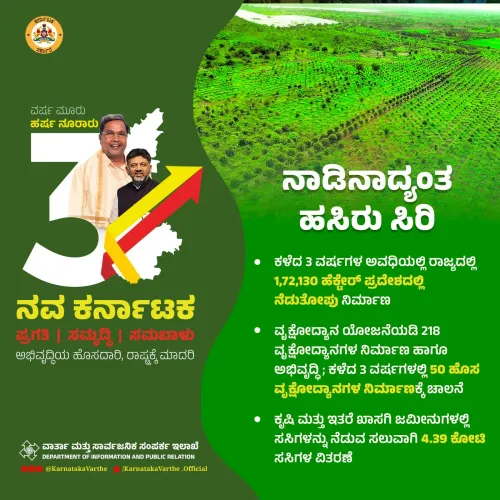
Karnataka Chief Minister Siddaramaiah on Friday, June 5, 2026, marked World Environment Day by calling on citizens to commit to planting trees and protecting the environment from all forms of pollution — urging that conservation become a daily practice, not merely a one-day declaration.
Writing in Kannada, the Chief Minister said: 'ಸಮತೋಲಿತ ಪರಿಸರವಿದ್ದರಷ್ಟೇ ಸಕಲ ಜೀವರಾಶಿಗಳಿಗೂ ಭೂಮಿಯ ಮೇಲೆ ಉಳಿಗಾಲ' ['A balanced environment is the only guarantee of survival for all living beings on Earth']. He extended greetings to the people of Karnataka — addressing them as naadabandhugalu, a term of kinship meaning 'fellow citizens of the land'.
Context
World Environment Day is observed annually on June 5 and was established by the United Nations General Assembly following the landmark Stockholm Conference of 1972. It is the principal global platform for raising awareness and mobilising action for the protection of the environment. State governments and public figures across India traditionally use the occasion to reaffirm environmental commitments.
Siddaramaiah's message specifically called for two pledges: growing trees and shrubs, and protecting the environment from 'all forms of pollution' — a formulation that encompasses air, water, soil, and noise pollution affecting both urban and rural Karnataka.
Policy Backdrop
Karnataka is home to biodiversity-rich zones including the Western Ghats, a UNESCO World Heritage Site, alongside rapidly urbanising centres such as Bengaluru, which faces chronic air and water quality challenges. Balancing industrial growth with ecological preservation has been a recurring policy tension for successive state governments.
India's National Environment Policy of 2006 laid the foundation for integrating environmental concerns into development planning, and the country has since committed to ambitious targets under the Paris Agreement and the National Action Plan on Climate Change. Karnataka maintains its own State Action Plan on Climate Change, which guides afforestation, water conservation, and pollution control efforts.
Stakeholders and Impact
The Chief Minister's message is directed at the general citizenry of Karnataka, as well as environmental groups and local bodies responsible for implementing green initiatives on the ground. The emphasis on making conservation a 'part of daily life' rather than a single-day gesture signals an intent to shift public behaviour beyond symbolic observances.
Urban residents of Bengaluru and other growing cities, who face the most direct consequences of pollution and shrinking green cover, stand as the most immediate stakeholders. Afforestation campaigns and pollution control programmes administered by state agencies are the primary instruments through which such political messaging is typically translated into action.
What's Next
Observers will watch for concrete follow-through in Karnataka's next state budget, particularly allocations for forestry, urban greening, and pollution control departments. Any revision or update to the State Action Plan on Climate Change in the coming months would indicate whether the World Environment Day pledge translates into policy momentum. The broader pattern of annual observance messages from Indian chief ministers underscores the growing political salience of environmental governance ahead of future electoral cycles.
Point of View
Implicitly acknowledging the gap between political messaging and on-ground action. For Karnataka, where rapid urbanisation in Bengaluru and industrial pressures on the Western Ghats create genuine policy tension, the message carries contextual weight beyond ceremonial obligation. Whether it precedes concrete budget or policy announcements will determine its lasting significance.
NationPress
20 Oct 2026
Frequently Asked Questions
What did Karnataka CM Siddaramaiah say on World Environment Day 2026?
Chief Minister Siddaramaiah called on citizens to pledge to plant trees and protect the environment from all forms of pollution, urging that conservation become a part of daily life rather than a one-day observance.
When is World Environment Day celebrated?
World Environment Day is celebrated every year on June 5. It was established by the United Nations General Assembly following the Stockholm Conference of 1972.
What environmental challenges does Karnataka face?
Karnataka faces a dual challenge: protecting biodiversity-rich areas like the Western Ghats while managing air, water, and soil pollution driven by rapid urbanisation, particularly in Bengaluru.
What is Karnataka's State Action Plan on Climate Change?
Karnataka's State Action Plan on Climate Change is a state-level policy framework that guides efforts on afforestation, water conservation, and pollution control, aligned with India's national climate commitments.
What did Siddaramaiah mean by 'naadabandhugalu'?
'Naadabandhugalu' is a Kannada term of kinship meaning 'fellow citizens of the land', which Siddaramaiah used to address the people of Karnataka in his World Environment Day message.