CM Siddaramaiah Pays Tribute to Babu Jagjivan Ram on Death Anniversary
Synopsis
Karnataka Chief Minister Siddaramaiah on 6 July 2026 paid tribute to former Deputy Prime Minister Babu Jagjivan Ram on his death anniversary, recalling his role as a pioneer of the Green Revolution, wartime Defence Minister, and champion of the working class.
Key Takeaways
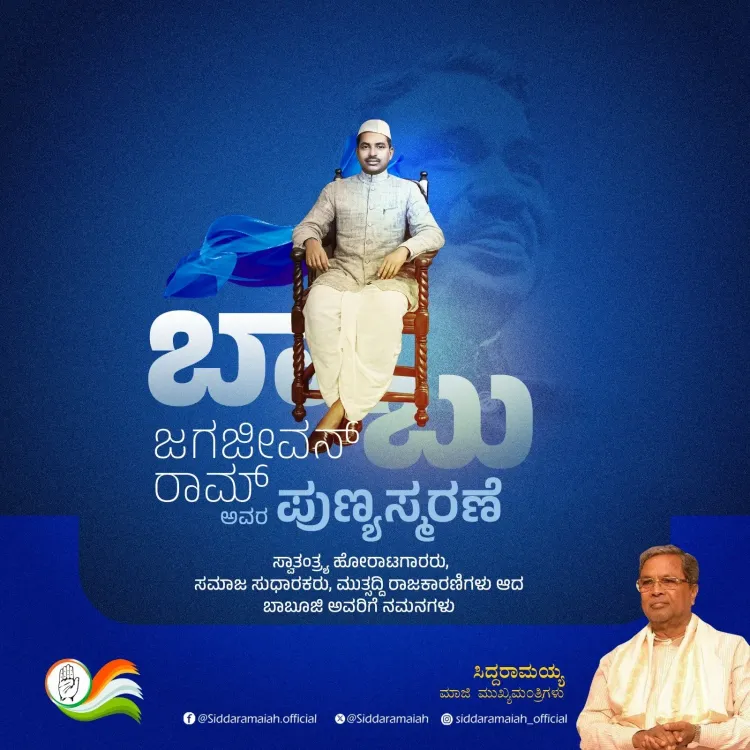
Karnataka CM Siddaramaiah posted a tribute in Kannada on X on 6 July 2026 , marking the death anniversary of Babu Jagjivan Ram .
Babu Jagjivan Ram served as Deputy Prime Minister of India from 1977 to 1979 , rising from a Dalit family in Bihar .
He played a pivotal role in the Green Revolution as Agriculture Minister in the mid-1960s, boosting India's food grain output.
As Defence Minister , he oversaw India's military operations during the 1971 Indo-Pakistan war that led to the creation of Bangladesh .
His Labour Ministry tenure advanced worker welfare legislation during India's early industrial development.
Jagjivan Ram passed away on 6 July 1986 ; his anniversaries are observed across party lines as markers of Dalit political achievement.
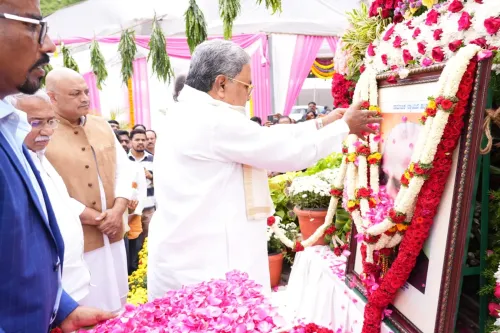
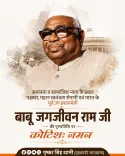
Karnataka Chief Minister Siddaramaiah on Monday, 6 July 2026, paid tribute to former Deputy Prime Minister Babu Jagjivan Ram on his death anniversary, honouring the Dalit leader's lifelong struggle against inequality and his foundational contributions to modern India.
Posting in Kannada on X, the Chief Minister wrote: 'ಅಸಮಾನತೆ, ಅನ್ಯಾಯ ಮತ್ತು ಅಪಮಾನಗಳನ್ನು ಸಾಧನೆಯ ಬಲದಿಂದಲೇ ಗೆದ್ದು...' — 'Having conquered inequality, injustice and humiliation through the strength of his achievements, and rising to the level of Deputy Prime Minister, Babu Jagjivan Ram's life of struggle is an inspiration to all. On his death anniversary, I bow in remembrance of his contributions to the building of a new India — as a pioneer of the Green Revolution, as a successful Defence Minister during wartime, and as a Labour Minister who protected the interests of the working class.'
Context
Babu Jagjivan Ram passed away on 6 July 1986, and his death anniversary is observed annually by political leaders across party lines. Born into a Dalit family in Bihar, he overcame deep-rooted social discrimination to become one of independent India's most consequential ministers, serving in cabinet for over four decades. His journey from social marginalisation to the second-highest executive office in the country remains a defining story of constitutional democracy's promise.
Chief Minister Siddaramaiah, a senior leader of the Indian National Congress and a long-standing advocate of social justice in Karnataka, has consistently used such anniversaries to draw connections between historical Dalit leadership and contemporary welfare politics.
Policy Backdrop
Jagjivan Ram's ministerial career spanned multiple transformative portfolios. As Agriculture Minister in the mid-1960s, he played a key role in advancing the Green Revolution, the programme that dramatically increased India's food grain production and moved the country away from chronic food shortages. His stewardship of agriculture policy during that period is credited with laying the groundwork for food security that persisted for decades.
As Defence Minister during the 1971 Indo-Pakistan war, he oversaw India's military campaign that culminated in the liberation of Bangladesh — widely regarded as one of independent India's most decisive military victories. His tenure as Labour Minister in the 1950s and 1960s saw the consolidation of worker welfare legislation at a time when India's industrial base was being built from scratch.
Stakeholders and Impact
Dalit communities across India regard Jagjivan Ram as a towering symbol of political representation and upward mobility achieved through institutional means. His legacy is particularly resonant in Bihar, his home state, and among agricultural labourers and industrial workers whose interests he championed across successive governments. For the Congress party, commemorating him reinforces its claim to a social justice legacy that predates contemporary Dalit political formations.
Siddaramaiah's tribute also carries weight in Karnataka, where Scheduled Caste and Scheduled Tribe communities constitute a significant portion of the electorate, and where the Congress government has staked its identity on welfare-oriented governance.
What's Next
Annual commemorations on 6 July — Jagjivan Ram's death anniversary — and 5 April — his birth anniversary — serve as recurring occasions for political leaders to restate commitments to Dalit welfare and social equity. Institutions and schemes named after him, including the Babu Jagjivan Ram Chhatrawas Yojana for Dalit students, continue to serve as policy touchpoints. As Karnataka approaches its mid-term political calendar, tributes of this nature signal the ruling Congress's continued effort to consolidate its social justice credentials with Dalit and working-class voters.
Point of View
A model the Congress party consistently positions as its own inheritance. By foregrounding Jagjivan Ram's policy achievements — the Green Revolution, the 1971 war, labour welfare — rather than only his identity, the Chief Minister frames Dalit leadership as nation-building competence, not merely representation. In Karnataka, where the Congress government has made Scheduled Caste welfare central to its governance narrative, such commemorations reinforce a direct line from historical Congress Dalit leadership to present-day policy. The tribute is routine in form but deliberate in its political signalling ahead of an active electoral cycle.
NationPress
6 Jul 2026
Frequently Asked Questions
Who was Babu Jagjivan Ram?
Babu Jagjivan Ram was a prominent Dalit political leader from Bihar who served in the Indian cabinet for over four decades, holding portfolios including Agriculture, Defence and Labour, and served as Deputy Prime Minister from 1977 to 1979.
When did Babu Jagjivan Ram die?
Babu Jagjivan Ram passed away on 6 July 1986. His death anniversary is observed annually by political leaders across India.
What was Babu Jagjivan Ram's role in the Green Revolution?
As Agriculture Minister in the mid-1960s, Babu Jagjivan Ram was a key figure in advancing the Green Revolution, the policy push that dramatically increased India's food grain production and helped the country achieve food security.
What did Babu Jagjivan Ram do during the 1971 war?
Babu Jagjivan Ram served as Defence Minister during the 1971 Indo-Pakistan war, overseeing India's military campaign that resulted in the creation of Bangladesh — one of independent India's most significant military outcomes.
Why did CM Siddaramaiah pay tribute to Babu Jagjivan Ram?
Karnataka Chief Minister Siddaramaiah paid tribute on 6 July 2026 to mark Babu Jagjivan Ram's death anniversary, honouring his legacy as a Dalit leader, Green Revolution pioneer, wartime Defence Minister and Labour Minister who championed the working class.