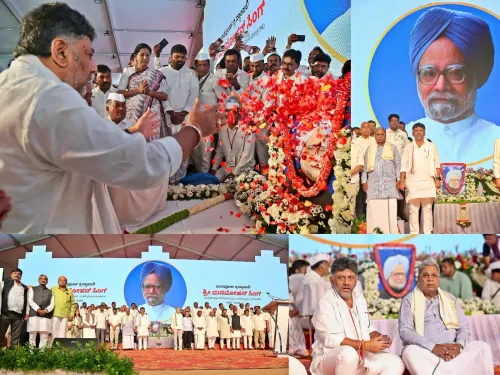
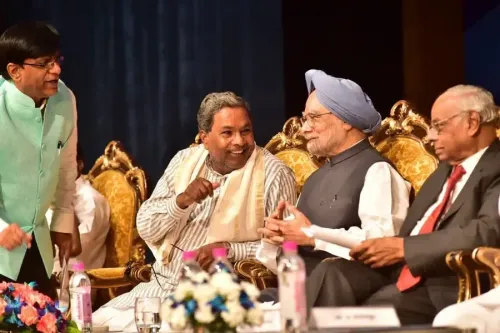
CM Siddaramaiah pays tribute to Dr Manmohan Singh on birth anniversary
Synopsis
Karnataka CM Siddaramaiah marks Dr Manmohan Singh's birth anniversary with a tribute in Kannada, honouring the former PM's 1991 economic reforms and the landmark RTI, RTE and National Food Security Acts enacted during his 2004–2014 tenure.
Key Takeaways
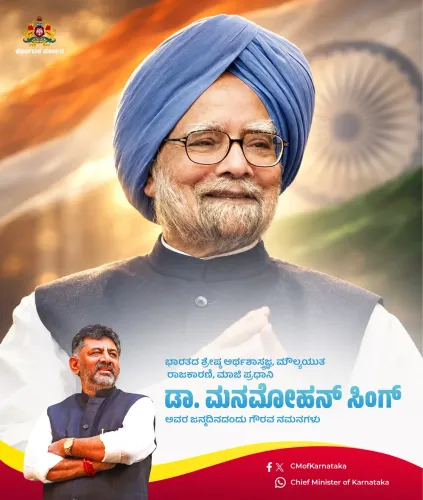
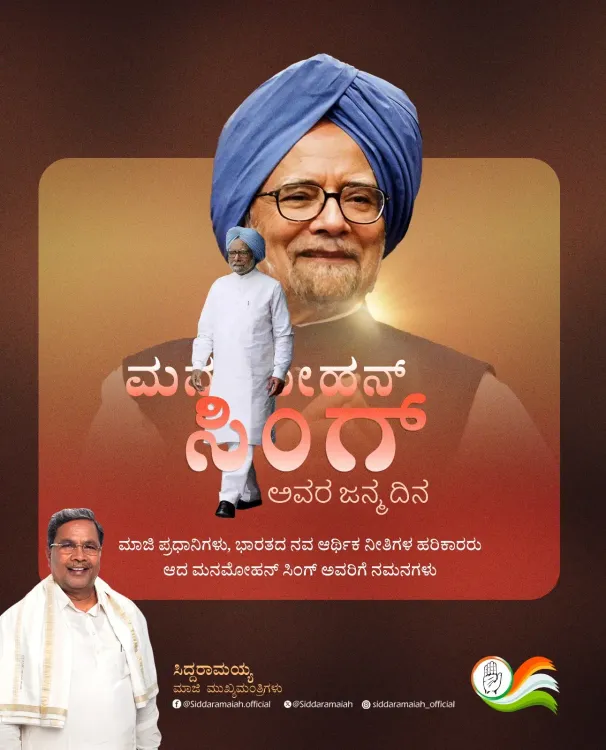
Karnataka CM Siddaramaiah posted a tribute in Kannada on September 26, 2026 , marking Dr Manmohan Singh's birth anniversary.
Dr Singh served as Finance Minister in 1991 , launching India's landmark economic liberalisation that dismantled the licence raj and invited foreign investment.
As Prime Minister from 2004 to 2014 , Singh led passage of the Right to Information Act (2005) , the Right to Education Act (2009) , and the National Food Security Act (2013) .
The Food Security Act entitled up to 75% of rural and 50% of urban households to subsidised food grains.
Siddaramaiah described Dr Singh as a model of 'knowledge, simplicity, restraint, and courtesy' — a standard for public life.
The tribute reflects Congress's consistent political narrative linking the UPA era to inclusive growth and rights-based welfare.
On what would have been one of India's most consequential leaders' birthdays, Karnataka Chief Minister Siddaramaiah on Saturday, September 26, 2026 paid a heartfelt tribute to former Prime Minister Dr Manmohan Singh, honouring the economist-statesman who rewrote India's economic destiny and enshrined welfare as a citizen's right.
Writing in Kannada, CM Siddaramaiah recalled Dr Singh as 'mahaan aarthika tajnya' — a great economic expert — who steered India out of crisis and built a sturdy foundation for its economy. 'On his birth anniversary, I respectfully remember the visionary leader who, through far-sighted reforms during a period of economic hardship, laid a strong foundation for the nation's economy, and who as Prime Minister gave equal priority to social justice alongside economic growth,' the Chief Minister wrote.
The architect of 1991 and what followed
Dr Manmohan Singh's biography is inseparable from modern India's economic turning points. As Finance Minister in 1991, he dismantled the licence raj, opened the economy to foreign investment, and pulled India back from the edge of a balance-of-payments collapse. That single reformist moment set the trajectory for decades of growth. When he returned as Prime Minister from 2004 to 2014 — leading the United Progressive Alliance coalition — he oversaw a period in which India's GDP growth regularly touched double digits.
But Siddaramaiah's tribute pointedly highlights what distinguished the Singh era beyond the growth numbers: the legislative architecture of rights-based welfare. It is a distinction the Congress party has consistently emphasised as its own policy identity.
RTI, RTE and the Food Security Act — three laws that changed daily lives
Siddaramaiah specifically names three landmark measures. The Right to Information Act, 2005 armed ordinary citizens with the power to demand accountability from public authorities — a transparency revolution. The Right of Children to Free and Compulsory Education Act, 2009 converted elementary schooling into a justiciable fundamental right for every child aged 6 to 14. Then came the National Food Security Act, 2013, which legally entitled up to 75 per cent of rural households and 50 per cent of urban households to subsidised food grains.
Together, these three laws represent what Siddaramaiah calls measures that 'paved the way for change in the lives of the poor and the middle class.' They are also the legislation most frequently invoked by Congress leaders to frame the 2004–2014 UPA period as one of inclusive growth — market liberalism married to social entitlement.
A personality that public life rarely sees
Beyond policy, the Chief Minister's tribute dwells on Dr Singh the man — 'a symbol of immense knowledge, simplicity, restraint, and courtesy' whose personal conduct, he says, remains a permanent model for public life. That image — the soft-spoken economist who preferred data to drama — has only grown in resonance in a noisier political era.
Siddaramaiah closes with a bow: 'Namasuttene' — I bow in respect — marking the birthday not merely as commemoration but as a moment to recommit to the values Dr Singh embodied.
On a day when Congress-ruled states across India honour the man who shaped the party's modern economic legacy, Karnataka's Chief Minister places himself squarely in that tradition — and implicitly frames the welfare laws Dr Singh championed as the benchmark against which present governance must be measured.
Point of View
The Karnataka CM reinforces the Congress narrative that the 2004–2014 UPA period uniquely combined market reform with social entitlement. The timing on Singh's birth anniversary, with tributes likely echoing across Congress-governed states, signals coordinated identity politics: the party presenting its historical record as the gold standard for inclusive governance. In an era of intense debate over growth-versus-equity in Indian policy, invoking Singh is simultaneously a tribute and a policy argument.
NationPress
26 Sept 2026
Frequently Asked Questions
When is Dr Manmohan Singh's birthday?
Dr Manmohan Singh was born on September 26 . Karnataka CM Siddaramaiah's tribute was posted on this date in 2026 to mark the occasion.
What were Dr Manmohan Singh's biggest achievements as Prime Minister?
As Prime Minister from 2004 to 2014 , Dr Singh oversaw passage of the Right to Information Act (2005) , the Right to Education Act (2009) , and the National Food Security Act (2013) , alongside sustained high GDP growth.
What did Manmohan Singh do in 1991?
As Finance Minister in 1991 , Dr Manmohan Singh introduced India's landmark economic liberalisation — dismantling industrial licensing, devaluing the rupee, and opening the economy to foreign investment to resolve a severe balance-of-payments crisis.
What is the National Food Security Act?
The National Food Security Act, 2013 is a law enacted under the UPA government that legally entitled up to 75% of rural and 50% of urban households in India to subsidised food grains.
Why did Siddaramaiah pay tribute to Manmohan Singh?
Karnataka Chief Minister Siddaramaiah posted the tribute on Dr Singh's birth anniversary, September 26 , honouring the former PM's economic reforms and welfare legislation as a lasting model for inclusive governance.