CM Siddaramaiah Pays Tribute to Sharana Hadapada Appanna on Jayanti
Synopsis
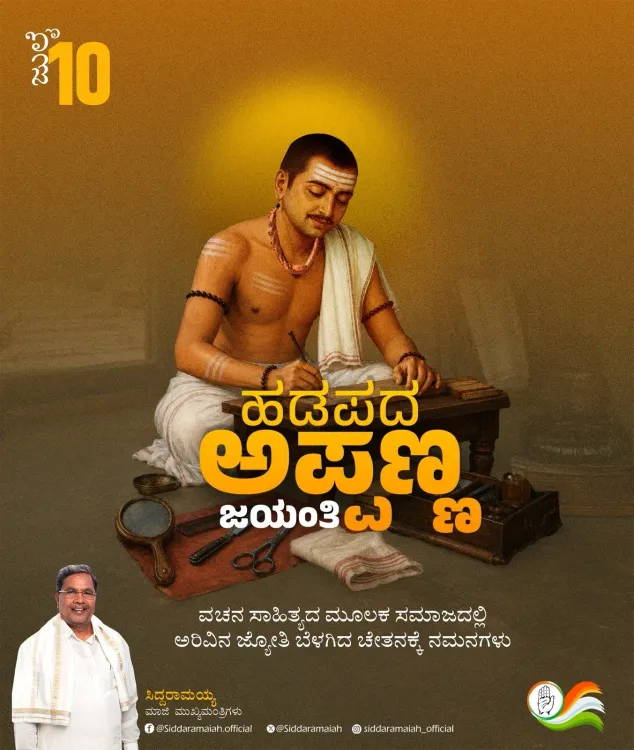
Karnataka Chief Minister Siddaramaiah on 10 July 2026 paid tribute to 12th-century sharana and vachana composer Hadapada Appanna on his jayanti, honouring Appanna's fight against caste and gender injustice and his role as a close associate of reformer Basaveshwara.
Key Takeaways
Chief Minister Siddaramaiah paid tribute to Hadapada Appanna on his jayanti on 10 July 2026 .
Hadapada Appanna was a 12th-century sharana, vachana composer, and close associate of Jagajyoti Basaveshwara .
Appanna is remembered for opposing centuries of exploitation based on caste, varna, and gender through his vachanas.
His verses articulated the values of kayakanishthe (dedication to labour) and dasohanishthe (community service).
Karnataka leaders across parties regularly observe jayantis of 12th-century vachanakaras as part of the state's social-justice political tradition.
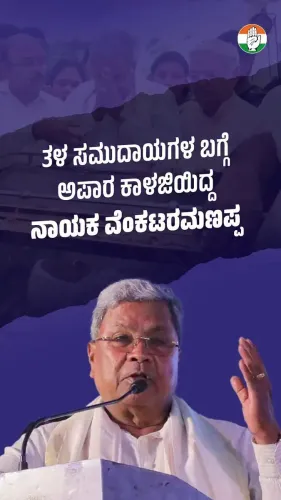
Karnataka Chief Minister Siddaramaiah on Friday, 10 July 2026 paid tribute to 12th-century vachana composer and social reformer Hadapada Appanna on his jayanti, honouring the sharana's lifelong struggle against caste, varna, and gender-based injustice.
Context
In his post, Chief Minister Siddaramaiah described Hadapada Appanna as one who 'sounded the trumpet of justice, equality, and truth against centuries of injustice, adharma, and exploitation carried out in the name of caste, varna, and gender.' He further noted that Appanna was a close associate of Jagajyoti Basaveshwara — the 12th-century reformer and founder of the Lingayat movement — and that Appanna worked to unite the exploited and marginalised communities of society, awakening self-respect and self-reliance among them.
The Chief Minister also acknowledged Appanna's literary contribution, noting that he articulated the values of kayakanishthe (dedication to labour), dasohanishthe (commitment to community service), devotion, detachment, and righteous conduct through the vachana form of verse.
Policy Backdrop
Basavanna, whose 12th-century reform movement gave rise to the Anubhava Mantapa — an egalitarian assembly for spiritual and social discourse — is the central figure of the Sharana movement in Karnataka. Hadapada Appanna was among Basavanna's closest companions and is remembered for vachanas that directly challenged hereditary caste hierarchies and the subordination of marginalised communities.
The Sharana movement's twin pillars — kayaka (dignified labour) and dasoha (sharing of resources) — have long been invoked in Karnataka's political and social discourse as foundational principles of equality. Vachana literature, composed by sharanas including Appanna, remains a living cultural and political reference in the state.
Stakeholders and Impact
Karnataka leaders across political parties regularly issue public tributes to 12th-century vachanakaras on their jayantis, signalling alignment with social-justice traditions that hold deep resonance among Lingayat and backward-class communities. For Chief Minister Siddaramaiah, whose political identity has long been associated with OBC mobilisation and social-equity advocacy, such tributes carry particular symbolic weight.
The emphasis on Appanna's role in uniting 'exploited and marginalised' communities connects medieval anti-caste narratives to the Congress government's contemporary welfare and cultural policy messaging in Karnataka.
What's Next
State-level jayanti programmes honouring Hadapada Appanna are expected to be observed across Karnataka, with Lingayat and Sharana heritage organisations likely to hold commemorative events. Observers will watch for any government announcements linked to vachana literature promotion, backward-class welfare schemes, or cultural initiatives that may follow in the coming weeks.
Point of View
Honouring a vachana composer who challenged caste hierarchies is as much a cultural statement as a political one. The framing — emphasising Appanna's work in building self-respect and self-reliance among exploited communities — maps neatly onto the Congress party's contemporary Dalit and backward-class outreach. Such jayanti tributes also serve to contest the symbolic ownership of Karnataka's Lingayat and Sharana heritage, a space of ongoing political competition in the state.
NationPress
10 Jul 2026
Frequently Asked Questions
Who was Hadapada Appanna?
Hadapada Appanna was a 12th-century sharana and vachana composer from Karnataka, a close associate of reformer Basavanna, who composed verses opposing caste, varna, and gender-based exploitation and promoted the values of dedicated labour and community service.
Why did CM Siddaramaiah pay tribute to Hadapada Appanna?
Chief Minister Siddaramaiah paid tribute on the occasion of Hadapada Appanna's jayanti on 10 July 2026, honouring the sharana's role in fighting social injustice and his contribution to vachana literature in Karnataka.
What is the Sharana movement?
The Sharana movement was a 12th-century socio-religious reform movement in Karnataka led by Basavanna that rejected hereditary caste hierarchies and promoted the principles of kayaka (dignified labour) and dasoha (sharing of resources) through vachana poetry.
What is Hadapada Appanna's connection to Basavanna?
Hadapada Appanna was described as one of the closest associates of Jagajyoti Basaveshwara, the founder of the Lingayat movement and organiser of the Anubhava Mantapa, and shared Basavanna's vision of a casteless, egalitarian society.