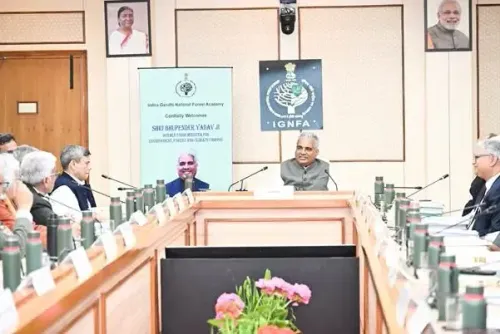
Bhupender Yadav Chairs 7th National CAMPA Governing Body Meet

Synopsis
Union Environment Minister Bhupender Yadav chaired the 7th Governing Body meeting of National CAMPA at CASFOS Coimbatore on 10 July 2026, reviewing compensatory afforestation progress, Net Present Value activities, and CAMPA fund flows across States and Union Territories for 2025-26.
Key Takeaways
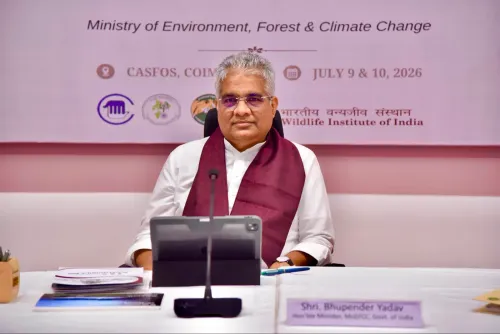
Bhupender Yadav chaired the 7th meeting of the Governing Body of National CAMPA on 10 July 2026 at CASFOS, Coimbatore .
The meeting reviewed progress of Net Present Value (NPV) and Compensatory Afforestation activities undertaken by States and Union Territories in 2025-26 .
Status of CAMPA funds — received, approved, and transferred during 2025-26 — was assessed at the meeting.
Several new proposals and initiatives to strengthen compensatory afforestation, forest conservation, and wildlife protection were discussed.
National CAMPA was constituted under the Compensatory Afforestation Fund Act, 2016 to administer funds generated from diversion of forest land for non-forest use.
State-wise utilisation and physical progress reports are expected to be reviewed in subsequent Governing Body meetings or parliamentary committees.
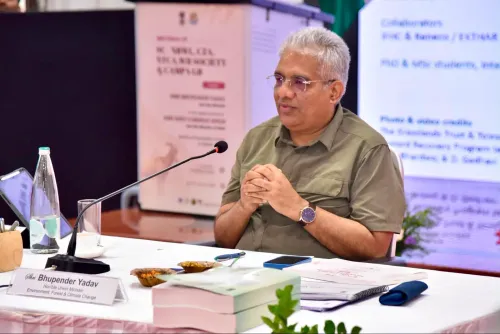
Union Environment Minister Bhupender Yadav chaired the 7th meeting of the Governing Body of National CAMPA on Friday, 10 July 2026, at the Central Academy for State Forest Service (CASFOS) in Coimbatore, Tamil Nadu. The meeting reviewed new proposals and assessed the progress of compensatory afforestation, forest conservation, and wildlife protection initiatives across the country.
Context
The meeting was convened to examine the status of Net Present Value (NPV) and Compensatory Afforestation (CA) activities carried out by States and Union Territories during 2025-26. The Governing Body also reviewed the flow of CAMPA funds — amounts received, approved, and transferred — during the current financial year. Yadav noted that 'several new proposals and initiatives' aimed at strengthening afforestation and wildlife protection were discussed, though specific proposals remain subject to official disclosure.
Policy Backdrop
The Compensatory Afforestation Fund Act, 2016 created the statutory framework for collecting and deploying funds generated whenever forest land is diverted for non-forest purposes such as mining, roads, or infrastructure. The legislation followed directions from the Supreme Court of India, which had long flagged the absence of a structured mechanism to ensure afforestation proceeds actually reached the ground. National CAMPA was constituted under the Ministry of Environment, Forest and Climate Change to administer the fund at the national level and review state-level plans annually.
Compensatory afforestation remains the primary legal instrument under the Forest Conservation Act, 1980 to offset forest land lost to development. India's National Forest Policy of 1988 set a target of bringing one-third of the country's land area under forest and tree cover, a goal that continues to anchor domestic restoration commitments alongside international pledges.
Stakeholders and Impact
State forest departments are the primary implementing agencies for CAMPA-funded activities; their utilisation of approved funds directly determines whether compensatory plantations are established and maintained. Project developers in sectors such as mining, road construction, and power generation contribute to the CAMPA corpus as a condition for receiving clearances under the Forest Conservation Act. The CASFOS Coimbatore campus, which hosted the meeting, is a premier training institute under the Ministry that builds the capacity of Indian Forest Service and State Forest Service officers — making it a symbolically appropriate venue for a governance review of this nature.
The review of fund transfers and physical progress in 2025-26 is significant for States that have large backlogs of approved but unutilised CAMPA allocations, a recurring concern flagged in parliamentary oversight.
What's Next
State-wise utilisation certificates and physical progress reports for CAMPA activities in 2025-26 are expected to be tabled or examined in subsequent Governing Body meetings or relevant parliamentary committees. The Ministry's decision on new proposals discussed at the 7th meeting will shape afforestation targets and fund disbursements for the remainder of the financial year. With India's forest and tree cover commitments forming a part of its Nationally Determined Contributions (NDCs) under the Paris Agreement, the pace of CAMPA fund utilisation will remain a closely watched indicator of on-ground delivery.
Point of View
Likely in response to longstanding concerns about states sitting on unspent CAMPA allocations. Taken together, the meeting fits a broader pattern of the Yadav-led Ministry using institutional forums to demonstrate governance rigour on India's forest restoration commitments ahead of international climate stocktakes.
NationPress
8 Oct 2026
Frequently Asked Questions
What is National CAMPA and what does it do?
National CAMPA is a statutory authority under India's Ministry of Environment, Forest and Climate Change, constituted under the Compensatory Afforestation Fund Act, 2016. It manages the fund collected from project developers who divert forest land for non-forest use, and approves state-level plans for afforestation and forest conservation.
What was discussed at the 7th CAMPA Governing Body meeting?
The 7th meeting, chaired by Union Environment Minister Bhupender Yadav on 10 July 2026, reviewed new proposals for compensatory afforestation, forest conservation, and wildlife protection, as well as the progress of Net Present Value and Compensatory Afforestation activities by States and Union Territories and the status of CAMPA fund flows in 2025-26.
Where was the 7th CAMPA Governing Body meeting held?
The meeting was held at the Central Academy for State Forest Service (CASFOS) in Coimbatore, Tamil Nadu, a premier training institute under the Ministry of Environment, Forest and Climate Change.
What is the Compensatory Afforestation Fund Act, 2016?
The Compensatory Afforestation Fund Act, 2016 is legislation that created the legal and institutional framework for collecting funds from developers who divert forest land for non-forest purposes such as roads, mining, or power projects, and for deploying those funds for afforestation and forest conservation activities.
How are CAMPA funds used by states?
State forest departments use CAMPA funds, approved and transferred by National CAMPA, to carry out compensatory afforestation plantations, wildlife protection measures, and other forest conservation activities. The pace of utilisation and submission of utilisation certificates by states is monitored by the Governing Body.