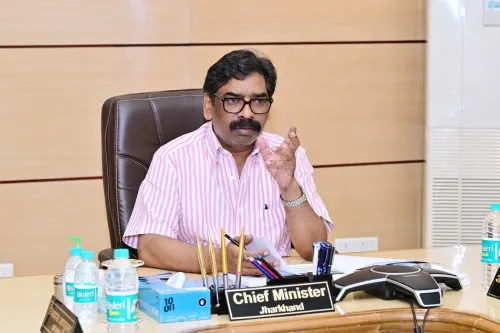
CM Hemant Soren Conducts Surprise Road Inspection in Jharkhand
Synopsis
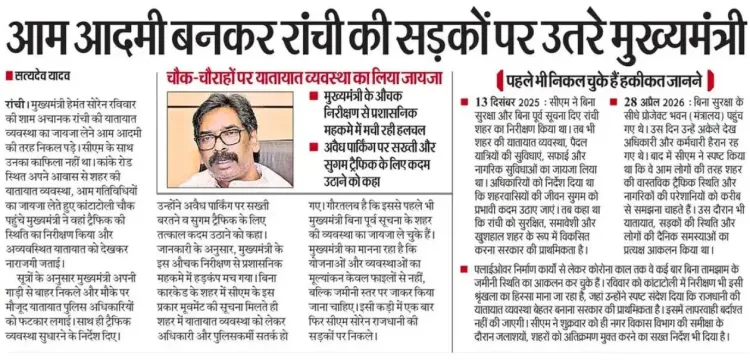
Chief Minister Hemant Soren personally inspected road conditions in Jharkhand on June 1, 2026, in an unannounced visit — his third surprise field inspection since December 2025 — aimed at directly assessing public hardships and infrastructure gaps.
Key Takeaways
Chief Minister Hemant Soren conducted a surprise road inspection on June 1, 2026 , personally assessing conditions on the ground.
The Chief Minister's Office confirmed this is at least the third such unannounced visit , with earlier inspections in December 2025 and April 2026 .
The visits are aimed at directly understanding the 'hardships of the public' without bureaucratic mediation.
Jharkhand faces persistent road connectivity challenges, particularly in rural and tribal areas that are central to the JMM's development agenda.
Follow-up action — repair orders, contractor accountability, or fresh budget allocations — will be the key metric of impact from these field visits.
The Chief Minister's Office of Jharkhand announced on Monday, June 1, 2026, that Chief Minister Hemant Soren personally took to the streets in an unannounced inspection to assess road conditions and understand the ground-level difficulties faced by ordinary citizens. The visit underscores a pattern of direct field engagement that the Chief Minister has made a hallmark of his administration.
Context
Posting in Hindi, the Chief Minister's Office stated that CM Soren was 'on the roads himself to closely understand the hardships of the public' — जनता की तकलीफों को करीब से समझने के लिए खुद सड़कों पर हैं मुख्यमंत्री. The post further noted that this was not an isolated instance, citing previous surprise inspections carried out in December 2025 and April 2026. The June 2026 visit thus represents at least the third such unannounced field visit within roughly six months.Policy Backdrop
Unannounced field inspections by chief ministers are an established administrative practice across Indian states, designed to cut through bureaucratic filters and get an unmediated view of public infrastructure. For Jharkhand — a state with a significant tribal population, dense forest cover, and persistent challenges in rural road connectivity — the quality of roads carries outsized importance for daily commuters, farmers transporting produce, and residents accessing health and education services. Hemant Soren and his party, the Jharkhand Mukti Morcha (JMM), have consistently positioned improved connectivity as central to the state's development agenda, particularly for tribal and remote communities that have historically been underserved by infrastructure investment.Stakeholders and Impact
The primary beneficiaries of any remedial action following such inspections are Jharkhand's road users — commuters, daily-wage workers, small traders, and rural households who depend on functional road networks for their livelihoods. When a chief minister personally documents deficiencies, it typically accelerates the administrative response chain: field engineers, district collectors, and the Public Works Department face heightened accountability. Civil society groups advocating for tribal and rural welfare in the state have long flagged poor road conditions as a barrier to equitable development, making these inspections politically as well as administratively significant.What's Next
The immediate focus will be on whether the June 2026 inspection translates into concrete follow-up — including repair orders, contractor notices, or fresh budget allocations for road maintenance. The pattern established by the earlier visits in December 2025 and April 2026 suggests the Chief Minister's Office views such inspections as a recurring accountability mechanism rather than a one-off event. Observers and residents will watch whether the state government issues specific directives or announces targeted infrastructure spending in the districts visited. If the cadence of surprise inspections continues, it could become a defining feature of CM Soren's governance communication ahead of future electoral cycles.Point of View
Direct accountability over administrative delegation — a posture that resonates strongly in a state where rural and tribal communities have long felt distant from state machinery. By making these visits a recurring practice rather than a one-time gesture, the Chief Minister's Office is building a narrative of hands-on leadership that serves both administrative and political purposes. The pattern also places pressure on district-level officials and contractors, who can no longer assume that infrastructure deficiencies will go unnoticed at the top. Whether this translates into measurable improvements in road quality will ultimately determine the substantive impact of what is, for now, a compelling governance signal.
NationPress
19 Sept 2026
Frequently Asked Questions
Why is CM Hemant Soren inspecting roads personally?
CM Hemant Soren is conducting personal, unannounced road inspections to directly assess the condition of public infrastructure and understand the hardships faced by ordinary citizens without relying solely on official reports.
How many times has Hemant Soren done surprise road inspections?
According to the Chief Minister's Office, CM Soren has conducted at least three such surprise inspections — in December 2025, April 2026, and June 2026.
What is the condition of roads in Jharkhand?
Jharkhand faces significant road connectivity challenges, particularly in rural and tribal areas, where poor infrastructure hampers access to markets, healthcare, and education.
What happens after a CM's surprise inspection of roads?
Typically, surprise inspections trigger accelerated administrative responses — including repair orders, notices to contractors, and potential budget allocations — as district officials and the Public Works Department face direct accountability.
What is Jharkhand Mukti Morcha's stance on infrastructure?
The Jharkhand Mukti Morcha, led by Hemant Soren, has consistently prioritised improved connectivity and infrastructure development, especially for tribal and remote communities, as a core part of its governance agenda.