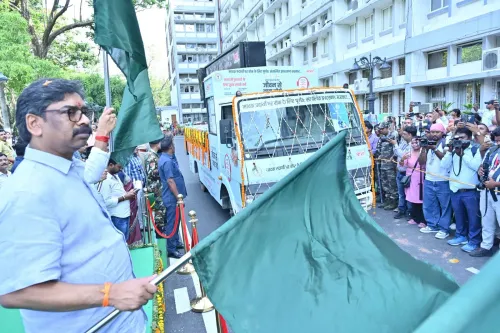
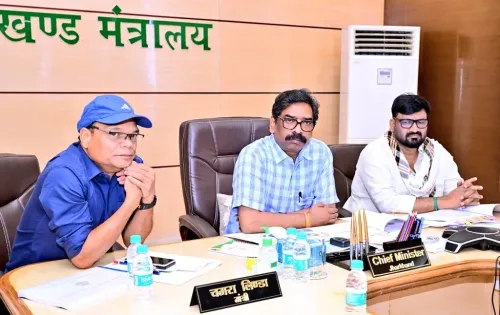
CM Hemant Soren Orders Crackdown on Illegal Liquor in Jharkhand
Synopsis
Chief Minister Hemant Soren has directed Jharkhand's Excise Department to act with full strictness against illegal liquor manufacturing, transport, sale and smuggling, while also mandating that local tribal communities be prioritised in excise warehouse construction across the state's districts.
Key Takeaways
CM Hemant Soren issued a directive on 24 July 2026 ordering a strict crackdown on illegal liquor manufacturing, transportation, sale, and smuggling across Jharkhand .
The Excise Department has been instructed to enforce these measures with full severity in all districts.
Local Adivasi (tribal) communities must be given priority and support in the construction of Excise Department warehouses across various districts.
The directive was issued by the Chief Minister's Office of Jharkhand via an official post on X.
The dual mandate combines a law-enforcement push with an affirmative livelihood provision for Scheduled Tribe populations .
Implementation outcomes will depend on follow-up district-level orders and whether tribal priority is made a binding condition in warehouse tenders.
The Chief Minister's Office of Jharkhand on Friday, 24 July 2026, issued a directive from Chief Minister Hemant Soren ordering strict action against illegal liquor manufacturing, transportation, sale, and smuggling across the state. The directive also called for giving priority and support to local tribal communities in the construction of Excise Department warehouses in various districts.
The post, addressed in part to @YogendraGomia, carried two clear mandates: first, that the state clamp down with full severity — 'puri kathorata ke saath ankush' (with complete strictness) — on the illicit liquor trade; and second, that warehouse construction work by the Excise Department across districts must actively involve and prioritise local Adivasi communities.
Context
Jharkhand is home to one of India's largest Scheduled Tribe populations, and illegal liquor has long been a public health and law-enforcement challenge in the state's tribal-dominated districts. The intersection of customary practices around local brew, organised smuggling networks, and weak enforcement in remote areas has made illicit liquor a persistent governance concern across successive administrations.
The Excise Department is the nodal state body responsible for regulating alcohol production, licensing distribution, and conducting enforcement raids. Directives of this nature from the Chief Minister's Office signal a top-down push to activate field-level machinery.
Policy Backdrop
Jharkhand governments have periodically issued crackdown orders on illegal liquor since the early 2010s, but enforcement outcomes have varied significantly across districts. The dual instruction — enforcement plus tribal inclusion in infrastructure — reflects a pattern seen across eastern Indian states that seek to balance prohibitionist pressures, state excise revenue, and affirmative provisions for Scheduled Tribe populations.
By directing that local Adivasi communities be given priority in warehouse construction contracts and employment, the Soren government signals an intent to convert regulatory infrastructure into a livelihood channel for marginalised groups. This approach mirrors similar provisions in other tribal-majority states where government construction projects are tied to local community participation mandates.
Stakeholders and Impact
The most immediate stakeholders are Excise Department field officers across Jharkhand's districts, who will be expected to intensify raids and prosecutions. For communities where illegal liquor supply chains have become embedded in local economies, stricter enforcement could disrupt livelihoods even as it targets health hazards.
Local tribal communities stand to benefit from the warehouse construction directive if implementation follows through — gaining employment and contractual work in government infrastructure projects. However, the actual scale of opportunity will depend on how many warehouse projects are sanctioned and how procurement norms are structured to enforce the priority clause.
What's Next
The key test will be whether the Excise Department issues district-level implementation orders and publishes enforcement data in the weeks ahead. Observers will also watch whether warehouse construction tenders explicitly incorporate the tribal community priority provision as a binding condition. A follow-up review by the Chief Minister's Office would signal whether this directive moves beyond a policy statement into measurable action on the ground.
Point of View
As with previous crackdown directives in the state, is whether field-level enforcement translates into sustained action or remains a top-down signal that dissipates without structural follow-through. If warehouse contracts do reach local communities and enforcement data is made public, this directive could mark a meaningful governance step rather than a routine administrative circular.
NationPress
22 Oct 2026
Frequently Asked Questions
What did CM Hemant Soren order regarding illegal liquor in Jharkhand?
CM Hemant Soren directed the Excise Department to clamp down with full strictness on illegal liquor manufacturing, transportation, sale, and smuggling across all districts of Jharkhand.
What is the role of tribal communities in Jharkhand's excise warehouse construction?
The Chief Minister's directive specifically mandates that local Adivasi (tribal) communities be given priority and support in the construction of Excise Department warehouses in various districts of the state.
Which department is responsible for implementing the liquor crackdown in Jharkhand?
The Jharkhand Excise Department is the nodal body responsible for regulating alcohol and enforcing action against illegal liquor, and it has been directed to act with full severity under this order.
Why is illegal liquor a major issue in Jharkhand?
Jharkhand has a large Scheduled Tribe population and remote districts where illegal liquor networks have operated for years, creating serious public health concerns and law-enforcement challenges for successive state governments.
What should we watch for after CM Soren's liquor crackdown directive?
Key indicators will include district-level implementation orders from the Excise Department, enforcement statistics such as raid and seizure data, and whether warehouse construction tenders include binding tribal community priority clauses.