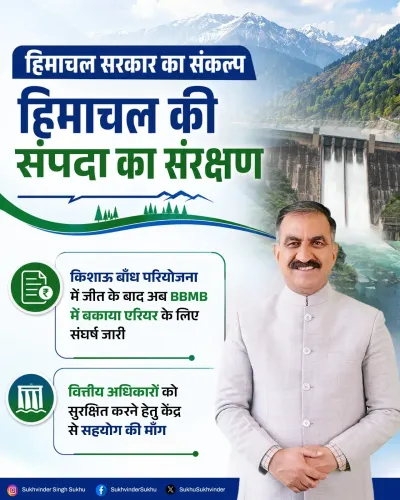
CM Sukhu hails Supreme Court BBMB win, cites Rs 15,000 cr gain
Synopsis
The Supreme Court ruled in Himachal Pradesh's favour on a 15-year-old BBMB arrears case, awarding the state 55-56 crore MU of electricity over 20 years — a gain CM Sukhu values at Rs 15,000 crore — while pledging fresh legal battles over Shanan Power Project and water cess.
Key Takeaways
The Supreme Court of India ruled on a BBMB arrears case pending for approximately 15 years , ruling in Himachal Pradesh's favour .
The state will receive 55–56 crore million units of electricity as arrears, spread over 20 years .
At Rs 6 per unit, the annual gain to the state exchequer is projected at Rs 500 crore ; at inter-state sale rates (Rs 13.5–15.5 per unit), this could reach Rs 1,000 crore annually .
Total projected revenue over the 20-year period: Rs 15,000 crore .
CM Sukhu called this the fourth historic legal victory of his government's roughly four-year tenure.
Himachal Pradesh plans separate legal battles over the Shanan Power Project and water cess claims.
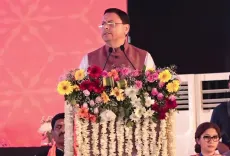
A fifteen-year legal battle ended in Himachal Pradesh's favour on 6 November 2026, when the Supreme Court of India ruled on pending arrears owed to the state from the Bhakra Beas Management Board (BBMB) — and Himachal Pradesh Chief Minister Sukhvinder Singh Sukhu wasted no time in calling it a generational win for the hill state's 7.5 million residents.
What the Supreme Court order actually delivers
The ruling awards Himachal Pradesh 55–56 crore million units (MU) of electricity as arrears from the BBMB — and critically, the state will continue receiving this power allocation for the next 20 years. At the current benchmark rate of Rs 6 per unit, that translates to roughly Rs 500 crore flowing into the state exchequer every year. Over the full two-decade horizon, CM Sukhu puts the cumulative gain at Rs 15,000 crore.
The numbers get sharper when you factor in inter-state sale rates. Sukhu pointed out that Himachal has already sold power to Rajasthan at Rs 15.5 per unit, to Kerala at Rs 14.5 per unit, and to Tamil Nadu at Rs 13.5 per unit. If the next round of power-purchase agreements is struck at comparable rates, annual revenue could double to approximately Rs 1,000 crore a year.
Four years, four 'historic victories' — Sukhu's scorecard
Posting on X in Hindi, the Chief Minister framed the judgment as the fourth historic win in roughly four years of his Congress government's tenure, crediting the people of the state, his cabinet colleagues, senior officials, and the legal team. 'इस ऐतिहासिक जीत का श्रेय मैं प्रदेश की जनता को देता हूँ' ('I credit this historic victory to the people of the state'), he wrote.
The win sits squarely within a decades-old fault line in Indian federal governance. The Punjab Reorganisation Act of 1966 created the statutory architecture for splitting Bhakra-Beas project revenues among successor states — Punjab, Haryana, Rajasthan, and Himachal Pradesh. Himachal, despite being the geographical source of the river system and a major contributor to its hydroelectric output, has long argued it was short-changed under the original allocation formula. Today's order is a judicial correction of that imbalance.
Shanan Project and water cess: the battles still ahead
Sukhu was explicit that the courtroom calendar is far from clear. The Shanan Power Project — a separate hydroelectric asset whose ownership and revenue-sharing remain contested — is next on the docket. The Chief Minister said his government would engage 'the country's leading lawyers' for that fight. A parallel campaign on water cess is also being prepared, widening the state's resource-federalism offensive on two fronts simultaneously.
Himachal Pradesh is not alone in this pattern — states across India routinely litigate inter-state water and power arrangements that date to post-reorganisation agreements, and the Supreme Court has emerged as the primary arena for resolving them. What sets today's order apart is the scale: half a century of institutional debt, compressed into a ruling that promises to reshape the state's fiscal headroom for a generation.
For a mountain state that has historically run deficit budgets and leaned heavily on central transfers, an additional Rs 500–1,000 crore annually is not a rounding error — it is a structural shift. The question now is how fast those units convert into signed power-purchase agreements, and whether the Shanan fight can extend the momentum.
Point of View
000 crore annual inflow, if realised through fresh power-purchase agreements, could meaningfully reduce Himachal's structural fiscal dependence on central transfers. The unresolved Shanan Project and water cess disputes mean the courts, not the legislature, remain the defining arena for Himachal's economic sovereignty for years to come.
NationPress
6 Nov 2026
Frequently Asked Questions
What is the BBMB arrears case that the Supreme Court ruled on?
The Bhakra Beas Management Board (BBMB) arrears case concerns electricity units owed to Himachal Pradesh under its share of power generated from Bhakra-Beas river projects. The state had been pursuing this claim in the Supreme Court for approximately 15 years before the court ruled in its favour on 6 November 2026.
How much electricity will Himachal Pradesh get from the BBMB verdict?
According to CM Sukhu, the Supreme Court order entitles Himachal Pradesh to 55–56 crore million units of electricity as arrears from BBMB, to be received over a period of 20 years.
How much money will Himachal Pradesh earn from this Supreme Court ruling?
CM Sukhu projects the state will earn approximately Rs 500 crore per year at the current rate of Rs 6 per unit, and potentially Rs 1,000 crore per year if power is sold at inter-state rates comparable to deals with Rajasthan, Kerala, and Tamil Nadu — totalling Rs 15,000 crore over 20 years.
What is the Shanan Power Project dispute in Himachal Pradesh?
The Shanan Power Project is a hydroelectric station in Himachal Pradesh whose ownership and revenue-sharing remain subject to separate ongoing legal disputes. CM Sukhu has pledged to pursue this case next, promising to engage leading national lawyers.
What is water cess and why is Himachal Pradesh fighting for it?
Water cess refers to a levy that Himachal Pradesh seeks to impose on the use of its river waters by other states or projects, as a form of compensation for the state's water resources. The government has indicated it will pursue this claim alongside the Shanan Power Project litigation.