CM Sukhu launches 3-Tesla MRI at Atal Super Specialty Institute, Shimla
Synopsis
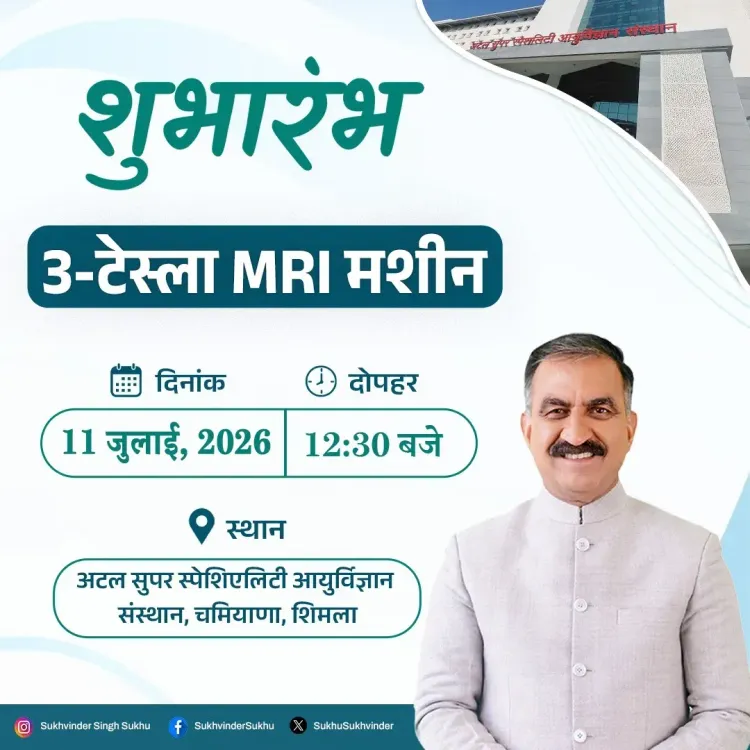
Himachal Pradesh Chief Minister Sukhvinder Singh Sukhu on 11 July 2026 inaugurated a three-Tesla MRI machine at Atal Super Specialty Ayurvigyan Sansthan in Chamiana, Shimla, boosting the state's public tertiary diagnostic capacity and reducing dependence on private imaging centres for patients across the region.
Key Takeaways
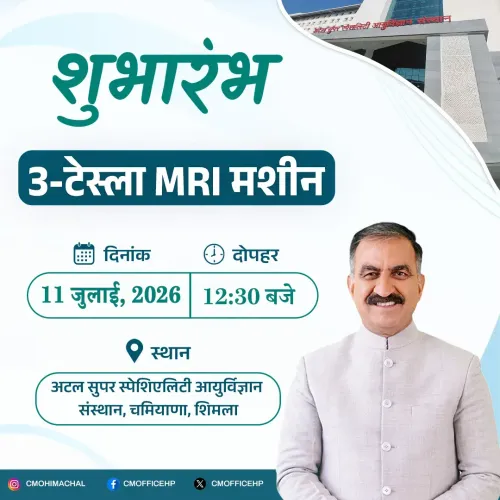
CM Sukhvinder Singh Sukhu inaugurated a three-Tesla MRI machine at Atal Super Specialty Ayurvigyan Sansthan, Chamiana, Shimla on 11 July 2026 .
A 3-Tesla MRI is the highest clinical field-strength category, enabling sharper neurological, musculoskeletal, and oncological imaging than standard 1.5-Tesla units.
The launch is part of Himachal Pradesh health department efforts since 2018 to upgrade diagnostic equipment in government tertiary hospitals.
The machine is expected to reduce patient referrals to private diagnostic centres and cut travel and cost burdens for residents of the Shimla region.
Rollout of similar equipment to other district hospitals in Himachal Pradesh and future health budget allocations remain key developments to watch.
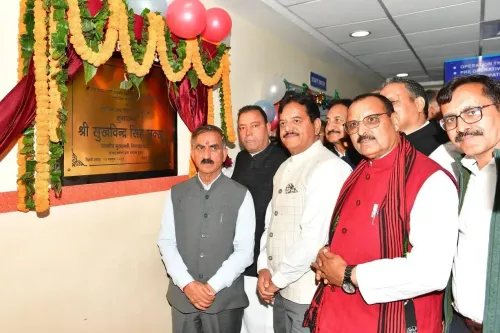
Himachal Pradesh Chief Minister Sukhvinder Singh Sukhu on Saturday, 11 July 2026, announced the inauguration of a three-Tesla MRI machine at Atal Super Specialty Ayurvigyan Sansthan in Chamiana, Shimla, marking a significant upgrade to the state's public tertiary healthcare infrastructure.
Context
In a post on X, CM Sukhu wrote: 'आज अटल सुपर स्पेशलिटी आयुर्विज्ञान संस्थान, चमियाणा, शिमला में थ्री-टेस्ला एमआरआई मशीन का शुभारंभ करूंगा' ('Today I will inaugurate a three-Tesla MRI machine at Atal Super Specialty Ayurvigyan Sansthan, Chamiana, Shimla'). He added that the advanced facility would 'add new capability towards accurate identification of diseases and effective treatment,' and that when advanced medical technology meets public service, 'it paves the way for better healthcare and greater trust for patients.'
The Atal Super Specialty Ayurvigyan Sansthan in Chamiana is a super-specialty tertiary care and medical training institution that serves as one of Himachal Pradesh's principal referral centres for complex cases from across the state.
Policy Backdrop
The launch fits within a broader push by the Himachal Pradesh health department — underway since 2018 — to procure high-end diagnostic equipment for government hospitals under state budget allocations earmarked for tertiary care upgrades. A three-Tesla MRI represents the highest field-strength category available for clinical imaging, enabling sharper resolution for neurological, musculoskeletal, and oncological diagnoses compared to the more common 1.5-Tesla units.
State governments across India have accelerated installation of 3-Tesla MRI machines in public super-specialty facilities to reduce patient referrals to private diagnostic centres, a pattern that carries particular significance in hill states where rugged geography already limits timely access to imaging services. For residents of Shimla and surrounding districts, in-house availability of this technology at a public institution can meaningfully cut both cost and travel burden.
Stakeholders and Impact
The primary beneficiaries are patients requiring advanced diagnostic imaging — particularly those with neurological conditions, spinal disorders, joint injuries, and suspected tumours — who would otherwise need to travel to private facilities or out-of-state centres. Residents across the Shimla region stand to gain the most immediate access.
Medical staff and residents at Atal Super Specialty Ayurvigyan Sansthan will also gain hands-on exposure to high-field MRI technology, strengthening the institution's clinical training capacity. For CM Sukhu's administration, the inauguration reinforces a governance narrative centred on delivering tangible public health infrastructure rather than policy announcements alone.
What's Next
Observers will watch whether comparable high-end diagnostic machines are rolled out to other district hospitals across Himachal Pradesh in subsequent phases. Any linked increase in state health budget outlays during the next assembly session would signal whether this inauguration is the beginning of a systematic equipment upgrade programme or a standalone addition.
The operationalisation of the 3-Tesla MRI at a public institution in Shimla sets a benchmark that other hill-state capitals may look to replicate, particularly as demand for advanced diagnostics in government facilities continues to outpace supply across India's mountainous regions.
Point of View
Giving the Sukhu administration a tangible deliverable in the healthcare space. For a hill state where geography is itself a health barrier, bringing high-field imaging into a government facility directly addresses a structural gap that private markets have historically filled at high cost to patients. The move also fits a wider national pattern of state governments investing in diagnostic sovereignty — reducing dependence on private chains for advanced imaging — which has gained political salience as public health spending faces scrutiny. Whether this becomes a replicable model across Himachal Pradesh's district hospitals, or remains a flagship-centre upgrade, will determine its long-term policy significance.
NationPress
11 Jul 2026
Frequently Asked Questions
What is a 3-Tesla MRI machine and why is it significant?
A 3-Tesla MRI machine uses a magnetic field twice as strong as the standard 1.5-Tesla unit, producing sharper and more detailed images. This makes it especially useful for diagnosing neurological conditions, spinal disorders, joint injuries, and cancers with greater accuracy.
Where is the new MRI machine installed in Himachal Pradesh?
The three-Tesla MRI machine has been installed at Atal Super Specialty Ayurvigyan Sansthan in Chamiana , a locality near Shimla that serves as a regional hub for advanced diagnostics and tertiary care in Himachal Pradesh.
Who inaugurated the 3-Tesla MRI at Atal Super Specialty Institute Shimla?
Himachal Pradesh Chief Minister Sukhvinder Singh Sukhu inaugurated the machine on 11 July 2026 , announcing the launch through a post on X.
How will the new MRI machine benefit patients in Himachal Pradesh?
Patients requiring advanced imaging — particularly for neurological, musculoskeletal, and cancer-related conditions — will now be able to access high-field MRI scans at a public institution in Shimla , reducing the need to travel to private centres or other states and lowering overall diagnostic costs.
What is Atal Super Specialty Ayurvigyan Sansthan in Chamiana?
Atal Super Specialty Ayurvigyan Sansthan is a government-run super-specialty tertiary care and medical training institute located in Chamiana, Shimla . It functions as one of Himachal Pradesh's principal referral centres for complex medical cases from across the state.