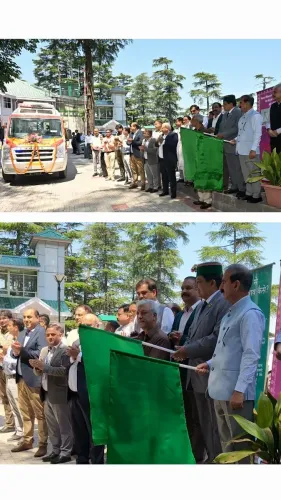
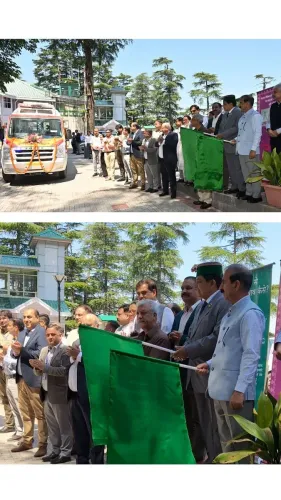
CM Sukhu flags off ALS ambulances from Shimla for emergency care

Synopsis
Himachal Pradesh Chief Minister Sukhvinder Singh Sukhu flagged off Advanced Life Support ambulances from Oak Over, Shimla on 8 June 2026, aiming to deliver on-site critical care to emergency patients and speed up safe hospital transfers across the hill state.
Key Takeaways
Chief Minister Sukhvinder Singh Sukhu flagged off ALS ambulances from Oak Over, Shimla on 8 June 2026 .
The ambulances are equipped to provide advanced life-saving medical care to critically ill patients at the scene of an emergency.
The deployment is intended to improve the speed, quality, and effectiveness of emergency health services in Himachal Pradesh .
Himachal Pradesh's hilly terrain makes pre-hospital ALS capacity especially critical for reducing preventable deaths.
The initiative aligns with the National Health Mission framework encouraging states to upgrade pre-hospital emergency infrastructure.
Future steps may include district-wise fleet expansion and integration with trauma centres, to be tracked in the next state health budget.
Himachal Pradesh Chief Minister Sukhvinder Singh Sukhu on Monday, 8 June 2026, flagged off Advanced Life Support (ALS) ambulances from Oak Over, Shimla, deploying them for public emergency health services across the hill state.
Announcing the move on X, the Chief Minister said the ambulances would provide 'उन्नत जीवनरक्षक चिकित्सा सुविधा' ('advanced life-saving medical facilities') to critically ill patients at the site of emergency, ensuring they are transported to hospital 'swiftly and safely.' He added that the deployment would strengthen 'the speed, quality and effectiveness' of emergency health services in the state.
Context
Himachal Pradesh's mountainous terrain poses a persistent challenge to pre-hospital emergency care. Narrow hill roads, long distances between habitations and hospitals, and weather disruptions can delay critical interventions, making on-site advanced medical support a matter of life and death for trauma and cardiac patients.
The state has operated the 108 emergency ambulance service for over a decade, but Basic Life Support vehicles have limited capacity to stabilise seriously ill patients before they reach a hospital. ALS ambulances bridge that gap by carrying paramedics and equipment capable of managing airways, administering intravenous drugs, and monitoring vitals en route.
Policy Backdrop
The flagging-off aligns with a broader national pattern in which state governments — particularly those with difficult geographies — have been upgrading pre-hospital care infrastructure under the National Health Mission (NHM) framework. NHM guidelines encourage states to add ALS capacity to their emergency response networks as part of strengthening district-level trauma care.
Himachal Pradesh's move mirrors similar upgrades undertaken by other hill and tribal states, where the 'golden hour' principle — providing advanced care within the first hour of a medical emergency — is hardest to honour without mobile critical-care units. The Oak Over residence in Shimla, the official Chief Ministerial bungalow, served as the ceremonial flagging-off point, signalling the government's political ownership of the initiative.
Stakeholders and Impact
The primary beneficiaries are residents of Himachal Pradesh's remote and semi-urban areas who currently face the longest transit times to secondary and tertiary hospitals. Trauma victims, patients experiencing cardiac events, and those requiring obstetric emergencies stand to gain the most from on-site stabilisation before hospital admission.
Healthcare workers and paramedics deployed on these units will now operate with a higher scope of practice, requiring specialised training in ALS protocols. District hospitals and referral centres will also see a qualitative change in the condition of patients arriving from the field, potentially improving survival and recovery outcomes.
What's Next
The state government's next steps are likely to include deploying ALS ambulances to high-burden districts beyond Shimla and integrating them with district-level trauma centres. Observers will watch the forthcoming state health budget and annual NHM report for details on the total fleet size, district-wise allocation, and training plans for paramedic staff.
If the rollout is scaled systematically, it could meaningfully reduce preventable deaths in the state's most inaccessible corridors — a metric that will be closely tracked by health administrators and opposition benches alike.
Point of View
Visible health-delivery action that allows the Sukhu government to demonstrate governance dividends in a state where infrastructure gaps in healthcare have long been a political liability. By anchoring the event at Oak Over — the Chief Ministerial residence — the administration signals direct executive ownership of the initiative rather than delegating it to the health department. Within the broader arc of National Health Mission-driven state investments, this move is incremental but strategically timed, coming ahead of what could be a budget cycle that faces fiscal scrutiny. The real test will be whether the fleet reaches the most remote sub-divisions or remains concentrated in better-connected urban corridors.
NationPress
24 Oct 2026
Frequently Asked Questions
What is an ALS ambulance and how is it different from a regular ambulance?
An Advanced Life Support (ALS) ambulance carries trained paramedics and specialised equipment — such as cardiac monitors, defibrillators, and airway management tools — that allow them to provide critical medical interventions at the scene and during transit, unlike basic ambulances that primarily offer transport.
Where were the ALS ambulances flagged off in Himachal Pradesh?
The ambulances were flagged off by Chief Minister Sukhvinder Singh Sukhu from Oak Over, the Chief Ministerial residence in Shimla, on 8 June 2026.
How will ALS ambulances help people in Himachal Pradesh's remote areas?
Given the state's difficult mountain terrain and long distances to hospitals, ALS ambulances can stabilise critically ill or injured patients on-site, reducing the risk of deterioration during the journey and improving survival chances.
What is the 108 ambulance service in Himachal Pradesh?
The 108 service is Himachal Pradesh's public emergency ambulance helpline, operational for over a decade, which dispatches ambulances in response to medical emergencies across the state.
Is this ALS ambulance launch part of a national health programme?
Yes, the deployment is consistent with the National Health Mission framework, which encourages states — especially those with challenging geographies — to strengthen pre-hospital emergency care by adding ALS capacity to their emergency response networks.