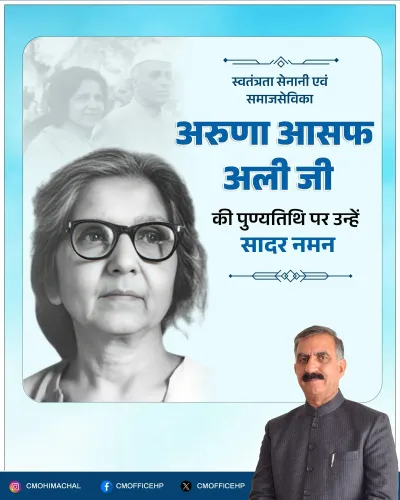
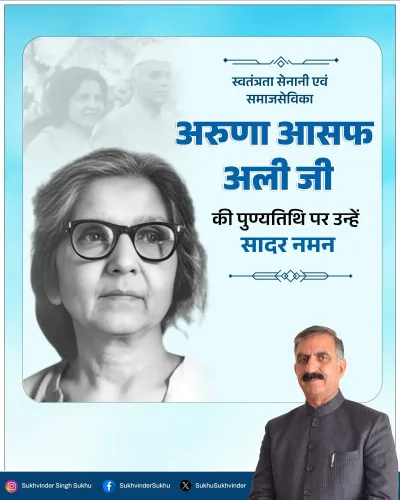
CM Sukhu pays tribute to Aruna Asaf Ali on death anniversary
Synopsis
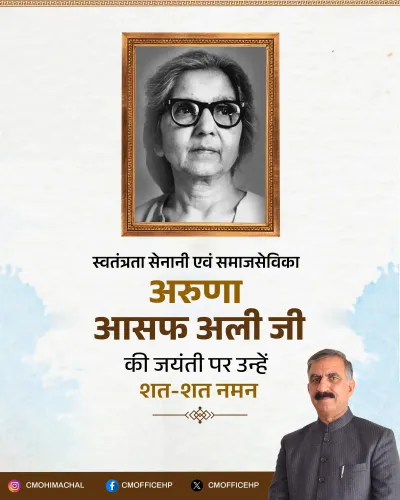
Himachal Pradesh CM Sukhvinder Singh Sukhu paid homage to Aruna Asaf Ali on her death anniversary, honouring the Quit India Movement leader who hoisted the tricolour at Gowalia Tank in 1942 and was posthumously awarded the Bharat Ratna in 1997.
Key Takeaways
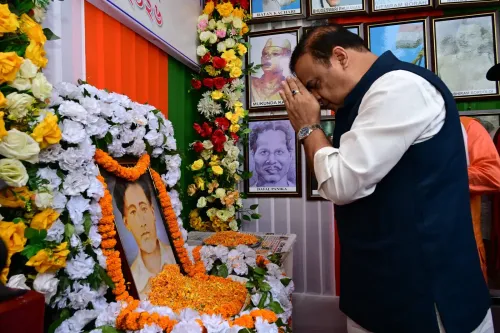
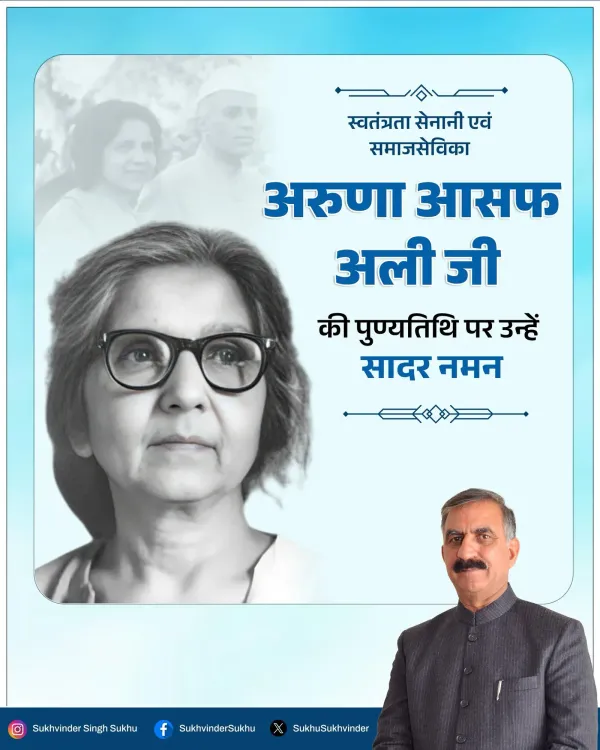
Himachal Pradesh CM Sukhvinder Singh Sukhu paid tribute to Aruna Asaf Ali on her death anniversary on 29 July .
Aruna Asaf Ali hoisted the Indian national flag at Gowalia Tank Maidan, Bombay on 8 August 1942 , a defining moment of the Quit India Movement.
She later served as Mayor of Delhi and remained active in social work after independence.
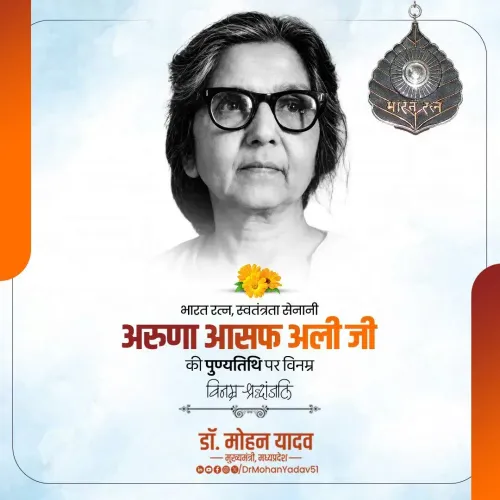
She was posthumously awarded the Bharat Ratna in 1997 for her role in India's freedom struggle.
CM Sukhu described her courage, dedication, and patriotism as a lasting inspiration for future generations.
She hoisted the tricolour when it was an act of defiance — and Aruna Asaf Ali never stopped defying. On her death anniversary, Himachal Pradesh Chief Minister Sukhvinder Singh Sukhu paid homage to one of the Quit India Movement's most iconic leaders, calling her courage and patriotism an enduring inspiration for generations to come.
Posting on 29 July, CM Sukhu wrote: 'Bharat Chhodo Andolan ki agrani neta, mahan swatantrata senani evam samajsevika Aruna Asaf Ali ji ki punyatithi par unhe shat-shat naman.' ('Heartfelt salutations to Aruna Asaf Ali — foremost leader of the Quit India Movement, great freedom fighter, and social worker — on her death anniversary.')
Aruna Asaf Ali and the Flag at Gowalia Tank
On 8 August 1942, the Indian National Congress launched the Quit India Movement at Gowalia Tank Maidan, Bombay — a mass civil disobedience campaign demanding an immediate end to British rule. When senior leaders were swiftly arrested, it was Aruna Asaf Ali who stepped forward and hoisted the Indian national flag at the maidan, an act that became one of the movement's most indelible images. British authorities declared her a wanted fugitive, but she continued organising underground resistance.
Her contribution extended well beyond the freedom struggle. She went on to serve as the Mayor of Delhi and remained active in social causes for decades. In 1997, she was posthumously awarded the Bharat Ratna — India's highest civilian honour — in recognition of her extraordinary role in the independence movement.
CM Sukhu's tribute reflects a well-established pattern among Congress-affiliated leaders of publicly invoking the party's historical legacy on the birth and death anniversaries of freedom fighters — connecting the present to the nationalist struggle that defined modern India.
Aruna Asaf Ali's story is not a footnote. It is a reminder that the republic was built, in no small part, by those who acted when others could not.
Point of View
A figure celebrated across party lines for her personal bravery, is broadly uncontroversial, but it also signals a deliberate effort to keep the Congress movement's historical identity visible at the state level. The Bharat Ratna conferred on Ali in 1997 under a Congress-backed government adds a layer of institutional memory to what might otherwise read as routine commemoration. In a political climate where ownership of nationalist symbols is fiercely contested, such tributes are rarely just ceremonial.
NationPress
29 Jul 2026
Frequently Asked Questions
Who was Aruna Asaf Ali?
Aruna Asaf Ali was a leading Indian freedom fighter best known for hoisting the national flag at Gowalia Tank Maidan in Bombay during the Quit India Movement of 1942. She later served as Mayor of Delhi and was posthumously awarded the Bharat Ratna in 1997.
What is the significance of Aruna Asaf Ali's death anniversary?
Her death anniversary is observed as an occasion to remember her bravery during the Quit India Movement, when she defied British authorities and kept the independence struggle alive through underground resistance.
What did CM Sukhu say about Aruna Asaf Ali?
CM Sukhvinder Singh Sukhu paid 'heartfelt salutations' to Aruna Asaf Ali, calling her courage, dedication, and unbreakable patriotism a lasting inspiration for future generations to walk the path of duty and national interest.
When was Aruna Asaf Ali awarded the Bharat Ratna?
Aruna Asaf Ali was posthumously awarded the Bharat Ratna, India's highest civilian honour, in 1997.
What was the Quit India Movement?
The Quit India Movement was a mass civil disobedience campaign launched by the Indian National Congress on 8 August 1942, demanding an immediate end to British colonial rule in India.