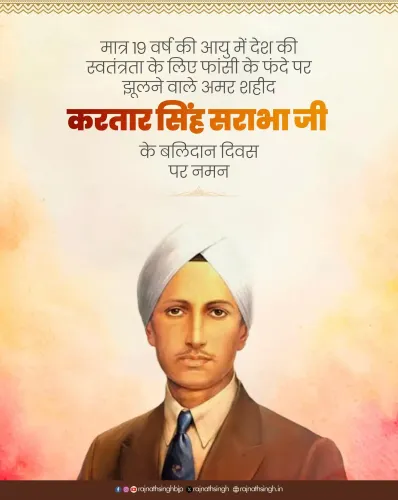
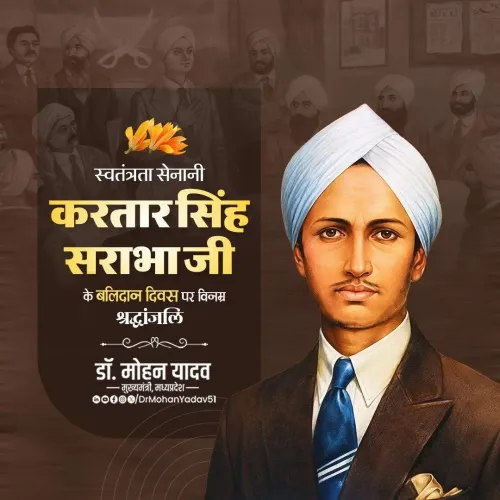
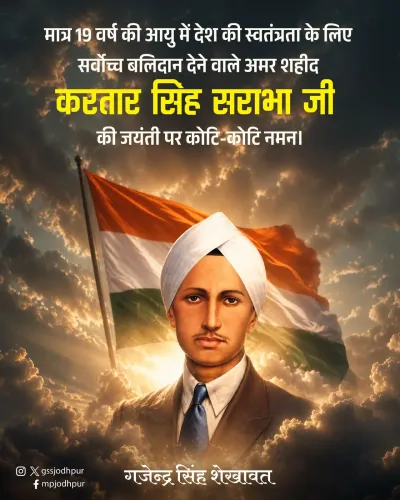
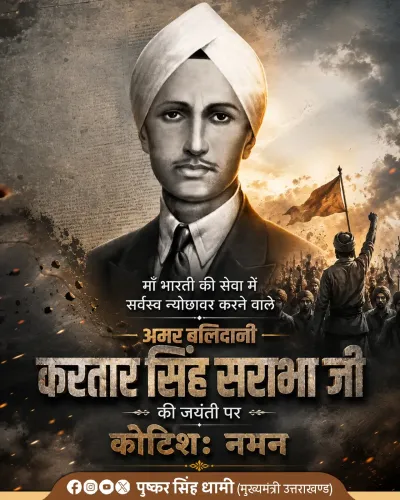
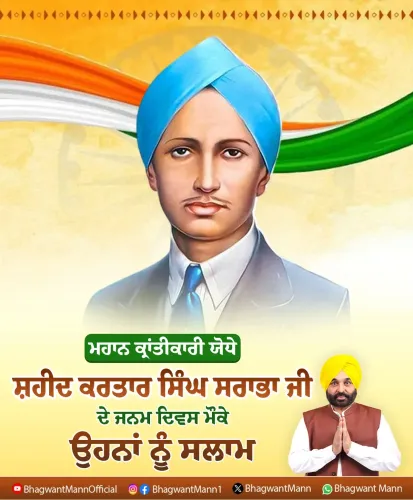
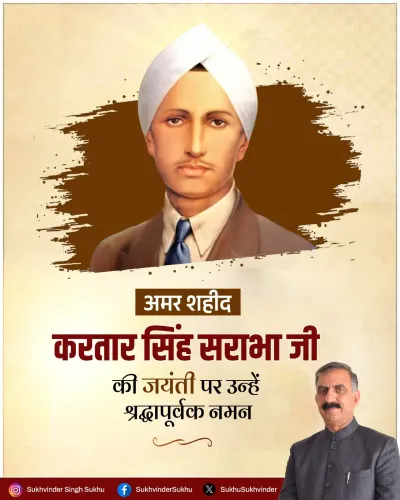
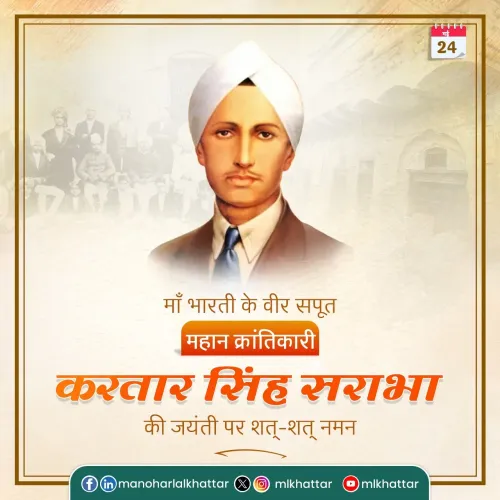
CM Sukhu pays tribute to martyr Kartar Singh Sarabha
Synopsis
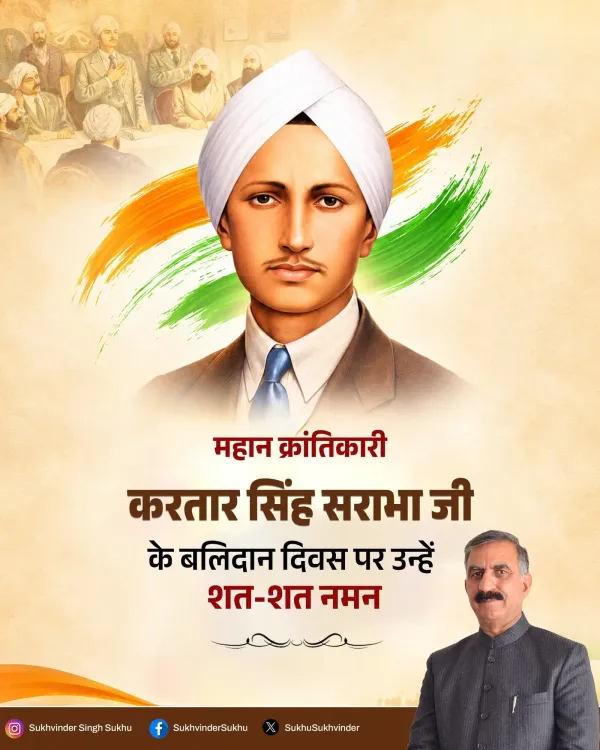
Himachal Pradesh Chief Minister Sukhvinder Singh Sukhu paid tribute to Ghadar Party revolutionary Kartar Singh Sarabha on the 111th anniversary of his martyrdom, calling his sacrifice at age 19 an eternal source of patriotic inspiration for every Indian.
Key Takeaways
CM Sukhvinder Singh Sukhu posted a Hindi tribute to Kartar Singh Sarabha on 16 November 2026 , his martyrdom anniversary.
Kartar Singh Sarabha was hanged at Lahore Central Jail on 16 November 1915 , aged 19 , by British colonial authorities.
Sarabha was a member of the Ghadar Party , founded in 1913 in San Francisco to overthrow British rule through armed revolt.
CM Sukhu called Sarabha's sacrifice 'supreme' and said it would 'ignite the flame of patriotism in every Indian for centuries.' The tribute reflects a broader pattern of Indian political leaders publicly commemorating independence-era revolutionaries on death anniversaries.
On the 111th martyrdom anniversary of one of India's youngest freedom fighters, Himachal Pradesh Chief Minister Sukhvinder Singh Sukhu paid solemn tribute to Kartar Singh Sarabha, the teenage revolutionary who gave his life for India's independence on 16 November 1915.
Posting on X in Hindi, CM Sukhu wrote: 'गदर पार्टी के महान क्रांतिकारी एवं अमर शहीद करतार सिंह सराभा जी के बलिदान दिवस पर उन्हें सादर नमन।' — 'Respectful salutations to the great revolutionary and immortal martyr of the Ghadar Party, Kartar Singh Sarabha, on his martyrdom day.' He added that Sarabha's supreme sacrifice at such a young age 'will continue to ignite the flame of patriotism in the heart of every Indian for centuries to come.'
Who was Kartar Singh Sarabha — and why his age still matters
Kartar Singh Sarabha was hanged at Lahore Central Jail on 16 November 1915, aged just 19, by British colonial authorities. He had joined the Ghadar Party — a revolutionary organisation founded in 1913 in San Francisco by Indian expatriates determined to overthrow British rule through armed uprising — and became one of its most fearless young operatives. His execution made him one of the youngest martyrs of India's early independence movement, a fact that lends his story a particular resonance whenever leaders speak of sacrifice.
The Ghadar Party drew Indians from across the diaspora, publishing its radical newspaper and mobilising labourers, students, and intellectuals alike. Sarabha, still a teenager when he joined the cause, is remembered not merely as a name in a history book but as a symbol of what absolute conviction looks like — before ambition, before caution, before compromise.
Tributes, memory, and the politics of remembrance
Indian political leaders across the spectrum observe martyrdom anniversaries of independence-era revolutionaries as a matter of public duty, using social media to keep these figures visible in national consciousness. CM Sukhu's tribute fits this established pattern — but on a day like 16 November, it also carries a quiet weight. The anniversary is not a national holiday; it requires deliberate remembrance.
That a sitting Chief Minister pauses to mark it signals that figures like Sarabha remain morally potent — not just historical footnotes, but touchstones for conversations about what public service and national loyalty are supposed to look like.
Nineteen years old. Hanged. Unbroken. The standard Sarabha set has outlasted the empire that set the gallows.
Point of View
Association with pre-Independence revolutionaries — particularly those outside the dominant Nehru-Gandhi narrative — broadens the party's historical ownership of the independence legacy. The Ghadar Party's internationalist, working-class roots also carry a subtle ideological resonance for centre-left politics. While the post advances no policy position, it functions as soft nation-building messaging with cross-partisan appeal.
NationPress
16 Nov 2026
Frequently Asked Questions
Who was Kartar Singh Sarabha?
Kartar Singh Sarabha was a young Indian revolutionary and member of the Ghadar Party who was hanged by British authorities at Lahore Central Jail on 16 November 1915 at the age of 19, making him one of the youngest martyrs of India's independence movement.
What was the Ghadar Party?
The Ghadar Party was a revolutionary organisation founded in 1913 in San Francisco by Indian expatriates who sought to overthrow British colonial rule in India through armed uprising. It published a radical newspaper and mobilised Indians across the diaspora.
Why did CM Sukhu post about Kartar Singh Sarabha?
16 November marks Kartar Singh Sarabha's martyrdom anniversary. Himachal Pradesh Chief Minister Sukhvinder Singh Sukhu posted a tribute on X to honour his memory and highlight the significance of his sacrifice for India's independence.
How old was Kartar Singh Sarabha when he was executed?
Kartar Singh Sarabha was 19 years old when he was executed by British colonial authorities at Lahore Central Jail on 16 November 1915.
What did CM Sukhu say about Kartar Singh Sarabha?
CM Sukhu said that Sarabha's supreme sacrifice at such a young age 'will continue to ignite the flame of patriotism in the heart of every Indian for centuries to come,' paying respectful salutations on his martyrdom day.