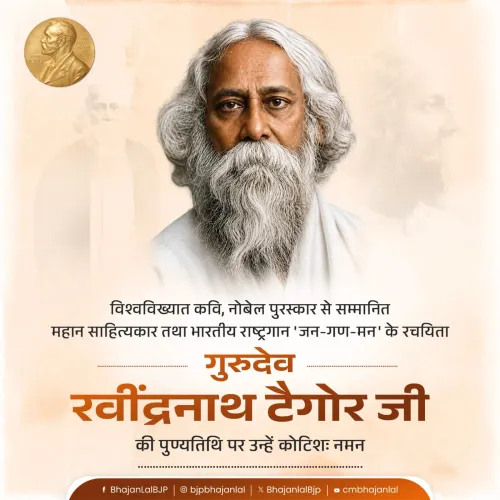
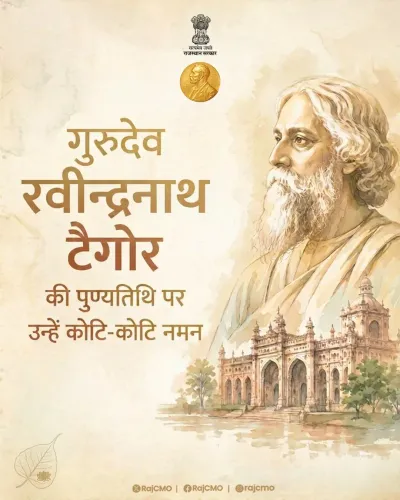
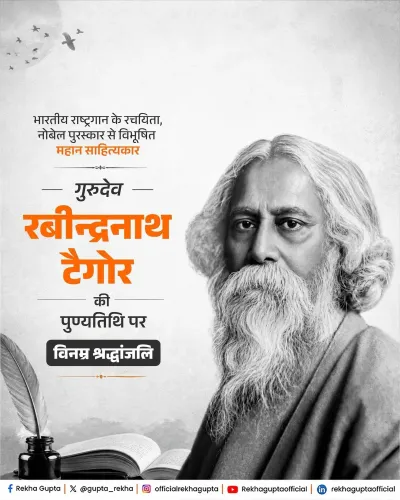
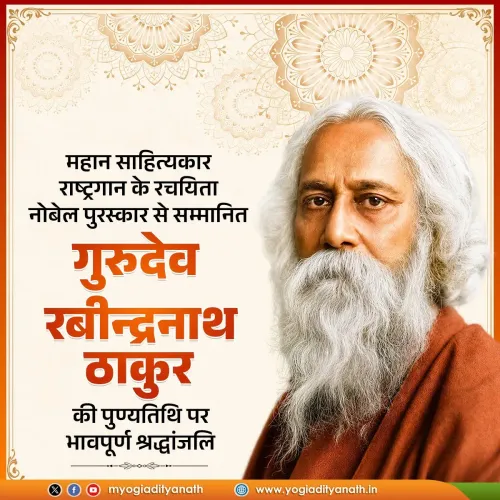
CM Sukhu pays tribute to Tagore on death anniversary
Synopsis
Himachal Pradesh Chief Minister Sukhvinder Singh Sukhu marked Rabindranath Tagore's death anniversary on 7 August, saluting the Nobel laureate as an unparalleled confluence of knowledge, art, culture, and human values whose thought continues to inspire India.
Key Takeaways
CM Sukhu posted a tribute to Rabindranath Tagore on his death anniversary, 7 August .
Tagore, born in 1861 , won the Nobel Prize in Literature in 1913 and composed India's national anthem Jana Gana Mana .
He founded Visva-Bharati University at Shantiniketan , a pioneering institution blending education, nature, and the arts.
Tagore passed away on 7 August 1941 ; the anniversary is marked annually by leaders across India's political spectrum.
CM Sukhu described Tagore's legacy as a guide toward 'truth, humanity, creativity and moral values.'
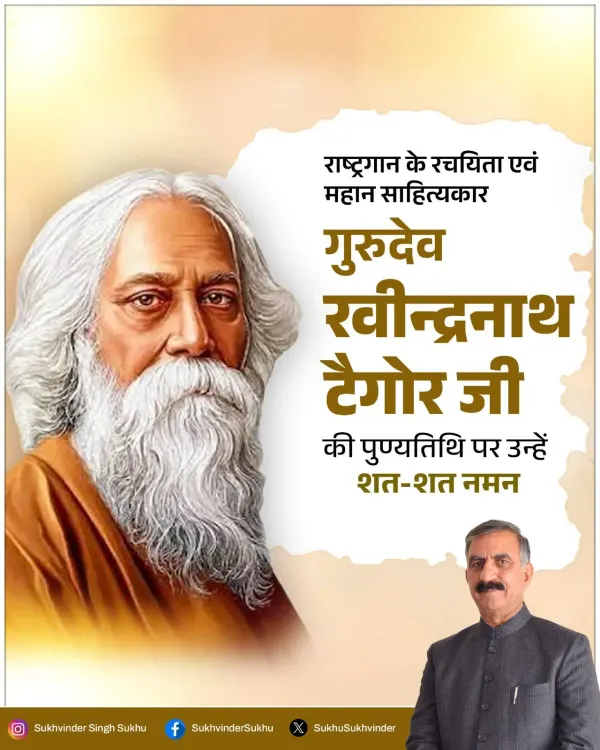
On the death anniversary of Rabindranath Tagore, Himachal Pradesh Chief Minister Sukhvinder Singh Sukhu offered his reverence to the poet-philosopher who gave India its national anthem and a literary legacy that endures across generations.
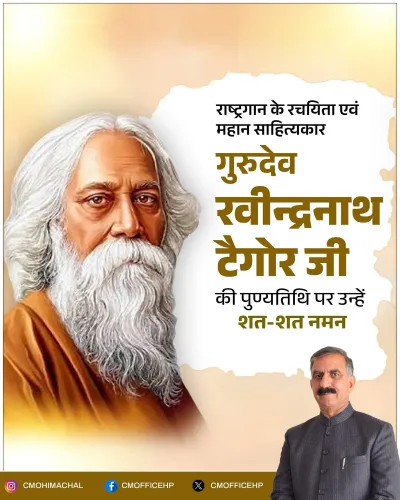
In a post on 7 August, CM Sukhu wrote: 'Rashtragan ke rachayita evam mahan sahityakar Gurudev Ravindranath Tagore ji ki punyatithi par unhe shat-shat naman.' — 'Heartfelt salutations to Gurudev Rabindranath Tagore, composer of the national anthem and great literary figure, on his death anniversary.' He described Tagore's life as 'an unparalleled confluence of knowledge, art, culture and human values', adding that Tagore's thought 'will forever inspire society to walk the path of truth, humanity, creativity and moral values.'
The man who wrote Jana Gana Mana
Rabindranath Tagore remains one of the most consequential figures in modern Indian history. Born in 1861 in Calcutta, he became the first non-European to win the Nobel Prize in Literature in 1913, recognised for his collection Gitanjali. His composition Jana Gana Mana was adopted as India's national anthem after independence, cementing his place at the very heart of the nation's identity.
Tagore's influence stretched far beyond verse. He founded Visva-Bharati University at Shantiniketan in West Bengal, envisioning an institution where education blended with nature, art, and a global humanist outlook. His novels, short stories, songs — the genre of Rabindra Sangeet — and his essays on nationalism and spirituality continue to be studied and performed across the subcontinent and beyond. He died on 7 August 1941.
A ritual of remembrance across the political spectrum
Every year on 7 August, Indian leaders from every major party mark Tagore's death anniversary with public tributes. The ritual reflects a rare cross-party consensus: Tagore's vision of a pluralist, humanist India belongs to no single political tradition. State governments, schools, and cultural institutions typically observe the day with readings, music, and commemorative events.
CM Sukhu's tribute follows that established pattern — a brief but sincere acknowledgement of a legacy that, as he put it, continues to steer society toward 'truth, humanity, and creativity.'
On the anniversary of his passing, Tagore's words still carry the weight of a nation's conscience.
Point of View
Invoking Tagore's humanist values — truth, creativity, moral purpose — is also a soft way to frame his own governance identity without entering contested political territory. The cross-party consensus around Tagore tributes underscores how the poet functions as a unifying national symbol, one no party can afford to ignore and none can fully claim.
NationPress
7 Aug 2026
Frequently Asked Questions
When did Rabindranath Tagore die?
Rabindranath Tagore died on 7 August 1941 in Calcutta. His death anniversary is observed annually across India with cultural events and tributes from public figures.
Why is Tagore called the composer of India's national anthem?
Tagore composed Jana Gana Mana , which was adopted as India's national anthem after independence in 1950 . The song was originally written in Bengali and first sung in 1911 .
What Nobel Prize did Rabindranath Tagore win?
Tagore won the Nobel Prize in Literature in 1913 , the first non-European to receive the honour. He was recognised for his collection of poems Gitanjali .
What is Visva-Bharati University?
Visva-Bharati University , located in Shantiniketan, West Bengal , was founded by Tagore in 1921 . It embodies his educational philosophy of learning in harmony with nature, art, and global culture.
Why did CM Sukhu pay tribute to Tagore?
Himachal Pradesh Chief Minister Sukhvinder Singh Sukhu paid tribute on 7 August , Tagore's death anniversary, honouring him as a symbol of knowledge, art, humanity, and moral values — a gesture common among Indian leaders across parties on this date.