CM Sukhu Vows to Strengthen Dairy Sector for Rural Prosperity
Synopsis
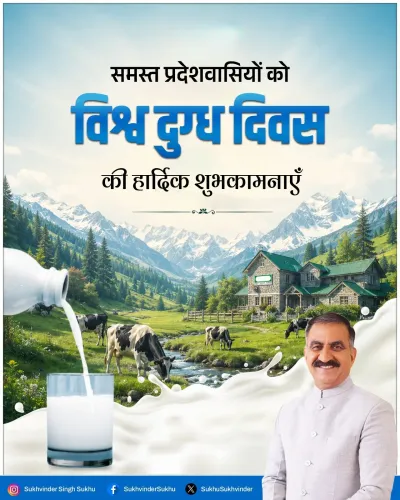
Chief Minister Sukhvinder Singh Sukhu on June 1, 2026 reaffirmed Himachal Pradesh's commitment to making dairy production more empowered, organised, and profitable, positioning the sector as a key driver of rural prosperity in the hill state.
Key Takeaways
Chief Minister Thakur Sukhvinder Singh Sukhu pledged on June 1, 2026 to strengthen dairy production in Himachal Pradesh .
The stated goal is to make milk production more 'empowered, organised, and profitable' to drive rural prosperity.
HP Milkfed , the state dairy cooperative, has been the backbone of dairy infrastructure in the state since the 1980s .
Dairy is considered especially suited to Himachal Pradesh's terrain, where traditional cropping faces climatic constraints.
The policy direction aligns with a broader national pattern of strengthening allied agricultural sectors to raise rural incomes.
Concrete follow-through is expected in state budget allocations and new guidelines for dairy infrastructure in the coming fiscal cycle.
The Chief Minister's Office of Himachal Pradesh, on behalf of Chief Minister Thakur Sukhvinder Singh Sukhu, on Monday, June 1, 2026, reaffirmed the state government's commitment to making milk production more empowered, organised, and profitable as a pathway to rural prosperity.
Context
Chief Minister Sukhu stated, 'Hamara prayas hai ki dugdh utpadan ko aur adhik sashakt, sangathit va labhakaari banakar gramin samridhi ko nayi disha di jaye' — 'Our endeavour is to give a new direction to rural prosperity by making milk production more empowered, organised, and profitable.' The statement signals a focused policy intent to elevate dairy farming from a subsistence activity to a structured, remunerative enterprise for Himachal Pradesh's rural communities.
The hill state has a substantial rural population that depends on livestock rearing, including dairy, as a primary or supplementary livelihood. Dairy is seen as particularly suited to Himachal Pradesh's mountainous terrain, where conventional cropping faces climatic and geographic constraints.
Policy Backdrop
Himachal Pradesh has operated dairy development programmes through its Animal Husbandry Department and the Himachal Pradesh Cooperative Milk Producers Federation Limited (HP Milkfed) since the 1980s, building out milk collection, chilling, and processing infrastructure across the state.
The state's approach mirrors the cooperative dairy model that transformed rural incomes across India following Operation Flood, the landmark national dairy development programme. By organising small and marginal producers into cooperatives, states have historically been able to guarantee procurement prices, reduce middlemen, and improve the bargaining power of farmers.
Across India, allied agricultural sectors — dairy, poultry, and fisheries — have gained renewed policy attention as governments seek to supplement farm incomes and cushion rural households against the volatility of crop cycles. Himachal Pradesh's emphasis on making dairy 'organised and profitable' fits squarely within this national pattern.
Stakeholders and Impact
Dairy farmers and rural households across Himachal Pradesh stand to benefit most directly from any strengthening of procurement networks, cooperative structures, and price support mechanisms. For many families in the hills, cattle rearing provides a year-round income stream that crop farming alone cannot guarantee.
HP Milkfed, the apex cooperative body, would be central to implementing any expanded policy — whether through new chilling plants, enhanced procurement routes, or improved value-addition facilities that allow farmers to earn more per litre of milk produced.
Organised dairy development also has downstream effects: better-fed, better-managed livestock improves milk yield over time, reduces input costs per unit, and can open export and branded-product opportunities for the state's cooperatives.
What's Next
Analysts and sector observers will watch for concrete follow-through in the form of state budget allocations, new guidelines for dairy infrastructure, or announcements relating to cooperative strengthening in the coming fiscal cycle. The Chief Minister's public articulation of this goal suggests it is likely to feature in upcoming policy and budgetary discussions.
If translated into actionable schemes — expanded chilling infrastructure, higher procurement prices, or easier credit access for dairy farmers — the initiative could meaningfully improve rural incomes across Himachal Pradesh's hill districts, reinforcing the government's broader rural development agenda.
Point of View
Profitable enterprise, the government is aligning itself with a national policy language that has proven electorally resonant. The invocation of 'rural prosperity' through cooperative strengthening also positions the state government as a steward of inclusive growth at a time when hill-state economies face pressure from climate-linked agricultural stress. Whether this translates into budgetary muscle or remains aspirational rhetoric will be the real test of the administration's intent.
NationPress
16 Oct 2026
Frequently Asked Questions
What did CM Sukhu say about dairy development in Himachal Pradesh?
Chief Minister Sukhvinder Singh Sukhu stated on June 1, 2026 that the government's endeavour is to make milk production more empowered, organised, and profitable to give a new direction to rural prosperity in Himachal Pradesh.
What is HP Milkfed and what role does it play?
HP Milkfed, or the Himachal Pradesh Cooperative Milk Producers Federation Limited, is the state-level dairy cooperative that procures, processes, and markets milk from local producers. It has been the primary institutional vehicle for dairy development in Himachal Pradesh since the 1980s.
Why is dairy farming important for Himachal Pradesh's rural economy?
Himachal Pradesh's mountainous terrain limits conventional crop farming, making livestock rearing and dairy a stable, year-round livelihood option for a large share of the state's rural population.
How does Himachal Pradesh's dairy policy connect to national schemes?
The state's cooperative dairy model is inspired by India's Operation Flood, which organised small producers into cooperatives to improve procurement prices and reduce dependence on middlemen, a model now widely adopted across Indian states.
What should we watch for next in Himachal Pradesh's dairy sector?
Observers will look for state budget allocations, new infrastructure guidelines for chilling plants and milk collection, and cooperative-strengthening measures in the next fiscal cycle as indicators of how the government plans to act on CM Sukhu's stated commitment.