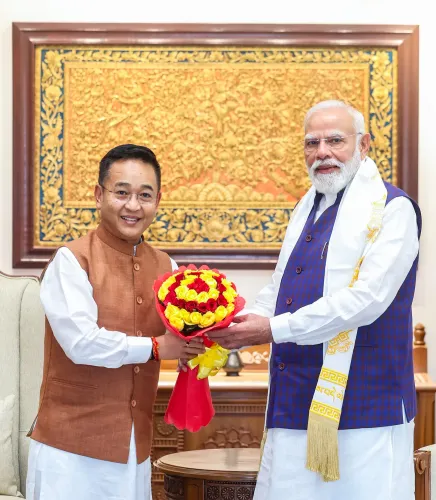
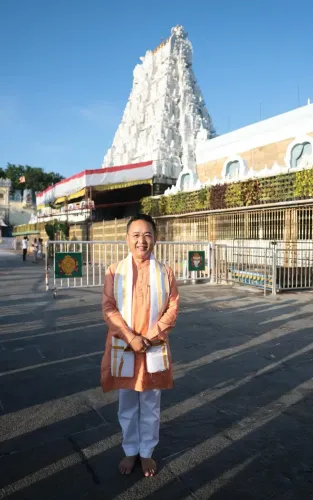
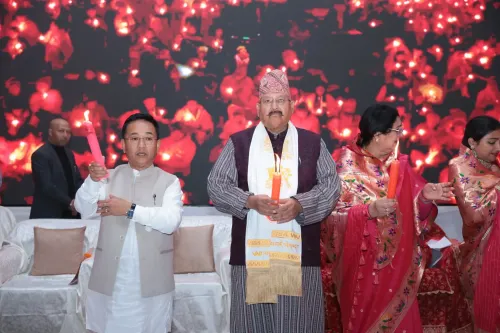
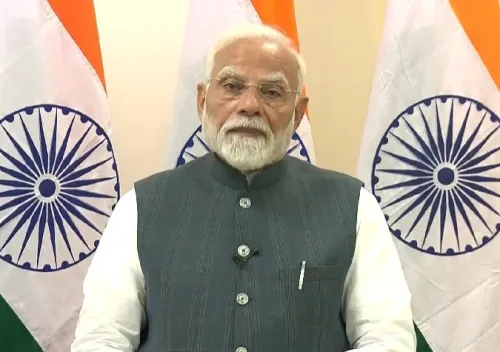
CM Tamang Congratulates PM Modi on 12 Years in Office

Synopsis
Sikkim Chief Minister Prem Singh Tamang on May 26, 2026, congratulated Prime Minister Narendra Modi on 12 years in office, highlighting Sikkim's progress in organic farming, connectivity, tourism, and sustainable development under central support for Himalayan and North Eastern states.
Key Takeaways
CM Prem Singh Tamang congratulated PM Modi on completing 12 years as Prime Minister on May 26, 2026 .
Tamang invoked the 'Sabka Saath, Sabka Vikas, Sabka Vishwas, Sabka Prayas' framework as the cornerstone of Modi's governance philosophy.
Sikkim became India's first fully organic state in 2016 , benefiting from Centre-state cooperation on sustainable agriculture.
The CM cited organic farming, tourism, connectivity, healthcare, and education as areas where Sikkim has gained from central policy support.
The message aligns Sikkim's development priorities with the national Viksit Bharat 2047 vision.
Central budget provisions for North Eastern and Himalayan connectivity projects remain a key area to watch in the coming fiscal cycle.
Sikkim Chief Minister Prem Singh Tamang on Tuesday, May 26, 2026, extended congratulations to Prime Minister Narendra Modi on completing 12 years of continuous service as the country's head of government, highlighting Sikkim's gains under central development initiatives for Himalayan and North Eastern states.
Context
Prime Minister Modi first assumed office in May 2014, making May 26, 2026 the completion of his twelfth year in power. CM Tamang, writing on behalf of the people of Sikkim, invoked the Prime Minister's guiding philosophy — 'Sabka Saath, Sabka Vikas, Sabka Vishwas, Sabka Prayas' ('Together with all, development for all, trust of all, effort of all') — as the framework that has shaped national progress over this period.
Tamang credited the Prime Minister's 'visionary leadership' with transforming Bharat into 'a stronger, self-reliant and globally respected nation,' citing advances across infrastructure, digital empowerment, welfare, and national security.
Policy Backdrop
Sikkim holds the distinction of being India's first fully organic state, a status formalised in 2016 through collaboration between the state government and the central administration. The post specifically acknowledges central support for organic farming, tourism, connectivity, healthcare, education, and sustainable development as areas where Sikkim has benefited from the broader national policy thrust toward Himalayan and North Eastern states.
Since 2014, successive central budgets have channelled dedicated resources toward connectivity and infrastructure schemes for North Eastern and Himalayan states, reflecting a stated priority of integrating these regions into the national development mainstream. Tamang's remarks align Sikkim's own environmental and agricultural identity with the Centre's Viksit Bharat vision — the long-term goal of making India a developed nation by 2047.
Stakeholders and Impact
The message carries direct relevance for Sikkim's organic farmers, whose livelihoods are closely tied to central procurement, certification, and export-support policies. Tourism operators and communities dependent on Himalayan connectivity projects also stand to benefit from continued federal attention to the region.
CM Tamang, who leads the Sikkim Krantikari Morcha and has governed the state since 2019, has consistently positioned Sikkim as a cooperative partner in the Centre's development agenda. His congratulatory post reinforces that alignment at a symbolically significant political milestone for the ruling dispensation at the national level.
What's Next
Attention will now turn to central budget provisions and scheme announcements targeting North Eastern connectivity, organic agriculture, and Himalayan tourism infrastructure in the coming fiscal cycle. Whether the goodwill expressed in such exchanges translates into fresh allocations or policy announcements for states like Sikkim will be closely watched by regional stakeholders and development analysts alike.
As India advances toward its Viksit Bharat 2047 goal, the role of smaller Himalayan states — with their unique environmental assets and strategic border locations — is likely to remain a focal point of Centre-state engagement.
Point of View
Tamang subtly lobbies for continued federal attention and resource flows to the region without making explicit demands. The tribute fits a broader pattern among BJP-allied or Centre-friendly state governments of using symbolic occasions to consolidate political goodwill and keep their states visible in the national policy conversation. The invocation of Viksit Bharat 2047 signals that Sikkim intends to position itself as an active contributor to — and beneficiary of — the long-arc national development narrative.
NationPress
10 Oct 2026
Frequently Asked Questions
Why is CM Prem Singh Tamang congratulating PM Modi in May 2026?
May 26, 2026 marks the completion of 12 years since Narendra Modi first took oath as Prime Minister in May 2014 . CM Tamang used the occasion to publicly acknowledge the milestone and highlight development benefits for Sikkim .
What is 'Sabka Saath, Sabka Vikas, Sabka Vishwas, Sabka Prayas'?
It is PM Modi's governing philosophy, translating roughly to 'Together with all, development for all, trust of all, effort of all.' The phrase has been the stated framework for inclusive national growth since 2014 , with 'Sabka Prayas' (everyone's effort) added in later years.
How has Sikkim benefited from central government schemes?
Sikkim was declared India's first fully organic state in 2016 through Centre-state collaboration. Central schemes have also supported tourism infrastructure, connectivity, healthcare, and education in the Himalayan state, as acknowledged by CM Tamang .
Who is Prem Singh Tamang and which party does he lead?
Prem Singh Tamang , also known as Golay, is the Chief Minister of Sikkim since 2019 and the founder-president of the Sikkim Krantikari Morcha (SKM) , the regional party that governs the state.
What is Viksit Bharat and how does it relate to Sikkim?
Viksit Bharat is the central government's vision to make India a fully developed nation by 2047 . CM Tamang pledged that the people of Sikkim remain committed to contributing toward this goal, particularly through the state's focus on sustainable development and environmental conservation.