CM Vijay Inaugurates Rs 19.20 Cr Cocoon Market in Dharmapuri
Synopsis
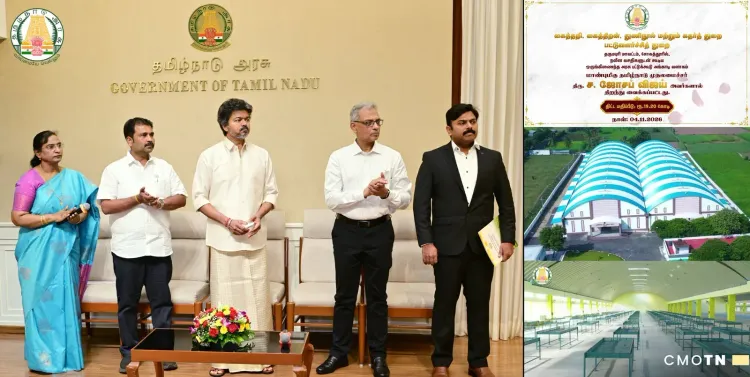
Chief Minister C. Joseph Vijay inaugurated the Rs 19.20 crore Integrated Government Cocoon Market Complex at Sogathur in Dharmapuri on 4 November 2026, providing regulated trading infrastructure to boost price realisation for the district's silk cocoon farmers.
Key Takeaways
Joseph Vijay inaugurated the facility on 4 November 2026 from the Chief Secretariat in Chennai.
The Integrated Government Cocoon Market Complex is located at Sogathur, Dharmapuri District — a major sericulture belt in northern Tamil Nadu.
Total construction cost: Rs 19.20 crore , with modern facilities for cocoon trading and price discovery.
The complex aims to reduce dependence on middlemen and improve direct price realisation for sericulture farmers.
Dharmapuri is one of Tamil Nadu's key mulberry cultivation and silk cocoon production zones.
The project could serve as a replicable model for similar market infrastructure in other sericulture districts across the state.
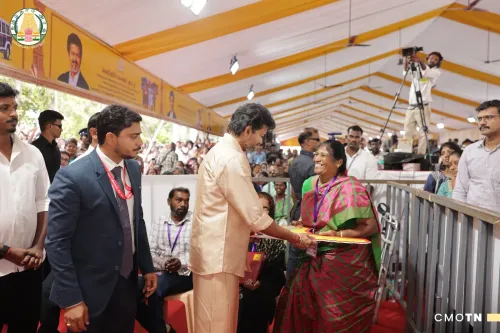
A new chapter opens for Tamil Nadu's sericulture belt: Chief Minister C. Joseph Vijay on Wednesday, 4 November 2026, inaugurated the Integrated Government Cocoon Market Complex at Sogathur in Dharmapuri District, a modern trading hub built at a cost of Rs 19.20 crore and designed to transform how the region's silk farmers sell their harvest.
What Rs 19.20 crore buys Dharmapuri's silk farmers
The complex was inaugurated from the Chief Secretariat in Chennai, with the ceremony marking the state government's commitment to building market infrastructure directly where sericulture clusters thrive. Dharmapuri District, tucked in northern Tamil Nadu, is one of the state's longest-standing mulberry cultivation and silk cocoon production zones — farmers here have grown the raw material for India's silk industry for generations, yet often sold into fragmented, middlemen-heavy local markets.
The new complex at Sogathur is designed to change that equation. With modern facilities consolidated under one roof, cocoon farmers and traders gain a regulated, transparent venue for price discovery — the kind of infrastructure that shortens the supply chain between the farmer's basket and the buyer's bid.
Dharmapuri's sericulture economy and the middlemen problem
Tamil Nadu governments have periodically invested in commodity market infrastructure — grain yards, vegetable mandis, fish landing centres — to improve price realisation at the farm gate. Sericulture has followed the same logic. Dharmapuri produces a significant share of the state's raw silk cocoons, but without an integrated market complex, farmers have historically navigated a patchwork of private intermediaries who set the terms of trade.
An integrated cocoon market shifts that balance. By bringing buyers, graders, and payment systems under state-regulated infrastructure, it creates competitive bidding that typically pushes farm-gate prices upward — a direct income gain for the smallholder households that dominate sericulture in this belt.
A template for other sericulture districts?
The investment in Sogathur will be watched closely by farmer groups and officials in other sericulture-active districts. Tamil Nadu's silk economy spans several northern and western districts, and a functioning model in Dharmapuri could become the blueprint the state replicates elsewhere. Whether allied schemes — cocoon storage, grading labs, or silkworm seed distribution centres — follow at the same site will determine how deep the facility's impact runs.
For now, Rs 19.20 crore and a ribbon cut by the Chief Minister signal that the state is not content to leave one of its oldest agricultural traditions to the mercy of unregulated trade. The looms are waiting — and the farmers who feed them just got a better place to sell.
Point of View
Farmer-visible delivery of welfare. By investing Rs 19.20 crore in a regulated cocoon market, the Vijay administration signals both its rural-economy priorities and its awareness that sericulture households in Dharmapuri represent a concentrated, politically attentive constituency. The deeper test will be operational — whether the complex genuinely compresses the trader-to-farmer price gap or becomes underutilised infrastructure. If it performs, it also hands the government a template to roll out across other silk-producing districts, amplifying its electoral and policy footprint in rural Tamil Nadu.
NationPress
4 Nov 2026
Frequently Asked Questions
What is the Integrated Government Cocoon Market Complex in Dharmapuri?
It is a state-built, modern trading complex at Sogathur in Dharmapuri District, Tamil Nadu, where silk cocoon farmers and buyers can transact under regulated conditions to ensure fair price discovery. It was constructed at a cost of Rs 19.20 crore.
Who inaugurated the Dharmapuri cocoon market complex?
Tamil Nadu Chief Minister C. Joseph Vijay inaugurated the complex on 4 November 2026, via a ceremony held at the Chief Secretariat in Chennai.
How much did the Sogathur cocoon market complex cost?
The complex was constructed at a cost of Rs 19 crore and 20 lakh (Rs 19.20 crore) with modern facilities.
Why is Dharmapuri significant for sericulture in Tamil Nadu?
Dharmapuri is one of Tamil Nadu's major mulberry cultivation and silk cocoon production districts, with a long history of sericulture activity that feeds the state's silk weaving industry.
How does the cocoon market complex help farmers?
By providing a regulated, government-run marketplace, the complex reduces dependence on private middlemen, enables competitive bidding among buyers, and is expected to improve farm-gate prices for sericulture farmers in the region.