Giriraj Singh highlights silk revolution in Telangana's Thalakondapally
Synopsis
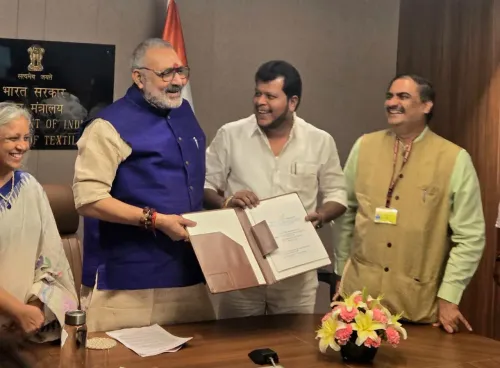
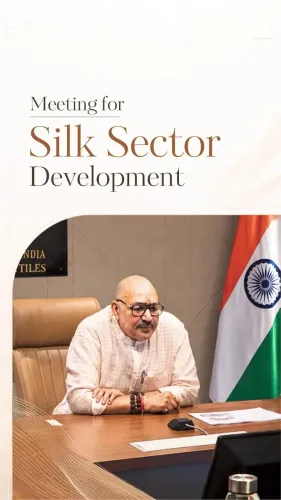
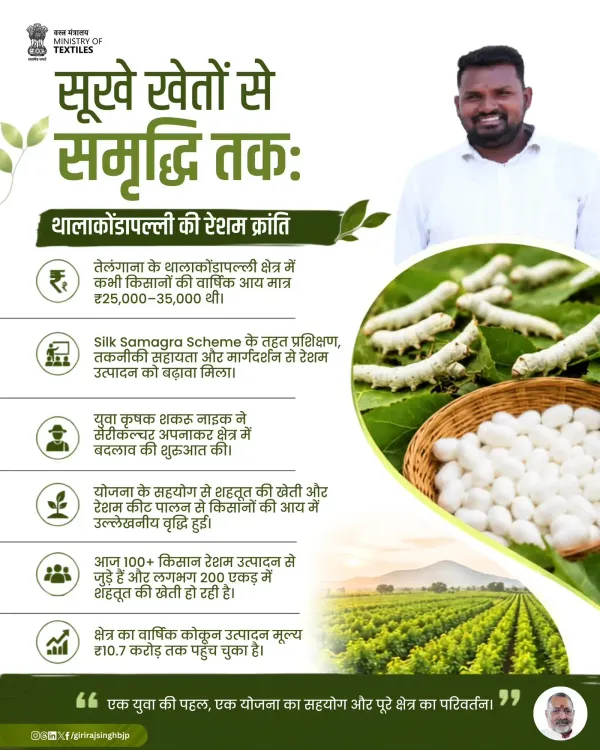
Union Textiles Minister Giriraj Singh on 25 June 2026 highlighted Thalakondapally in Telangana as a model silk village, crediting the Silk Samagra scheme's training and technical support for raising farmer incomes and generating rural employment through sericulture.
Key Takeaways
Union Textiles Minister Giriraj Singh on 25 June 2026 spotlighted Thalakondapally, Telangana as a success story of silk-based rural transformation.
The Silk Samagra scheme, launched in 2017 by the Ministry of Textiles , provides training, technology and market support to sericulture farmers.
Farmers in Thalakondapally who previously depended on limited income are now generating new livelihoods and employment through silk production.
The scheme aims to expand domestic raw silk output and reduce India's dependence on imported silk.
The post credits a combination of a young farmer's initiative, government support and collective community effort for the village's sericulture growth.
The Ministry of Textiles is expected to review annual Silk Samagra allocations and state-level targets in its next policy cycle.
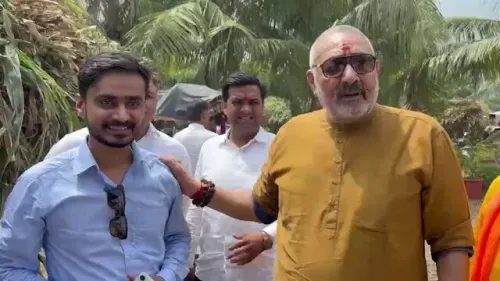
Union Textiles Minister Giriraj Singh on Thursday, 25 June 2026, highlighted how farmers in Thalakondapally, Telangana, have transformed their livelihoods through sericulture under the central government's Silk Samagra scheme, calling the village a model of the country's silk revolution.
Posting on X in Hindi, the Minister wrote: 'तेलंगाना के थालाकोंडापल्ली में कभी सीमित आय पर निर्भर किसान आज रेशम उत्पादन के माध्यम से नई पहचान और समृद्धि हासिल कर रहे हैं' — 'Farmers in Thalakondapally, Telangana, who once depended on limited income, are today achieving new identity and prosperity through silk production.' He added that training, technical support and guidance provided under the Silk Samagra scheme had not only raised farmer incomes but also created new opportunities for employment and development across the region.
Context
Thalakondapally is a village in Telangana where sericulture has been promoted as an alternative livelihood under centrally sponsored programmes. Singh's post credits the combined effort of a young local farmer's initiative, government support, and collective community action for the village's emergence as what he described as an example of a 'silk revolution' — 'रेशम क्रांति का उदाहरण'.
Telangana has been expanding its focus on sericulture as part of broader agricultural diversification, and centrally driven programmes have played a supporting role in that shift. The Minister's post underlines the state-level impact of a scheme administered from New Delhi.
Policy Backdrop
The Silk Samagra scheme was launched in 2017 by the Ministry of Textiles as a restructured, consolidated programme that brought together earlier sericulture initiatives. Its core objectives include expanding domestic raw silk production, reducing India's dependence on imported silk, and improving incomes for farming communities engaged in silk cultivation.
The scheme provides an integrated package — covering training, technology transfer and market linkage — aimed at making sericulture a viable primary or supplementary income source for rural households. Giriraj Singh, who has frequently spotlighted scheme outcomes in rural constituencies, has used social media to amplify on-ground results from multiple states.
Stakeholders and Impact
The primary beneficiaries highlighted in the Minister's post are sericulture farmers and rural youth in Thalakondapally. The broader pattern reflects the central government's strategy of promoting allied agricultural activities — such as sericulture, apiculture and fisheries — to supplement farm incomes beyond traditional crop cycles.
By showcasing a specific village, the communication also serves to demonstrate the reach of the Silk Samagra programme into Telangana, a state governed by a non-BJP administration, signalling that central scheme benefits are being delivered across political boundaries. Employment generation in rural areas remains a key metric for evaluating such programmes.
What's Next
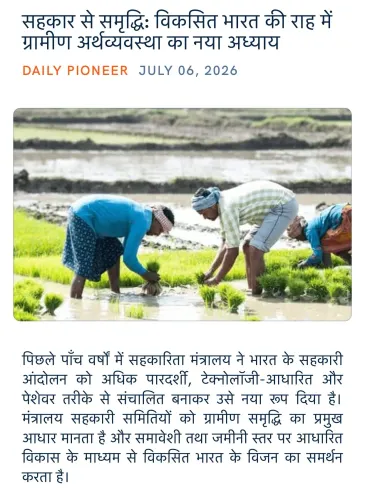
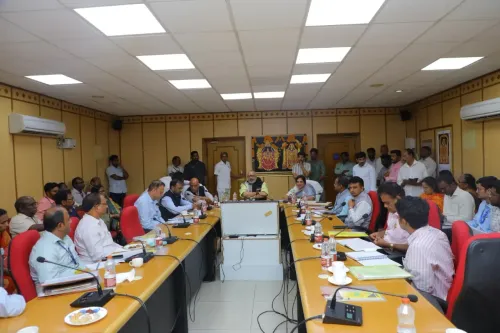
The Ministry of Textiles is expected to conduct its next annual review of Silk Samagra allocations and targets, which will offer a clearer picture of scheme coverage and outcomes at the national level. Any state-central coordination meetings on sericulture production targets for Telangana could further shape the trajectory of programmes like the one benefiting Thalakondapally.
As India seeks to boost its position as a global silk producer, village-level success stories are likely to inform future budget allocations and the scope of integrated textile welfare schemes.
Point of View
A non-BJP-governed state, allows the Centre to claim credit for scheme delivery across political lines, a recurring pattern in BJP's welfare messaging ahead of electoral cycles. The Silk Samagra spotlight also fits a broader textile-sector push to reduce import dependence and position India as a global silk hub, with farmer welfare as the public-facing rationale. Whether such posts translate into measurable budget gains for the scheme will be tested at the next Union Budget and annual Ministry review.
NationPress
24 Sept 2026
Frequently Asked Questions
What is the Silk Samagra scheme?
Silk Samagra is a central sector scheme launched in 2017 by India's Ministry of Textiles to develop the silk industry through integrated support — including training, technology transfer and financial assistance — for sericulture farmers.
What did Giriraj Singh say about Thalakondapally?
Union Textiles Minister Giriraj Singh said that farmers in Thalakondapally, Telangana, who once had limited income, are now achieving prosperity through silk production under the Silk Samagra scheme, calling the village an example of a 'silk revolution'.
Where is Thalakondapally and why is it in the news?
Thalakondapally is a village in Telangana, southern India. It is in the news because Union Textiles Minister Giriraj Singh cited it on 25 June 2026 as a model of sericulture-led rural transformation under the central government's Silk Samagra scheme.
How does sericulture help farmers in India?
Sericulture — the cultivation of silkworms for raw silk — provides farmers with a supplementary or primary income source. Central schemes like Silk Samagra offer training and technical support to make it a viable livelihood, particularly for small and marginal farmers.
What is India's goal for domestic silk production?
India aims to expand domestic raw silk output to reduce dependence on imported silk, particularly from China. The Silk Samagra scheme is one of the key policy instruments the Ministry of Textiles uses to achieve this goal by supporting farmers across silk-producing states.