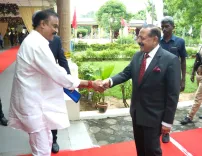
CM Joseph Vijay meets Australian Consulate-General at Secretariat

Synopsis
Chief Minister C. Joseph Vijay received a delegation from the Australian Consulate-General, South India, at the Tamil Nadu Secretariat on 22 October 2026, with Consul-General Silai Zaki leading talks that reflect deepening sub-national Australia-India engagement.
Key Takeaways
Joseph Vijay met the Australian Consulate-General delegation at the Tamil Nadu Secretariat on 22 October 2026 .
The delegation was led by Consul-General Tmt.
Silai Zaki , joined by two Deputy Consul-Generals and a Manager.
The Australian Consulate-General in Chennai covers Tamil Nadu and other southern states, focusing on investment, consular services, and people-to-people links.
The meeting builds on the India-Australia ECTA (2022) , which liberalised tariffs and boosted bilateral trade momentum.
Key sectors of mutual interest include education, technology, and critical minerals .
Any follow-up MoUs, trade missions, or education partnerships will indicate whether this meeting produces concrete outcomes.
Diplomacy walked into the Tamil Nadu Secretariat on Thursday, 22 October 2026, when a four-member delegation from the Australian Consulate-General, South India, called on Chief Minister C. Joseph Vijay — a meeting that underscores how sub-national ties between Indian states and Australia have grown well beyond occasional pleasantries into a steady drumbeat of engagement.
The delegation was led by Consul-General Tmt. Silai Zaki, accompanied by Deputy Consul-General Tmt. Katrina Knapp, Deputy Consul-General Thiru. Alexander Veneziano, and Manager Thiru. V. Karthikeyan. The meeting took place at the Secretariat in Chennai, the nerve centre of Tamil Nadu's administration.
Chennai as Australia's southern gateway
The Australian Consulate-General in Chennai covers Tamil Nadu and neighbouring southern states, serving as the primary node for consular services, investment promotion, and people-to-people connections in the region. Over the past decade, Australia has steadily expanded its diplomatic footprint in South India — a deliberate move reflecting the growing weight of the southern states in India's economic story.
That expansion has a firm policy foundation. The landmark India-Australia Economic Cooperation and Trade Agreement (ECTA), signed in 2022, liberalised tariffs across a broad range of goods and services, creating a faster lane for bilateral commerce. Tamil Nadu, with its diversified manufacturing base, strong IT services sector, and world-class engineering colleges, sits squarely in the crosshairs of Australian interest in sectors such as education, critical minerals, and technology.
The pattern behind the protocol
Indian states regularly host foreign consular delegations precisely because investment decisions and people-to-people partnerships increasingly bypass New Delhi and land directly at state capitals. For Australia, the calculus is straightforward: southern India's demographic dividend and industrial capacity make it a priority corridor.
Wednesday's meeting follows standard diplomatic practice, but the composition of the delegation — four officials, including the Consul-General herself — signals that Australia is treating the Tamil Nadu relationship as more than a courtesy call. Observers will now watch for any follow-up announcements: MoUs, trade missions, or formal education-linkage programmes between Tamil Nadu institutions and Australian counterparts would mark the meeting as a stepping stone rather than a standalone event.
The ball is now in Chennai's court — and Australia is clearly waiting for the return.
Point of View
A trend accelerated by the 2022 ECTA. For Australia, direct engagement with state governments bypasses federal bottlenecks and shortens the path to investment and education partnerships. The composition of the Consulate-General delegation — led by the top envoy for South India — suggests Canberra views Tamil Nadu as a priority corridor, not a box-ticking stop. Whether this translates into binding agreements will be the true measure of the meeting's weight.
NationPress
22 Oct 2026
Frequently Asked Questions
Who met CM Joseph Vijay from the Australian Consulate?
Consul-General Tmt. Silai Zaki led the delegation, which also included Deputy Consul-General Tmt. Katrina Knapp, Deputy Consul-General Thiru. Alexander Veneziano, and Manager Thiru. V. Karthikeyan.
Where did the meeting between CM Vijay and the Australian delegation take place?
The meeting took place at the Tamil Nadu Secretariat in Chennai on 22 October 2026.
What is the Australian Consulate-General South India?
It is Australia's consular mission based in Chennai that covers Tamil Nadu and surrounding southern states, handling consular services, trade promotion, and bilateral engagement.
What is the India-Australia ECTA and how does it affect Tamil Nadu?
The India-Australia Economic Cooperation and Trade Agreement, signed in 2022, liberalised tariffs on goods and services; Tamil Nadu's manufacturing, IT, and education sectors stand to benefit from the expanded trade framework.
What outcomes could follow from the CM Vijay-Australian Consulate meeting?
Observers are watching for potential MoUs, trade missions, or formal education-linkage programmes between Tamil Nadu institutions and Australian counterparts as possible follow-up actions.