CM Vijay Orders 231 New Substations, 15,058 Power Staff for Tamil Nadu
Synopsis
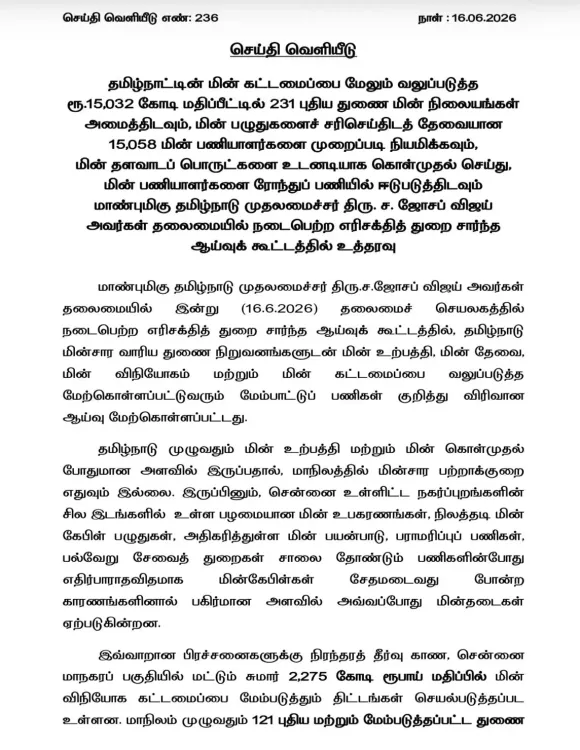
Chief Minister Joseph Vijay has ordered 231 new sub-stations at Rs 15,032 crore, formal appointment of 15,058 electricity workers, and immediate equipment procurement to strengthen Tamil Nadu's power infrastructure, following an Energy Department review meeting on 16 June 2026.
Key Takeaways
231 new sub-stations are to be constructed across Tamil Nadu at an estimated cost of Rs 15,032 crore .
15,058 electricity personnel will be formally appointed to handle fault repairs and field operations.
Immediate procurement of electrical equipment and deployment of workers on patrol duty were also ordered.
The decisions were taken at an Energy Department review meeting chaired by CM Joseph Vijay on 16 June 2026 .
TANGEDCO is the state utility responsible for implementing these capital works and recruitment drives.
The move is aimed at reducing outage durations and improving fault-response times for consumers across the state.
The Chief Minister's Office of Tamil Nadu announced on Tuesday, 16 June 2026 that Chief Minister Joseph Vijay has directed the construction of 231 new substations at an estimated cost of Rs 15,032 crore and the formal appointment of 15,058 electricity workers to strengthen the state's power infrastructure — decisions taken at a high-level Energy Department review meeting chaired by the Chief Minister.
Context
The directives emerged from an energy-sector review meeting presided over by CM Joseph Vijay. The post, published in Tamil, states that the meeting ordered the establishment of 231 new sub-stations worth Rs 15,032 crore, the regular appointment of 15,058 electricity personnel to handle fault repairs, and the immediate procurement of electrical equipment alongside the deployment of power workers on patrol duty.
The instructions cover three distinct operational priorities: capital infrastructure expansion, human resource regularisation, and immediate field-level readiness — a combination that signals both long-term planning and short-term crisis preparedness.
Policy Backdrop
Tamil Nadu has a long history of periodic substation augmentation and transmission-strengthening schemes, particularly to reduce aggregate technical and commercial losses. The state utility, TANGEDCO (Tamil Nadu Generation and Distribution Corporation), is the implementing agency for such capital works and recruitment drives.
Southern states have repeatedly invested in transmission and distribution upgrades to accommodate rising industrial demand and the integration of variable renewable energy sources. Such high-level reviews are often triggered by monsoon-related outages or summer peak-load pressures that expose gaps in the existing grid.
The scale of this announcement — over Rs 15,000 crore in substation investment combined with the appointment of more than 15,000 field personnel — places it among the larger single-round power infrastructure decisions in the state's recent history.
Stakeholders and Impact
The primary beneficiaries are Tamil Nadu's electricity consumers, who stand to gain from reduced outage durations and improved fault-response times once the new substations are commissioned and the additional workforce is deployed. Industrial clusters, agricultural pump-set users, and urban residential areas are all expected to see improved supply reliability.
The 15,058 electricity workers to be formally appointed represent a significant regularisation of the power sector workforce. Patrol duty deployment of these personnel is intended to enable proactive identification and faster rectification of faults before they escalate into prolonged outages.
Equipment suppliers and civil contractors stand to benefit from the procurement and construction activity that the 231 substation project will generate across the state.
What's Next
Attention will now turn to TANGEDCO board meetings and subsequent state budget documents for tendering timelines on the 231 substations and the phased schedule for on-boarding the 15,058 recruits. The pace of procurement of electrical materials — explicitly ordered to be 'immediate' — will be an early indicator of execution intent.
If implemented on schedule, the combined investment and workforce expansion could materially improve Tamil Nadu's distribution infrastructure ahead of the next summer peak-load season, setting a benchmark for power-sector governance among southern states.
Point of View
Workforce regularisation, and immediate field deployment — suggest the Vijay administration is responding to mounting public pressure over power reliability rather than executing a routine upgrade cycle. Bundling a Rs 15,032 crore infrastructure announcement with a 15,058-strong recruitment order in a single review meeting is a deliberate political signal of decisive governance. For TANGEDCO, the challenge will be translating cabinet-room urgency into procurement and tendering speed, an area where state utilities have historically lagged. How quickly tenders are floated and appointments notified will determine whether this announcement becomes a policy milestone or a deferred promise.
NationPress
15 Sept 2026
Frequently Asked Questions
How many new substations will be built in Tamil Nadu?
231 new sub-stations are to be constructed across Tamil Nadu as ordered by Chief Minister Joseph Vijay at an Energy Department review meeting on 16 June 2026 .
What is the cost of Tamil Nadu's new substation project?
The 231 new sub-stations have been estimated to cost Rs 15,032 crore , making it one of the larger single-round power infrastructure investments in the state's recent history.
How many electricity workers will be appointed in Tamil Nadu?
15,058 electricity personnel are to be formally appointed to carry out fault repairs and patrol duties across the state's power distribution network.
Which agency will implement Tamil Nadu's substation expansion?
TANGEDCO (Tamil Nadu Generation and Distribution Corporation), the state-owned power utility, is the implementing agency for both the substation construction and the recruitment of electricity workers.
Why is Tamil Nadu building new substations?
The expansion is aimed at strengthening the state's power grid to reduce outages, handle rising industrial and residential demand, and improve fault-response times, particularly during peak-load and monsoon seasons.