CM Vishnu Deo Sai backs 'Hasdev Brand' to empower SHG women
Synopsis
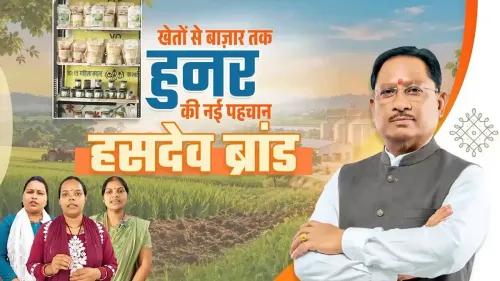
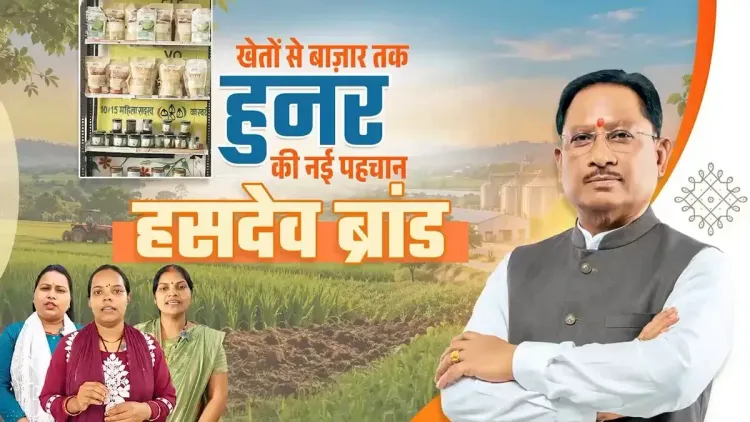
Chhattisgarh CM Vishnu Deo Sai spotlighted the 'Hasdev Brand' on 27 October 2026, calling it a meaningful push to brand and market SHG women's products, as the state rolls out multiple district-level livelihood initiatives for rural and tribal women.
Key Takeaways
CM Vishnu Deo Sai publicly endorsed the 'Hasdev Brand' as a flagship self-help group initiative on 27 October 2026 .
The brand aims to improve market linkages for products made by women in Chhattisgarh's self-help groups.
CM Sai stated that similar district-level initiatives are taking shape across the state simultaneously.
The initiative aligns with the Deendayal Antyodaya Yojana – National Rural Livelihoods Mission (DAY-NRLM) , launched nationally in 2011 .
The CM framed women's self-reliance as the foundational driver of family and community progress in Chhattisgarh.
When a family's women stand on their own feet, the whole household moves forward — and Chhattisgarh Chief Minister Vishnu Deo Sai is putting state machinery behind that conviction. On Tuesday, 27 October 2026, the CM highlighted the 'Hasdev Brand' initiative, framing it as a concrete step toward turning self-help group women's skills into sustainable livelihoods across the state.
Writing in Hindi on X, CM Sai said: 'हमारी महतारी-बहनों की आत्मनिर्भरता से ही परिवार की प्रगति को नई ताकत मिलती है' — 'It is the self-reliance of our mothers and sisters that gives new strength to family progress.' He added that the state's 'good governance' administration is working to sharpen women's skills through self-help groups and create opportunities for their advancement, calling the 'Hasdev Brand' a meaningful initiative in that direction.
What the Hasdev Brand signals for Chhattisgarh's SHG economy
The Hasdev Brand sits within a well-established national framework: India's Deendayal Antyodaya Yojana – National Rural Livelihoods Mission (DAY-NRLM), launched in 2011, has spent over a decade scaling self-help groups into economic units for rural and tribal women. The logic is straightforward — skill training alone doesn't translate to income unless products find buyers. Branding and market linkages close that gap.
Chhattisgarh's move to attach a distinct regional identity — the Hasdev name, drawn from one of the state's significant river basins — to SHG products follows a pattern other Indian states have used to lift group-made goods out of local haats and into wider retail and institutional markets. It signals an intent to position these products as a coherent, recognisable line rather than a loose collection of cottage-industry output.
The wider push: district-level initiatives taking shape across the state
CM Sai indicated that similar efforts are multiplying across Chhattisgarh, with women 'carving new paths to self-reliance through hard work and skill.' That framing — multiple simultaneous district-level pilots rather than a single centralised scheme — suggests the government is testing branding and market models in parallel, looking for what scales.
Rural women's self-help groups have historically been among the more durable vehicles for women's economic participation in central India, where tribal and agrarian communities often lack access to formal employment. A government-backed brand can accelerate access to procurement programmes, e-commerce platforms, and institutional buyers — links that individual groups rarely build on their own.
The proof, as always, will be in the market numbers: how many groups get onboarded, which product categories carry the Hasdev label, and whether distribution reaches beyond the state's borders. That audit is still ahead. But the political signal today is clear — in Sai's Chhattisgarh, women's economic agency is being positioned as the engine of family and community progress, not an afterthought to it.
Point of View
But its real test will be distribution reach and revenue data for member groups. The emphasis on multiple simultaneous district-level pilots reflects a standard BJP state-government playbook: seed many initiatives, then amplify whichever gains traction. For the DAY-NRLM architecture, a state government putting visible political capital behind SHG market linkages is generally a positive accelerant — but only if procurement and e-commerce integration follows the optics.
NationPress
27 Oct 2026
Frequently Asked Questions
What is the Hasdev Brand in Chhattisgarh?
The Hasdev Brand is a Chhattisgarh government initiative to give a unified market identity to products made by women in self-help groups (SHGs), helping them access wider retail and institutional buyers. CM Vishnu Deo Sai described it as a meaningful step toward women's self-reliance on 27 October 2026.
What are self-help groups and how do they work in Chhattisgarh?
Self-help groups (SHGs) are small community collectives — usually of rural or tribal women — that pool savings, access credit, and produce goods or services together. In Chhattisgarh, they operate under the national DAY-NRLM framework launched in 2011, which provides skill training and market linkage support.
What is DAY-NRLM and why does it matter for women in Chhattisgarh?
The Deendayal Antyodaya Yojana – National Rural Livelihoods Mission (DAY-NRLM) was launched in 2011 to scale self-help groups across rural India as vehicles for women's economic empowerment. It funds skill training, credit access, and market linkages — the backbone on which state-level initiatives like the Hasdev Brand build.
Who is Vishnu Deo Sai and what is his role in Chhattisgarh?
Vishnu Deo Sai is the Chief Minister of Chhattisgarh and a BJP leader. He took office in December 2023 and has focused on rural welfare and women's livelihood schemes as key pillars of his administration's identity.
How does the Hasdev Brand help SHG women earn more?
By attaching a consistent regional brand identity to SHG products, the initiative aims to improve product visibility and credibility in markets beyond local haats, potentially unlocking access to e-commerce platforms, government procurement, and institutional buyers — channels that individual groups typically cannot access on their own.