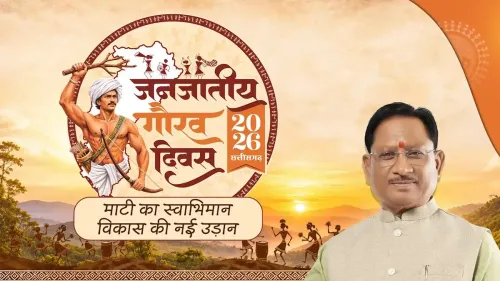
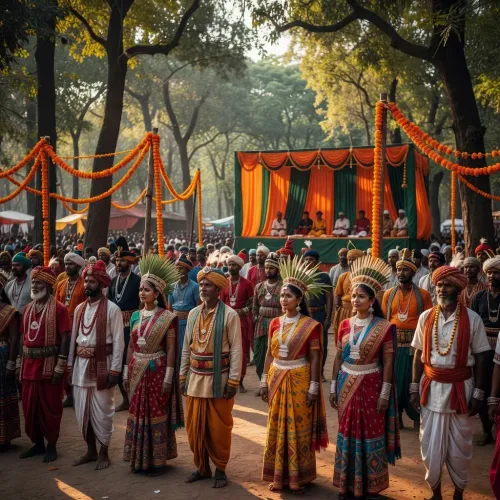
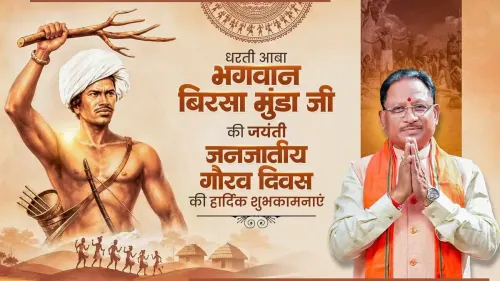
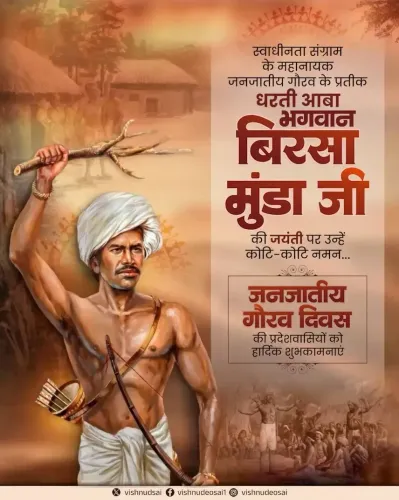
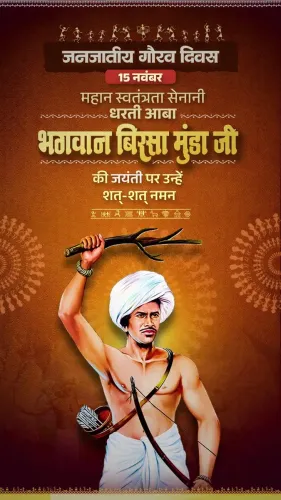
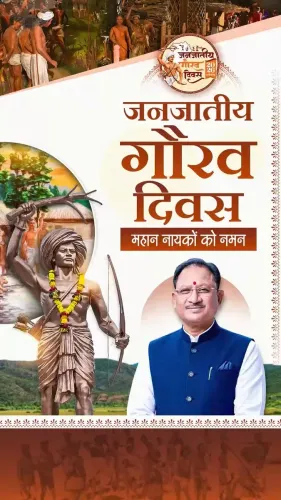
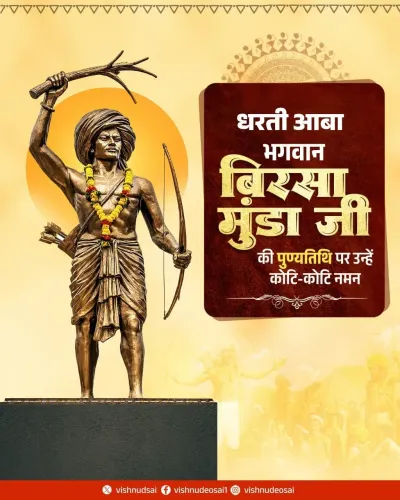
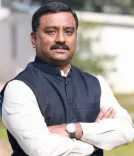
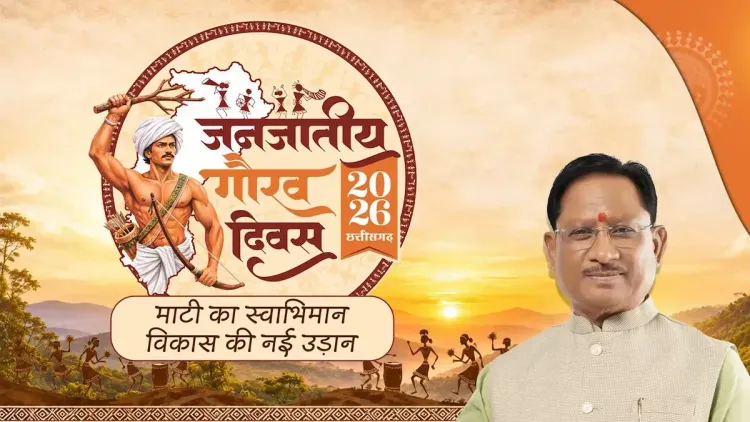
CM Vishnu Deo Sai honours Birsa Munda on Janjatiya Gaurav Diwas
Synopsis
On Janjatiya Gaurav Diwas, Chhattisgarh CM Vishnu Deo Sai paid tribute to Bhagwan Birsa Munda and Veer Narayan Singh, pledging that every tribal family in the state connects to education and development opportunities.
Key Takeaways
15 November is observed as Janjatiya Gaurav Diwas nationally, marking Bhagwan Birsa Munda's birth anniversary — a day institutionalised by the Government of India in 2021 .
Chhattisgarh CM Vishnu Deo Sai named both Birsa Munda and Veer Narayan Singh as inspirational martyrs for the state's tribal communities.
Veer Narayan Singh was a 19th-century Chhattisgarh tribal chieftain executed by the British in Raipur in 1857 .
CM Sai pledged to link every tribal family to opportunities in education, prosperity, and development while preserving tribal culture and traditions.
Chhattisgarh has one of India's highest Scheduled Tribe population shares, making tribal welfare messaging central to the state's political landscape.
The post closed with 'Jai Johar' , a traditional Gondi greeting, underscoring the cultural register of the tribute.
On the birth anniversary of Bhagwan Birsa Munda — the tribal freedom fighter revered as Dharti Aaba (Father of the Earth) — Chhattisgarh Chief Minister Vishnu Deo Sai invoked the state's deep tribal identity and pledged that every tribal family must be connected to new opportunities in education, prosperity, and development. The message, shared on 15 November 2026, coincides with the national observance of Janjatiya Gaurav Diwas.
Posting in Hindi, CM Sai wrote: 'Chhattisgarh's identity is tied to the rich culture, glorious traditions, and self-respect of our tribal society. The struggle and sacrifice of great heroes like Dharti Aaba Bhagwan Birsa Munda and Shaheed Veer Narayan Singh are our inspiration.' He closed with the traditional Gondi salutation 'Jai Johar!' — a greeting that carries particular weight on this day.
Who Janjatiya Gaurav Diwas honours — and why 15 November
Birsa Munda, born on 15 November 1875 in present-day Jharkhand, led the Ulgulan (Great Tumult) — an armed uprising of the Munda tribe against British land-grab policies and forced labour. He died in British custody in 1900 at the age of just 25, becoming one of the youngest and most celebrated faces of India's tribal resistance. The Government of India declared 15 November as Janjatiya Gaurav Diwas in 2021, institutionalising his birth anniversary as a national day to honour tribal contributions to the independence movement.
Veer Narayan Singh, the other hero named by CM Sai, is a homegrown Chhattisgarh symbol — a 19th-century tribal chieftain who led resistance against British rule and was publicly executed in Raipur in 1857, the same year as the Sepoy Mutiny. His name alongside Birsa Munda's signals Chhattisgarh's intent to anchor the day in its own martyrdom narrative, not just the national one.
Chhattisgarh's tribal population and what the pledge means
Chhattisgarh is among India's states with the highest proportion of Scheduled Tribe residents — tribal communities make up roughly a third of the state's population, spread across its forested central and northern belts. For the BJP-led state government, Janjatiya Gaurav Diwas is both a cultural moment and a political one: annual commemorations are routinely paired with welfare messaging around education and livelihood schemes aimed at tribal constituencies.
CM Sai's pledge — that tribal families be connected to 'new opportunities' in education and development — follows the pattern of cultural recognition tied to development promises that has defined BJP governance in tribal-majority states. The specifics of any state programmes announced around 15 November 2026 remain to be detailed in formal government communications.
With 'Jai Johar' echoing from the CM's office and hashtags #JanjatiyaGauravDiwas and #JanjatiyaGauravDiwasCG trending, Chhattisgarh's tribal communities are at the centre of the national conversation today — exactly where their leaders insist they belong.
Point of View
CM Sai threads a dual narrative: aligning Chhattisgarh with the Centre's tribal-recognition agenda while asserting the state's own martyrdom legacy. This is consistent with BJP's broader strategy of converting cultural commemoration into a durable political bond with tribal electorates — a constituency that proved decisive in Chhattisgarh's 2023 assembly elections. The developmental promise embedded in the tribute — education, prosperity, inclusion — signals that Janjatiya Gaurav Diwas is evolving from a symbolic day into a platform for welfare delivery messaging. How the state government translates that pledge into specific programme announcements will be the real test of this year's observance.
NationPress
15 Nov 2026
Frequently Asked Questions
What is Janjatiya Gaurav Diwas and when is it celebrated?
Janjatiya Gaurav Diwas is a national observance held every year on 15 November , the birth anniversary of tribal freedom fighter Bhagwan Birsa Munda . The Government of India declared it in 2021 to honour tribal contributions to India's independence movement.
Who was Bhagwan Birsa Munda?
Bhagwan Birsa Munda , born on 15 November 1875 , was a tribal freedom fighter from present-day Jharkhand revered as Dharti Aaba (Father of the Earth). He led the Ulgulan uprising against British land and labour policies and died in British custody in 1900 at age 25.
Who was Veer Narayan Singh of Chhattisgarh?
Veer Narayan Singh was a 19th-century tribal chieftain from Chhattisgarh who led resistance against British rule. He was publicly executed in Raipur in 1857 and is considered one of the state's foremost tribal martyrs.
What did Chhattisgarh CM Vishnu Deo Sai say on Janjatiya Gaurav Diwas 2026?
CM Vishnu Deo Sai paid tribute to Birsa Munda and Veer Narayan Singh , described Chhattisgarh's identity as rooted in tribal culture and self-respect, and pledged that every tribal family would be connected to new opportunities in education, prosperity, and development .
What is the tribal population share in Chhattisgarh?
Chhattisgarh has one of India's highest proportions of Scheduled Tribe residents, with tribal communities accounting for roughly a third of the state's total population, concentrated in its forested central and northern regions.