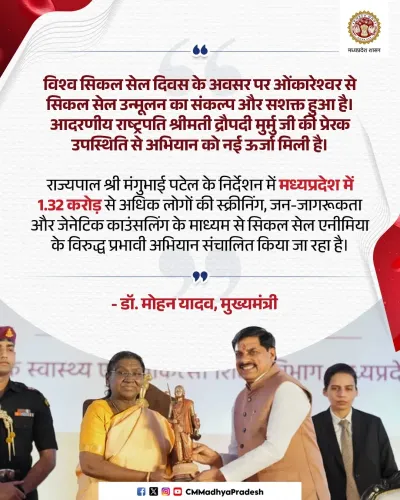
CM Mohan Yadav Backs Sickle Cell Mission, Quotes President Murmu

Synopsis
Madhya Pradesh CM Dr. Mohan Yadav amplified President Draupadi Murmu's vision for India's National Sickle Cell Anaemia Elimination Mission on 19 June 2026, highlighting its three pillars: pre-marital genetic counselling, mass screening, and continuous healthcare management targeting tribal communities by 2047.
Key Takeaways
Mohan Yadav shared President Draupadi Murmu's remarks on the National Sickle Cell Anaemia Elimination Mission on 19 June 2026 .
President Murmu identified three mission pillars: large-scale awareness and pre-marital genetic counselling ; comprehensive early screening ; and holistic, continuous healthcare management .
The mission was announced in Union Budget 2023 targeting screening of 7 crore people across 17 states by 2047 .
Madhya Pradesh is among the highest-prevalence states, with tribal communities bearing a disproportionate disease burden.
Integration with Ayushman Bharat digital health records is a key anticipated next step for state-level implementation.
Madhya Pradesh Chief Minister Dr. Mohan Yadav on Friday, 19 June 2026 shared remarks by President Draupadi Murmu outlining the three core pillars of India's National Sickle Cell Anaemia Elimination Mission, amplifying the Centre's push to eradicate the hereditary blood disorder by 2047.
Context
The post, shared from Dr. Yadav's official X account, quotes President Murmu as saying she was 'moved by the vision of this mission' and went on to enumerate its three principal dimensions: large-scale awareness and pre-marital genetic counselling; comprehensive screening for early disease detection; and ensuring continuity of healthcare through holistic management. The original remarks were delivered by Rashtrapati Smt. Draupadi Murmu ji at an event associated with the mission, though the precise venue and date of her address have not been independently confirmed.
Chief Minister Yadav's decision to amplify the President's words signals Madhya Pradesh's active alignment with the national programme, which holds particular significance for the state given its large tribal population — one of the communities most affected by sickle cell disease across central India.
Policy Backdrop
The National Sickle Cell Anaemia Elimination Mission was announced in the Union Budget 2023 with a mandate to screen 7 crore people across 17 high-prevalence states by 2047. The programme targets hemoglobinopathies — inherited blood disorders disproportionately concentrated in tribal communities of central and eastern India, including Madhya Pradesh, Chhattisgarh, Jharkhand, and Odisha.
India's National Health Policy 2017 had already identified early detection of genetic blood disorders as a priority, but the 2023 mission gave the effort a dedicated institutional framework, budget allocation, and a clear elimination timeline. Pre-marital genetic counselling — the first pillar cited by President Murmu — is seen as the most upstream intervention, aiming to reduce new incidence at the community level before birth.
Stakeholders and Impact
The mission's primary beneficiaries are tribal communities and patients living with sickle cell disease, a condition that causes chronic pain, organ damage, and shortened life expectancy. In Madhya Pradesh alone, tribal groups such as the Gondi, Bhil, and Baiga communities carry elevated carrier rates, making the state a critical implementation zone for both screening camps and follow-up care.
Healthcare workers, district hospitals, and Ayushman Bharat digital health infrastructure are expected to be the delivery backbone. Integration of screening data with digital health records would allow continuous monitoring of at-risk individuals — the 'continuity of healthcare' dimension that President Murmu highlighted as the mission's third pillar.
What's Next
Observers will watch whether Madhya Pradesh accelerates state-level rollout of pre-marital screening camps and formally links outcomes to the Ayushman Bharat Digital Health Mission records system. The Chief Minister's public endorsement of the presidential address may also precede a state-level policy announcement or campaign launch targeting tribal districts. With 2047 as the elimination deadline, the next two years are widely regarded as decisive for building the screening and counselling infrastructure needed to meet the target.
Point of View
CM Yadav is doing more than signal solidarity with a central programme — he is staking a visible political claim on a health issue that directly affects Madhya Pradesh's large tribal electorate. The three-pillar structure the President outlined mirrors a shift in Indian public health from reactive treatment to upstream genetic intervention, a relatively new frontier for state governments. Madhya Pradesh's early and vocal alignment could position it as a model implementation state, inviting both central funding and scrutiny over delivery timelines. The broader arc here is the BJP's effort to demonstrate welfare outreach to tribal communities ahead of future electoral cycles in central India.
NationPress
19 Sept 2026
Frequently Asked Questions
What is the National Sickle Cell Anaemia Elimination Mission?
It is a central government programme announced in the Union Budget 2023 to screen 7 crore people across 17 high-prevalence states and eliminate sickle cell disease in India by 2047, with a focus on tribal communities.
Why did CM Mohan Yadav share President Murmu's remarks on sickle cell disease?
CM Yadav shared the remarks to amplify the mission's vision and signal Madhya Pradesh's alignment with the national programme, which is especially relevant given the state's large tribal population that carries elevated sickle cell carrier rates.
What are the three pillars of the sickle cell mission mentioned by President Murmu?
President Murmu outlined: first, large-scale awareness and pre-marital genetic counselling; second, comprehensive screening for early disease detection; and third, ensuring continuity of care through holistic healthcare management.
Which communities are most affected by sickle cell disease in Madhya Pradesh?
Tribal communities including the Gondi, Bhil, and Baiga groups in Madhya Pradesh carry elevated sickle cell carrier rates, making them the primary target population for the mission's screening and counselling efforts.
How does Ayushman Bharat connect to the sickle cell mission?
Integration of sickle cell screening data with Ayushman Bharat digital health records is expected to enable continuous monitoring of at-risk individuals and ensure long-term healthcare follow-up across the state.