CM Mohan Yadav cites 76% women, 40% Muslim support in MP assembly
Synopsis
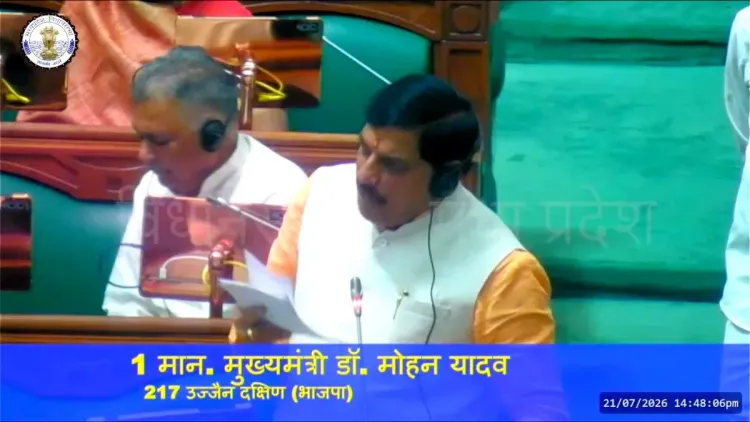
Madhya Pradesh CM Dr. Mohan Yadav told the Vidhan Sabha on 22 July 2026 that 76 per cent of women including Muslim women, and over 40 per cent of Muslim men, support a measure under legislative discussion — framing the figures as a mirror of ground-level consensus.
Key Takeaways
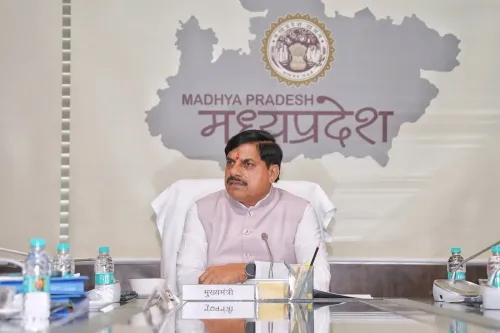
Mohan Yadav , Chief Minister of Madhya Pradesh , cited support figures for a legislative measure in the Vidhan Sabha on 22 July 2026 .
He claimed 76 per cent of women — including Muslim women — back the measure under discussion.
He also stated that over 40 per cent of Muslim men support the initiative.
The statement was made under the hashtag #VidhanSabhaMP , indicating an active assembly session context.
The BJP has a pattern since 2019 of citing Muslim women's support for personal-law reforms to counter majoritarianism allegations.
The specific bill or policy referred to was not named explicitly in the Chief Minister's post.
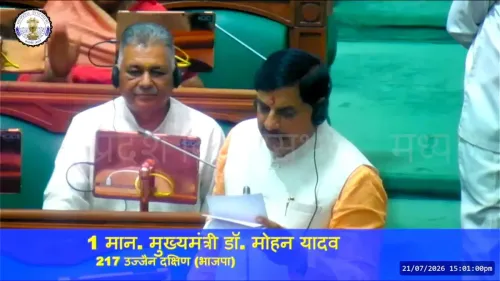
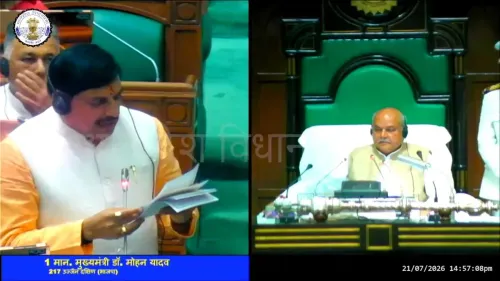
Madhya Pradesh Chief Minister Dr. Mohan Yadav on Wednesday, 22 July 2026, cited survey figures in the Madhya Pradesh Vidhan Sabha claiming that 76 per cent of women — including Muslim women — and over 40 per cent of Muslim men support a policy or legislative measure under discussion, calling the numbers a reflection of ground-level sentiment.
Context
Speaking in what appears to be a legislative session under the hashtag #VidhanSabhaMP, Dr. Yadav stated — '76% माता-बहनों और मुस्लिम बहनों ने अगर इसका समर्थन किया है, तो यह अपने आप में आईना बताने के बराबर है' — meaning, 'If 76 per cent of mothers, sisters, and Muslim sisters have supported this, it is in itself equivalent to holding up a mirror.' He added that more than 40 per cent of Muslim men also back the measure.
The Chief Minister framed the figures as self-evident proof of the initiative's cross-community acceptance, using the metaphor of a mirror to suggest the data speaks for itself without need for further argument.
Policy Backdrop
The BJP-led government in Madhya Pradesh has a documented record of anchoring personal-law and social-reform legislation in the language of women's protection. The state enacted the Prohibition of Unlawful Conversion of Religion Act in 2020, and the BJP at the national level passed the Muslim Women (Protection of Rights on Marriage) Act 2019, which banned instant triple talaq.
Since 2019, citing opinion data or surveys showing support among Muslim women for personal-law reforms has become a recurring feature of legislative sessions and election campaigns across Hindi-heartland states. The gender-justice framing is used to counter accusations of majoritarianism and to signal outreach beyond the party's core voter base.
Dr. Yadav assumed office in December 2023, succeeding Shivraj Singh Chouhan, and has continued this legislative and messaging tradition in the assembly.
Stakeholders and Impact
Muslim women are the central stakeholders invoked in Dr. Yadav's remarks, positioned as primary beneficiaries of the measure in question. The inclusion of Muslim men's support — cited at over 40 per cent — broadens the claim of consensus beyond gender lines.
Women voters across communities in Madhya Pradesh have been a focus of BJP outreach since the state assembly elections. Citing multi-community support data in a legislative forum reinforces that political calculus while also placing the measure on record in the Vidhan Sabha.
What's Next
Observers will watch the Madhya Pradesh Vidhan Sabha session closely for the specific bill or policy instrument to which these support figures are attributed, as the Chief Minister's statement did not name the measure explicitly in the post. Any state-level movement toward Uniform Civil Code provisions or amendments to existing personal-law-adjacent legislation would be consistent with the trajectory suggested by this statement.
The figures cited by Dr. Yadav are likely to be contested or scrutinised by opposition parties in the assembly, making the source and methodology of the survey a key point of debate in the coming days.
Point of View
Not merely a social media statement — it places a political claim where it can be officially cited and challenged. The BJP's consistent use of Muslim women's endorsement as a shield against majoritarianism charges has deepened since the triple talaq legislation of 2019, and Yadav is clearly extending that playbook to the state level. The 40 per cent Muslim male support figure is the more politically significant claim, as it attempts to neutralise the narrative that the party's social-reform agenda divides communities along religious lines. How the opposition responds in the assembly — and whether the source data for these figures is tabled — will determine whether this becomes a policy milestone or a contested talking point.
NationPress
21 Oct 2026
Frequently Asked Questions
What did MP CM Mohan Yadav say in the Vidhan Sabha on 22 July 2026?
Dr. Mohan Yadav stated that 76 per cent of women including Muslim women, and more than 40 per cent of Muslim men, support a measure being discussed in the Madhya Pradesh Vidhan Sabha, describing the figures as a mirror of public sentiment.
Which policy or bill did Mohan Yadav refer to in his Vidhan Sabha statement?
The Chief Minister did not name the specific bill or policy explicitly in his public statement; the measure is under discussion in the ongoing Madhya Pradesh assembly session tagged #VidhanSabhaMP.
Why does the BJP cite Muslim women's support for its policies?
Since the Muslim Women (Protection of Rights on Marriage) Act 2019 that banned instant triple talaq, the BJP has consistently cited Muslim women's backing for personal-law and welfare reforms to counter accusations of majoritarianism and to demonstrate cross-community appeal.
What is the BJP's record on Muslim women's legislation in Madhya Pradesh?
Madhya Pradesh under BJP governance enacted the Prohibition of Unlawful Conversion of Religion Act in 2020, framed as protection for women from coercion, and has aligned with the central government's triple talaq ban as part of a broader gender-justice legislative agenda.
What should we watch for after Mohan Yadav's Vidhan Sabha statement?
Key things to watch include the identification of the specific bill these support figures relate to, any tabling of survey methodology in the assembly, opposition responses, and potential state-level moves toward Uniform Civil Code provisions in Madhya Pradesh.