CM Mohan Yadav Hails PM Modi's Indo-Pacific Maritime Pact With New Zealand
Synopsis
During PM Modi's visit to New Zealand, India agreed on an Indo-Pacific maritime cooperation framework covering bilateral naval exercises, logistics support, and hydrography. Madhya Pradesh CM Dr. Mohan Yadav shared the announcement, highlighting the pact's role in boosting operational coordination between the two nations.
Key Takeaways
India and New Zealand agreed on a framework for maritime cooperation in the Indo-Pacific during PM Narendra Modi's visit to New Zealand.
The framework covers three pillars: bilateral naval exercises , logistics support , and hydrography .
Madhya Pradesh CM Dr.
Mohan Yadav shared the announcement on 11 July 2026 , quoting PM Modi directly.
The agreement extends India's long-standing Indo-Pacific maritime strategy, first articulated at the 2018 Shangri-La Dialogue .
The Indian Navy and the Royal New Zealand Navy are the primary institutional beneficiaries of enhanced interoperability.
A formal MoU or joint statement detailing the framework's scope and exercise schedules is anticipated following the visit.
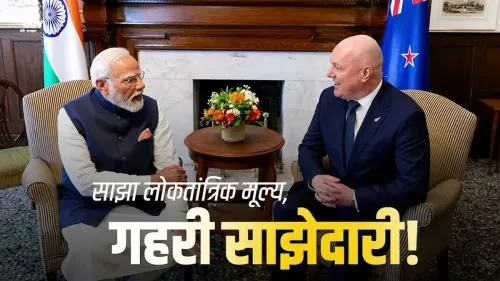
Madhya Pradesh Chief Minister Dr. Mohan Yadav on Saturday, 11 July 2026, shared a statement attributed to Prime Minister Narendra Modi announcing that India and New Zealand had reached agreement on a framework for maritime cooperation in the Indo-Pacific, citing advances in bilateral naval exercises, logistics support, and hydrography.
Context
Quoting PM Modi directly, CM Dr. Mohan Yadav wrote: 'आज हमने Indo-Pacific में Maritime Cooperation के लिए एक Framework पर सहमति बनाई है' ['Today we have reached agreement on a framework for Maritime Cooperation in the Indo-Pacific']. The post, shared from Dr. Yadav's official handle, was tagged #PMModiinNewzealand, indicating the announcement came during a high-level visit by the Prime Minister to New Zealand.
The framework, as quoted, covers three pillars: bilateral naval exercises, logistics support, and hydrography. Together, these are designed to improve operational coordination and maritime domain awareness between the two countries.
Policy Backdrop
India's Indo-Pacific maritime engagement has deep roots. At the 2018 Shangri-La Dialogue, PM Modi outlined India's vision for an open, free, and inclusive Indo-Pacific, emphasising rules-based order and cooperative security at sea. Since then, India has steadily expanded its network of bilateral defence arrangements across the region, covering logistics access agreements, joint patrols, and hydrographic data sharing.
New Zealand, as an Indo-Pacific nation with significant maritime interests, fits squarely into this strategic outreach. India has pursued similar frameworks with partners sharing concerns about sea-lane security and freedom of navigation, and the New Zealand agreement represents a further extension of this consistent pattern.
Stakeholders and Impact
The primary institutional beneficiary is the Indian Navy, which stands to gain enhanced access to logistics infrastructure and improved interoperability with the Royal New Zealand Navy through structured joint exercises. Hydrographic cooperation will contribute to more accurate maritime charting and improved situational awareness across shared waters.
For New Zealand, the framework deepens its engagement with one of the Indo-Pacific's largest naval powers at a time when regional sea-lane security is a shared priority. Broader regional partners and multilateral groupings focused on Indo-Pacific stability will also be watching the operationalisation of this framework closely.
What's Next
Attention will now turn to the release of any joint statement or formal Memorandum of Understanding text from the New Zealand leg of PM Modi's visit, which would detail the specific scope and timelines of the agreed framework. Follow-on announcements regarding the schedule of bilateral naval exercises and the modalities of logistics and hydrographic cooperation are expected in the weeks ahead.
The agreement, if formalised through a published MoU, would mark a significant step in India's effort to build a dense web of maritime partnerships across the Indo-Pacific — one that complements its existing multilateral commitments and reinforces its position as a net security provider in the region.
Point of View
Institution-building, and deliberately low-friction. By anchoring cooperation in naval exercises, logistics, and hydrography rather than a sweeping defence treaty, New Delhi keeps the partnership palatable for Wellington while locking in practical interoperability gains. CM Yadav amplifying a foreign-policy milestone from his state-level platform reflects the BJP's deliberate effort to align regional leaders with the Centre's diplomatic narrative. The broader arc is clear: India is methodically filling in the map of bilateral maritime arrangements, and the New Zealand agreement is another node in that network.
NationPress
10 Oct 2026
Frequently Asked Questions
What did India and New Zealand agree on during PM Modi's visit?
India and New Zealand agreed on a framework for maritime cooperation in the Indo-Pacific, covering bilateral naval exercises, logistics support, and hydrography, aimed at improving operational coordination between the two countries.
What is the Indo-Pacific maritime framework India signed with New Zealand?
The framework is a bilateral agreement that structures cooperation across three areas: joint naval exercises, mutual logistics support, and hydrographic collaboration, designed to enhance maritime domain awareness and interoperability.
Why did Madhya Pradesh CM Mohan Yadav post about India-New Zealand maritime cooperation?
CM Dr. Mohan Yadav shared a quote attributed to PM Modi to highlight the diplomatic achievement during the Prime Minister's New Zealand visit, amplifying the Centre's foreign policy messaging from his state-level platform.
What is India's Indo-Pacific maritime strategy?
India has pursued an Indo-Pacific maritime strategy since at least the 2018 Shangri-La Dialogue, focusing on open seas, rules-based order, and building a network of bilateral defence and logistics agreements with regional partners to improve sea-lane security and interoperability.
What happens next after the India-New Zealand maritime cooperation framework?
A formal joint statement or Memorandum of Understanding is expected to be released detailing the framework's scope and timelines, followed by scheduled bilateral naval exercises and the operationalisation of logistics and hydrographic cooperation.