Odisha CMO: Jagannath Temple land records corrected in Satyabadi, Khordha, Pipili
Synopsis
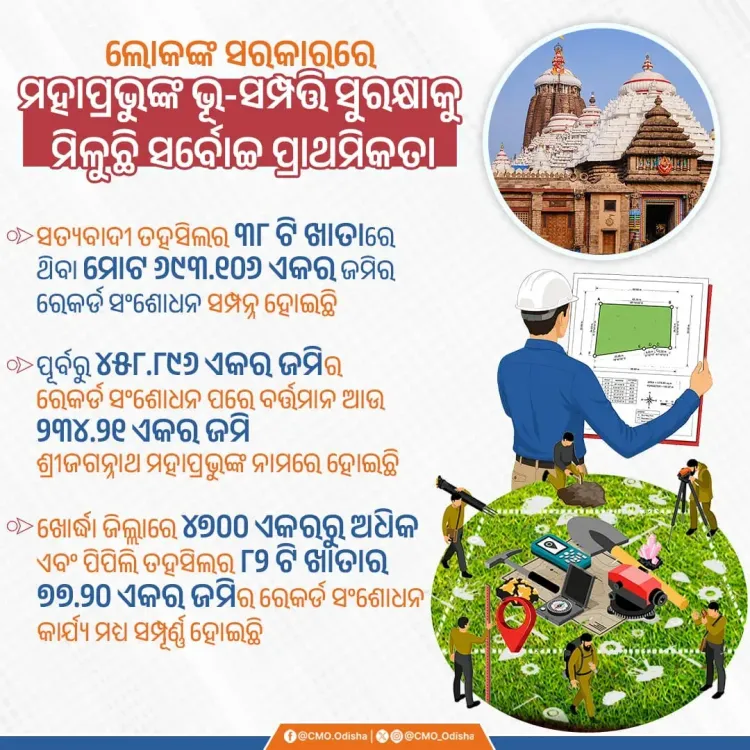
The Chief Minister's Office of Odisha has announced the completion of land record corrections for Mahaprabhu Shri Jagannath's properties in Satyabadi tehsil (693.106 acres), Khordha, and Pipili — framing the exercise as the state government's firm commitment to protecting temple endowments, maintaining clean revenue records, and preserving cultural heritage.
Key Takeaways
The Chief Minister's Office of Odisha announced on 11 July 2026 the completion of land record corrections for Mahaprabhu Shri Jagannath's properties.
Record correction covering 693.106 acres has been completed in Satyabadi tehsil , Puri district .
Similar exercises have been successfully concluded in Khordha and Pipili areas.
The drive falls under the Shri Jagannath Temple Act framework, with state oversight of the temple's extensive land endowments.
The initiative aligns with Odisha's broader digital revenue modernisation effort, including the Bhulekh platform.
Further phases of record correction in remaining Puri -area tehsils are expected to follow.
The Chief Minister's Office of Odisha announced on Saturday, 11 July 2026 that the state government has completed land record corrections for properties belonging to Mahaprabhu Shri Jagannath across multiple tehsils, reaffirming its commitment to protecting the deity's endowments. The corrections span Satyabadi tehsil in Puri district as well as the Khordha and Pipili areas, marking a significant administrative milestone in the ongoing temple-land governance drive.
Context
The post, written in Odia, states: 'Mahaprabhunka sampattira suraksha, swachchha bhu-record byabastha o aitihasya sanrakshana prati ehi padakshep lokanka sarkarara druda pratibaddhataara pratiphalana' — meaning, 'This step reflects the people's government's firm commitment to protecting the Lord's property, maintaining clean land records, and preserving heritage.' The CMO described safeguarding Mahaprabhu Shri Jagannath's land as both a responsibility and a resolve of the people's government.
According to the post, record correction covering 693.106 acres of land has been completed in Satyabadi tehsil, while similar exercises have been successfully concluded in Khordha and Pipili. The announcement frames these corrections as a top-priority governance action.
Policy Backdrop
The Shri Jagannath Temple in Puri holds one of the largest religious land endowments in India, accumulated over centuries of royal patronage and public donations. The Government of Odisha administers these properties under the framework of the Shri Jagannath Temple Act, which mandates state oversight of the temple's assets and revenue streams.
Periodic special drives for verifying and correcting temple land records have been conducted since the early 2000s to prevent encroachment and resolve title disputes. More recently, these efforts have been integrated with Odisha's digital revenue platform Bhulekh, enabling more transparent and accessible land record management across the state.
Stakeholders and Impact
The primary beneficiaries of accurate land records are the Shri Jagannath Temple administration and the millions of devotees whose offerings and donations sustain the institution. Revenue officials and tehsildars in Puri district, Khordha, and Pipili have been central to executing the record correction exercise on the ground.
Clean land records reduce the risk of encroachment, litigation, and revenue leakage — all of which have historically plagued temple endowments across India. For local communities around Satyabadi, Khordha, and Pipili, the updated records also bring greater legal clarity over land use in areas adjacent to temple holdings.
What's Next
The CMO's statement signals that further phases of the record correction drive are expected in remaining tehsils within the Puri region. The Revenue and Disaster Management Department of Odisha is likely to issue formal notifications as each phase is completed, providing a verifiable public record of progress.
Sustained political attention to temple land governance suggests that the issue will remain a visible priority for the state administration, with heritage protection and anti-encroachment measures forming a key plank of its public-facing governance narrative in the months ahead.
Point of View
The CMO's office moves the narrative from intent to measurable delivery, a distinction that matters in a state where temple land disputes have long been politically sensitive. The integration of these corrections with digital revenue systems like Bhulekh also positions Odisha within the national trend of land record modernisation, lending the exercise a technocratic legitimacy beyond its devotional framing. The phased approach suggests a sustained campaign rather than a one-off announcement, keeping the Jagannath endowment issue in public view.
NationPress
10 Oct 2026
Frequently Asked Questions
What land record correction has Odisha completed for Jagannath Temple?
The Odisha government has completed land record corrections for 693.106 acres of Mahaprabhu Shri Jagannath's property in Satyabadi tehsil, Puri district, and has also concluded similar exercises in Khordha and Pipili areas.
Why is Jagannath Temple land record correction important?
Accurate land records prevent encroachment, resolve title disputes, and stop revenue leakage from the temple's extensive endowments — protecting assets that have been accumulated over centuries and are administered under state oversight.
Which areas are covered in Odisha's Jagannath Temple land drive?
The current phase covers Satyabadi tehsil in Puri district, as well as Khordha and Pipili, with further phases expected in remaining Puri-area tehsils.
Under which law does Odisha manage Jagannath Temple lands?
The Government of Odisha administers Shri Jagannath Temple properties under the Shri Jagannath Temple Act, which mandates state oversight of the temple's assets and revenue.
What is Bhulekh and how does it relate to Jagannath Temple land records?
Bhulekh is Odisha's digital land records platform. The state has aligned temple land record corrections with Bhulekh to enable more transparent and accessible management of revenue records, including those of major religious endowments.