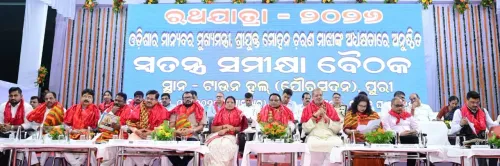
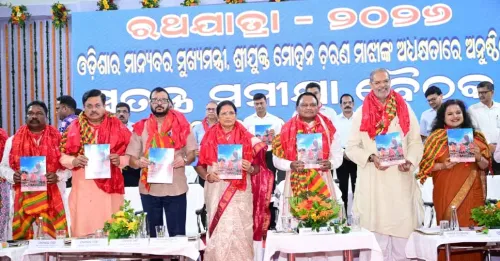
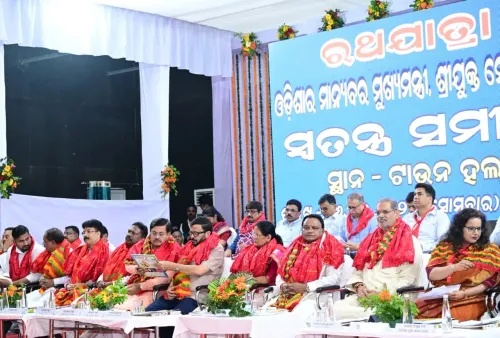
Odisha CM Mohan Majhi Reviews Rath Yatra Preparations
Synopsis
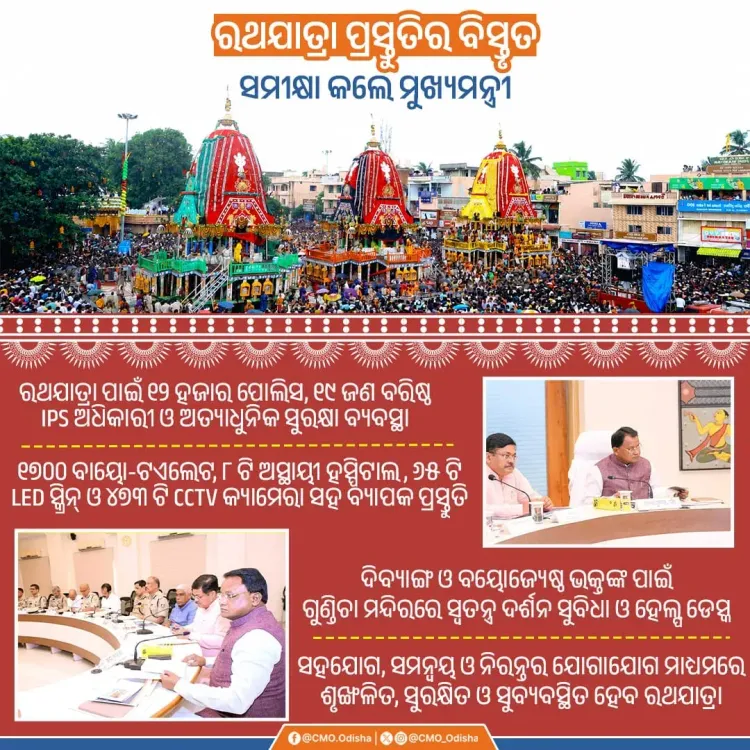
Chief Minister Mohan Majhi has reviewed Rath Yatra preparations in Puri, directing all departments to prioritise security, healthcare, sanitation, and transport for the millions of devotees expected at one of India's largest annual religious festivals.
Key Takeaways
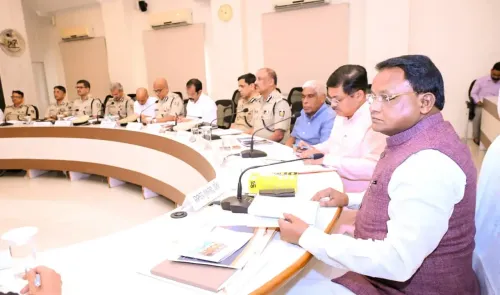
CM Mohan Majhi personally chaired a detailed review of Rath Yatra preparations on 11 July 2026 .
The review covered five priority areas: security, healthcare, sanitation, transport, and devotee convenience .
The festival is held annually in Puri, Odisha , at the site of the Jagannath Temple , drawing crores of pilgrims.
The Government of Odisha has a long-standing multi-department coordination mechanism for the event.
The CMO described the Rath Yatra as 'a grand festival of faith and emotion for crores of devotees.' Post-event assessments are expected to inform procedural improvements for future editions.
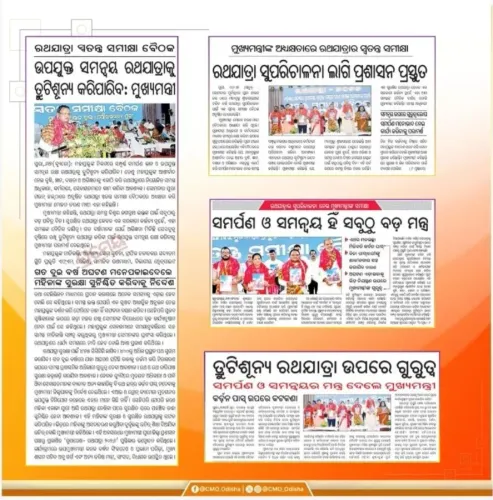
The Chief Minister's Office of Odisha announced on Saturday, 11 July 2026 that Chief Minister Mohan Majhi has conducted a detailed review of preparations for the Rath Yatra festival in Puri, prioritising security, healthcare, sanitation, and transport for the millions of devotees expected to attend.
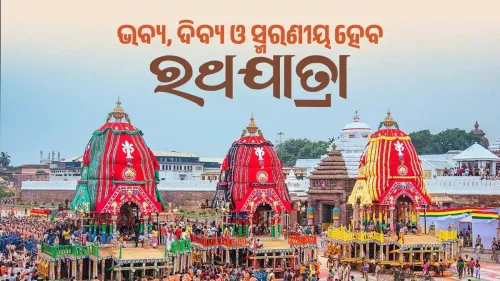
The CMO posted in Odia, describing the Rath Yatra as 'koti koti bhaktanka astha o bhababegara mahaparbba' — 'a grand festival of faith and emotion for crores of devotees' — and stated that the state government is working to make the occasion 'disciplined, safe, and well-organised.'
Context
The Rath Yatra is one of India's largest annual religious gatherings, held in the coastal city of Puri, home to the iconic Jagannath Temple. The festival involves the ceremonial procession of chariots carrying Lord Jagannath, his brother Balabhadra, and sister Subhadra through the town's main avenue, drawing devotees from across India and abroad. Crowd sizes routinely run into the lakhs, making pre-festival coordination a significant administrative undertaking.
The CMO's post confirmed that CM Majhi personally chaired the preparedness review, signalling direct executive engagement with festival logistics ahead of the event.
Policy Backdrop
The Government of Odisha has a long-standing practice of convening multi-department reviews before the Rath Yatra, bringing together police, health, public works, and transport officials to align on crowd management and service delivery. This institutional mechanism has evolved over successive administrations as pilgrim footfall has grown year on year.
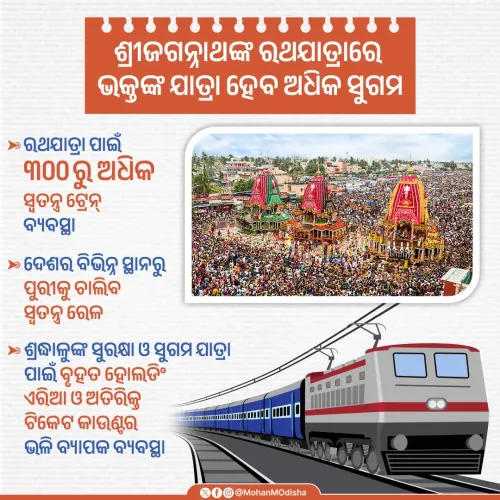
The CMO stated that the 'people's government' is according the highest priority to security, healthcare, sanitation, traffic management, and devotee convenience — the five pillars that typically anchor state planning for large-scale religious events across India.
Stakeholders and Impact
The primary beneficiaries of the review are the crores of pilgrims who travel to Puri for the Rath Yatra, many of whom undertake long journeys and depend entirely on state-provided services once they arrive. Effective coordination between police and health departments directly determines crowd safety outcomes at an event of this scale.
Local residents, traders, and hospitality businesses in Puri are also stakeholders, as the festival is the single largest driver of economic activity in the city each year. Smooth logistics benefit the broader regional economy as well as the state's reputation as a pilgrimage destination.
What's Next
The immediate focus will be on the execution of the Rath Yatra itself, with all five identified departments — security, health, sanitation, transport, and devotee facilitation — expected to operationalise the plans reviewed by CM Majhi. Post-event assessments by the state administration will determine whether any procedural updates are warranted for future editions.
The CMO closed its post with a prayer: 'Mahaprabhuanka kruparu chalita barshara Rath Yatra samanku sugama o smaraniya heu' — 'By the grace of Mahaprabhu, may this year's Rath Yatra be smooth and memorable for all.' That aspiration now rests on the preparedness machinery the Chief Minister has set in motion.
Point of View
Health, sanitation, transport, and devotee facilitation mirrors best practices adopted by other state governments for large pilgrimages, suggesting institutional learning is now embedded in Odisha's pre-festival playbook. For a government that came to power in 2024 partly on the promise of better management of Puri's religious infrastructure, a smooth Rath Yatra carries symbolic weight beyond logistics. How the state performs on the ground will be an early benchmark for its longer-term ambitions around Puri's development as a world-class pilgrimage destination.
NationPress
11 Jul 2026
Frequently Asked Questions
When is Rath Yatra 2026 in Puri?
The exact date of Rath Yatra 2026 has not been specified in the official announcement, but the Chief Minister's Office of Odisha indicated preparations are underway as of 11 July 2026 , suggesting the festival is imminent.
What preparations has the Odisha government made for Rath Yatra 2026?
Chief Minister Mohan Majhi has reviewed preparations covering five areas: security, healthcare, sanitation, transport management, and devotee convenience, making these the highest priorities for the state administration.
Who is in charge of Rath Yatra arrangements in Puri?
The Government of Odisha , under Chief Minister Mohan Majhi , coordinates Rath Yatra arrangements through a multi-department mechanism involving police, health, transport, and sanitation agencies.
How many people attend Rath Yatra in Puri?
The Rath Yatra in Puri draws lakhs to crores of devotees each year, making it one of India's largest annual religious gatherings and a significant crowd-management challenge for the state.
What is the significance of Rath Yatra?
Rath Yatra is the annual chariot festival of Lord Jagannath held in Puri, Odisha , in which chariots carrying Lord Jagannath, Balabhadra, and Subhadra are pulled through the city's main avenue by devotees, symbolising the lord's journey to his birthplace.