Giriraj Singh flags 30% drop in India's energy intensity since 1991
Synopsis
Union Textiles Minister Giriraj Singh highlighted on 11 July 2026 that India's energy intensity has fallen 30 per cent since the 1991 liberalisation, signalling reduced exposure to global oil price shocks. The trend reflects three decades of structural reform, industrial modernisation, and targeted efficiency policies including the Bureau of Energy Efficiency's PAT scheme.
Key Takeaways
India's energy intensity has declined by 30 per cent since 1991 , meaning the economy produces significantly more GDP per unit of energy consumed.
The shift traces back to the 1991 economic liberalisation under PM Narasimha Rao and Finance Minister Manmohan Singh, which introduced competitive pressures that drove industrial efficiency.
The Bureau of Energy Efficiency (BEE) , set up in 2002 , and its Perform Achieve and Trade (PAT) scheme have been key policy instruments sustaining the decline.
A lower energy intensity reduces India's current account and rupee exposure to global crude oil price spikes.
The trend supports India's Nationally Determined Contributions under the Paris Agreement and its 2070 net-zero goal.
Union Minister Giriraj Singh shared the data via the NaMo App on 11 July 2026 , signalling BJP's intent to highlight long-run reform dividends.
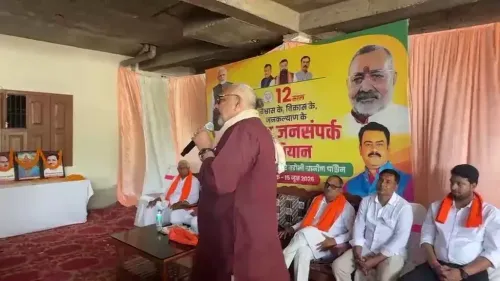
Union Textiles Minister Giriraj Singh on Saturday, 11 July 2026, shared data showing that India's energy intensity has fallen by 30 per cent since 1991, citing the development as evidence that the country's vulnerability to global oil price shocks has significantly diminished over three decades of structural reform.
Context
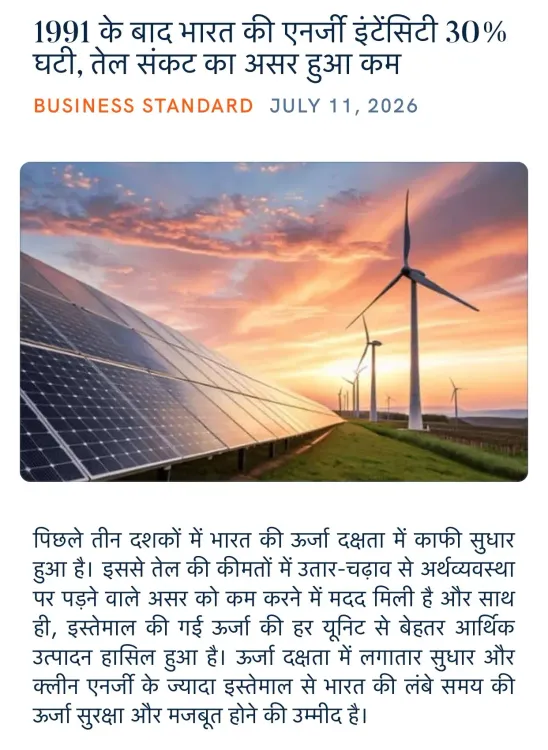
Posting on X via the NaMo App, Singh highlighted a report indicating that "1991 ke baad Bharat ki energy intensity 30% ghati, tel sankat ka asar hua kam" ('India's energy intensity has fallen 30% since 1991, the impact of oil crises has reduced'). The minister's post draws attention to a long-run structural shift in how efficiently the Indian economy uses energy to generate output.
Energy intensity measures the amount of energy consumed per unit of GDP. A sustained decline means the economy is producing more economic value for every unit of energy it burns — a marker of industrial modernisation and improved energy productivity.
Policy Backdrop
The 1991 economic liberalisation — launched under Prime Minister P.V. Narasimha Rao and Finance Minister Manmohan Singh during a balance-of-payments crisis — dismantled industrial licensing and reduced import barriers. Economists have long argued that the competitive pressures unleashed by those reforms pushed Indian industry toward leaner, more efficient production processes.
Successive governments reinforced this trajectory through dedicated energy-efficiency architecture. The Bureau of Energy Efficiency (BEE), established in 2002 under the Ministry of Power, has driven programmes spanning industrial units, appliances, and buildings. The Perform Achieve and Trade (PAT) scheme, which incentivises large energy consumers to hit efficiency targets and trade surplus certificates, is among the flagship instruments credited with accelerating the decline in energy intensity.
The same downward trend in energy intensity underpins India's Nationally Determined Contributions (NDCs) under the Paris Agreement, where reducing the emissions intensity of GDP is a core commitment.
Stakeholders and Impact
Indian industries — particularly energy-intensive sectors such as steel, cement, aluminium, and textiles — are the primary actors whose operational upgrades have driven the aggregate improvement. A lower energy-intensity economy is also less exposed to imported inflation triggered by crude oil price spikes, a vulnerability that has historically strained India's current account and the rupee.
Oil importers and refiners face a structurally different demand environment compared with the early 1990s, when India's oil import bill could rapidly destabilise public finances during global supply disruptions. The 30 per cent reduction in energy intensity since 1991 represents a meaningful buffer against such shocks, even as absolute energy consumption continues to rise with economic growth.
What's Next
Analysts will watch for the next Economic Survey chapter dedicated to energy, which typically quantifies India's energy productivity gains and sets the tone for near-term policy. Any revision of targets under the PAT scheme or a new cycle of BEE star-rating norms for appliances could further accelerate the trajectory that Singh's post celebrates.
As India pushes toward its 2070 net-zero target, sustaining and deepening the decline in energy intensity will be central to squaring the circle between rapid economic expansion and climate commitments — making the post-1991 record both a benchmark and a baseline for future ambition.
Point of View
Linking the BJP's governance narrative to a decades-long structural improvement that predates the party's current tenure — a politically nuanced move that appropriates the broad arc of post-1991 liberalisation. By framing reduced oil-shock vulnerability as a policy achievement worth amplifying, the minister is also making an implicit case for continued investment in energy efficiency at a time when global crude markets remain volatile. The choice of the NaMo App as a distribution channel underscores that this is as much a party-communication exercise as a policy update. Analysts will note that the 30 per cent figure, if validated by official data, would be a significant talking point as India negotiates its next round of climate commitments and defends its development-versus-decarbonisation balancing act on the global stage.
NationPress
11 Jul 2026
Frequently Asked Questions
What is energy intensity and why does it matter for India?
Energy intensity measures how much energy an economy uses to produce one unit of GDP. A falling energy intensity means India is growing more efficiently, reducing its dependence on costly oil imports and limiting exposure to global price shocks.
Why is 1991 used as the baseline for India's energy intensity comparison?
1991 marks the launch of India's landmark economic liberalisation under PM Narasimha Rao and Finance Minister Manmohan Singh , which opened the economy to competition and is widely regarded as the starting point of modern industrial restructuring in India.
What government schemes have helped reduce India's energy intensity?
The Bureau of Energy Efficiency (BEE) , established in 2002 , and its Perform Achieve and Trade (PAT) scheme are the primary policy instruments. PAT sets efficiency targets for large industrial consumers and allows them to trade surplus energy-saving certificates.
What did Giriraj Singh post about India's energy intensity?
On 11 July 2026 , Union Textiles Minister Giriraj Singh shared data via the NaMo App on X stating that India's energy intensity has fallen 30 per cent since 1991 , reducing the country's vulnerability to oil price crises.
How does India's lower energy intensity connect to its climate commitments?
Reducing the emissions intensity of GDP is a core pledge in India's Nationally Determined Contributions (NDCs) under the Paris Agreement . A 30 per cent drop in energy intensity since 1991 demonstrates progress toward this goal and supports India's broader 2070 net-zero target.