CM Mohan Yadav Breaks Ground on 48-km Indore-Ujjain Greenfield Corridor
Synopsis
Madhya Pradesh CM Dr. Mohan Yadav and Union Minister Manohar Lal Khattar broke ground on a 48-km Indore-Ujjain Greenfield Four-Lane Corridor at Sanwer on 20 June 2026, linking Pithampur and Nimar to the Delhi-Mumbai Economic Corridor, alongside PMAY-U housing events covering over 80,000 homes.
Key Takeaways
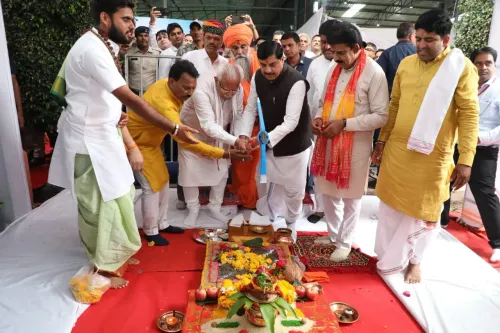
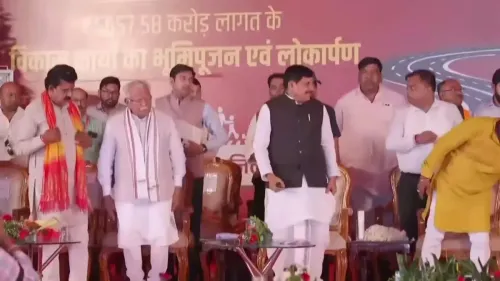
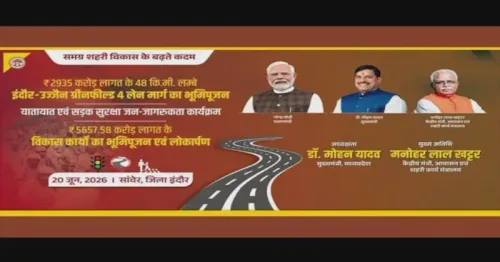
Mohan Yadav and Union Minister Manohar Lal Khattar performed the ground-breaking of the 48-km Indore-Ujjain Greenfield Four-Lane Corridor at Sanwer, Indore district on 20 June 2026 .
The corridor will connect Pithampur and the Nimar region to the Delhi-Mumbai Economic Corridor , boosting industrial freight access.
Ground-breaking was held simultaneously for more than 42,000 urban homes under Pradhan Mantri Awas Yojana (Urban) , with house-warming ceremonies for 38,000 completed homes .
The planned metropolitan region covers 16,000 sq km across 6 districts — Indore, Ujjain, Dewas, Shajapur, Dhar and Ratlam — integrating 6 railway junctions, 2 airports, 4 airstrips and 2 national highways .
The greenfield alignment follows the Bharatmala Pariyojana framework, which accelerated secondary-city connectivity to national corridors after 2018 .
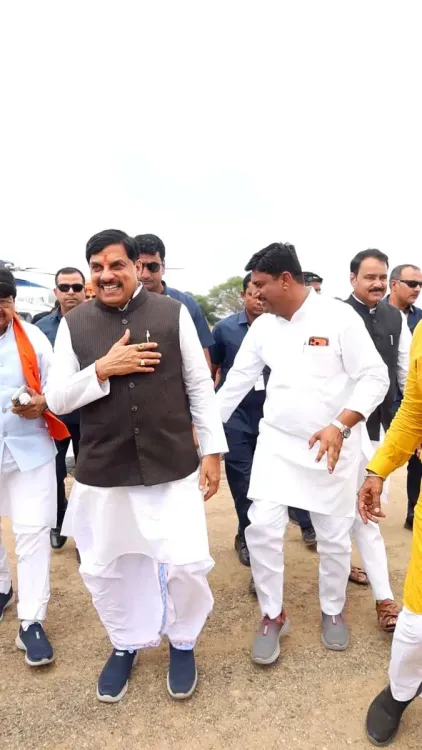
Madhya Pradesh Chief Minister Dr. Mohan Yadav on Saturday, 20 June 2026, performed the ground-breaking ceremony for the 48-kilometre Indore-Ujjain Greenfield Four-Lane Corridor at Sanwer in Indore district, alongside Union Minister Manohar Lal Khattar. The project is designed to become a new engine of development for the Ujjain-Sanwer-Indore region.
Announcing the development on X, CM Yadav wrote that the corridor would link Pithampur and the Nimar region to the Delhi-Mumbai Economic Corridor (DMEC), positioning western Madhya Pradesh as a critical node in India's national freight and industrial network. 'फोरलेन ग्रीनफील्ड कॉरिडोर उज्जैन-सांवेर-इंदौर क्षेत्र के विकास का नया पर्याय बनेगा' ('The four-lane greenfield corridor will become a new synonym for development in the Ujjain-Sanwer-Indore region'), he stated.
Context
The Indore-Ujjain Greenfield Corridor is a new-alignment highway that avoids existing urban settlements, reducing travel time and freight costs between two of Madhya Pradesh's most economically active cities. Pithampur, located near Indore, is one of the state's largest industrial clusters and stands to gain direct, high-speed access to the national corridor network once the road is operational.
The event also witnessed the ground-breaking for more than 42,000 urban homes and the formal house-warming (grih-pravesh) of 38,000 completed homes under the Pradhan Mantri Awas Yojana (Urban), with beneficiaries receiving their entitlements at the ceremony. The dual announcement underscores the state government's strategy of combining infrastructure and social-housing milestones into single high-visibility events.
Policy Backdrop
The Delhi-Mumbai Industrial Corridor project was first announced in 2006 to build dedicated freight and industrial infrastructure across six states, with western Madhya Pradesh — including districts such as Indore, Dewas and Dhar — forming a key segment. Greenfield road alignments connecting secondary cities to DMEC nodes were accelerated under the Bharatmala Pariyojana after 2018.
Pradhan Mantri Awas Yojana (Urban), launched in 2015, targets urban housing shortages through in-situ rehabilitation and credit-linked subsidies. Madhya Pradesh has been one of the programme's larger implementing states, channelling central and state funds into planned urban settlements across its growing cities.
Stakeholders and Impact
The proposed metropolitan region spans 16,000 square kilometres across six districts — Indore, Ujjain, Dewas, Shajapur, Dhar and Ratlam — and will integrate 6 railway junctions, 2 airports, 4 airstrips and 2 national highways into a unified multi-modal network. This scale of planned connectivity is among the largest district-cluster frameworks announced in the state.
Industrial units in Pithampur and agricultural producers in the Nimar belt are the immediate beneficiaries of faster freight access to the DMEC. Urban residents across the six-district zone are expected to benefit from both improved commute corridors and the expanded housing stock being rolled out under PMAY-U.
What's Next
Attention will now turn to land acquisition timelines, contractor appointment and construction milestones for the 48-km corridor. Integration with DMEC nodes and coordination with National Highways Authority of India will be closely watched. On the housing front, the next phase of PMAY-U beneficiary verification and additional sanctions for the six-district metropolitan area are expected to follow the ground-breaking ceremony. The corridor's completion will be a key test of the state-centre coordination model that underpins both the road and housing components of Saturday's event.
Point of View
Potentially accelerating investment decisions that had stalled due to connectivity gaps. Bundling the PMAY-U housing milestone into the same event broadens the political optics beyond industry to urban voters, a constituency that will matter in future state cycles. The real test will be whether land acquisition and construction velocity match the ambition of the six-district metropolitan framework announced alongside the road.
NationPress
19 Sept 2026
Frequently Asked Questions
What is the Indore-Ujjain Greenfield Corridor?
The Indore-Ujjain Greenfield Corridor is a new 48-kilometre, four-lane highway being built on a fresh alignment between Indore and Ujjain in Madhya Pradesh. Its ground-breaking was performed at Sanwer on 20 June 2026 by CM Dr. Mohan Yadav and Union Minister Manohar Lal Khattar.
How will the corridor connect to the Delhi-Mumbai Economic Corridor?
The greenfield road will link the Pithampur industrial area and the Nimar region directly to the Delhi-Mumbai Economic Corridor , giving western Madhya Pradesh freight and industrial traffic faster access to the national highway and rail network running between Delhi and Mumbai.
What housing announcements were made at the Sanwer event?
At the same event, ground-breaking was performed for more than 42,000 homes under Pradhan Mantri Awas Yojana (Urban) , while 38,000 completed homes were handed over to beneficiaries through formal house-warming ceremonies.
Which districts are included in the proposed Madhya Pradesh metropolitan region?
The planned metropolitan region spans 16,000 square kilometres across Indore, Ujjain, Dewas, Shajapur, Dhar and Ratlam , and is set to include 6 railway junctions, 2 airports, 4 airstrips and 2 national highways .
What is Pradhan Mantri Awas Yojana (Urban)?
Pradhan Mantri Awas Yojana (Urban) is a central government scheme launched in 2015 to address urban housing shortages through in-situ rehabilitation, affordable housing construction and credit-linked subsidies for economically weaker sections and low-income groups.