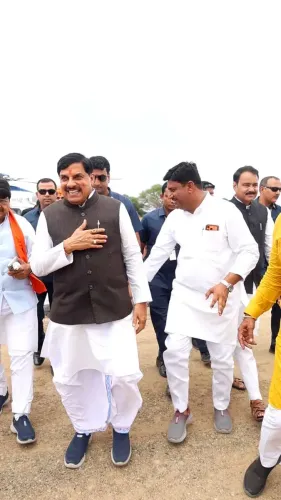
CM Mohan Yadav to Lay Foundation of Indore-Ujjain Corridor

Synopsis
Madhya Pradesh Chief Minister Dr. Mohan Yadav and Union Minister Manohar Lal Khattar performed the groundbreaking of the 48-km Indore-Ujjain Green Field Corridor on 20 June 2026. The ₹2,935 crore project aims to boost connectivity, commerce, and pilgrim tourism in western Madhya Pradesh.
Key Takeaways
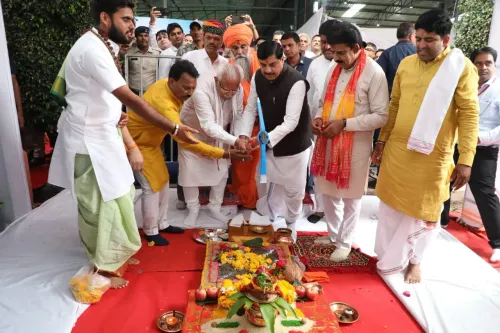
Mohan Yadav and Union Minister Manohar Lal Khattar jointly performed the bhumi pujan of the Indore-Ujjain Green Field Corridor on 20 June 2026 .
The corridor is 48 kilometres long and will follow a new greenfield alignment between Indore and Ujjain .
The project is estimated to cost approximately ₹2,935 crore .
The corridor is intended to reduce travel time and improve freight and pilgrim movement between Madhya Pradesh's commercial capital and a major religious centre.
The project aligns with the national Bharatmala Pariyojana framework for greenfield expressway development.
Key milestones to watch include land acquisition, contract awards, and potential integration with logistics or rail infrastructure in the region.
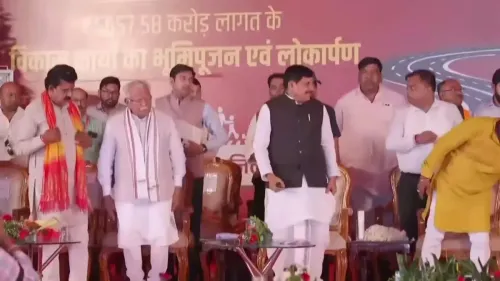
Madhya Pradesh Chief Minister Dr. Mohan Yadav announced on Saturday, 20 June 2026 that he will perform the groundbreaking ceremony for the Indore-Ujjain Green Field Corridor alongside Union Minister Manohar Lal Khattar. The 48-kilometre greenfield road project, estimated to cost approximately ₹2,935 crore, is set to significantly improve connectivity between Indore and Ujjain in western Madhya Pradesh.
Posting in Hindi on X, Chief Minister Yadav wrote: 'माननीय केंद्रीय मंत्री श्री @mlkhattar जी के साथ आज इंदौर-उज्जैन ग्रीन फील्ड कॉरिडोर का भूमिपूजन करूंगा' — 'Today I will perform the groundbreaking of the Indore-Ujjain Green Field Corridor along with honourable Union Minister Shri Khattar.' He added that the corridor 'will make travel between Indore and Ujjain more convenient and faster, and will add a new chapter to the economic progress of the state.'
Context
The Indore-Ujjain Green Field Corridor is a dedicated new-alignment highway that bypasses existing congested routes between the two cities. At 48 km in length and a projected investment of ₹2,935 crore, it represents one of the larger single road infrastructure commitments announced for western Madhya Pradesh in recent years. The bhumi pujan, or groundbreaking ritual, marks the formal commencement of the project.
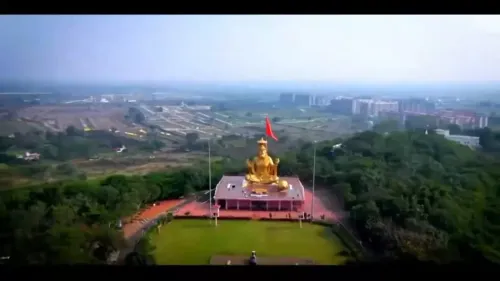
Indore is Madhya Pradesh's largest city and its primary commercial and industrial hub. Ujjain, located roughly 55 km to the north-east, is one of India's most significant religious centres, home to the Mahakaleshwar Jyotirlinga temple and a major destination for pilgrims year-round. The corridor is expected to serve both freight movement and the substantial religious tourism traffic that flows between the two cities.
Policy Backdrop
The project fits within the broader national push under the Bharatmala Pariyojana, launched in 2015, which prioritised greenfield expressway alignments to reduce travel times and create economic corridors across states. Madhya Pradesh has used this framework to outline multiple four-lane and expressway projects linking Indore with Bhopal and other regional centres over successive planning cycles.
Central and state governments have steadily expanded India's national highway network through greenfield alignments, with a focus on improving freight and passenger movement between tier-2 cities. Madhya Pradesh has positioned such corridors as part of its strategy to accelerate industrialisation and boost tourism, mirroring similar projects rolled out in neighbouring states.
Stakeholders and Impact
The primary beneficiaries of the corridor will be daily commuters and businesses operating between Indore and Ujjain. Faster, smoother connectivity is expected to reduce logistics costs for industries based in Indore's manufacturing and pharmaceutical clusters. Pilgrims and tourists visiting Ujjain's temples — including the Mahakaleshwar Jyotirlinga — stand to benefit from reduced travel times and improved road safety on a dedicated alignment.
The involvement of Union Minister Manohar Lal Khattar, who brings prior experience as a state chief minister and has participated in multiple Madhya Pradesh infrastructure events, signals continued central government attention to the state's road development agenda. The joint ceremony underscores the Centre-state partnership model that underpins large greenfield highway projects.
What's Next
Following the bhumi pujan, attention will shift to land acquisition progress and the award of construction contracts, which are typically the most time-sensitive phases of greenfield corridor projects. Stakeholders will also watch for any integration of the corridor with planned rail or logistics infrastructure in the Indore-Ujjain region.
If executed on schedule, the corridor could meaningfully reposition western Madhya Pradesh's connectivity profile, reinforcing Indore's emergence as a logistics and investment destination while amplifying Ujjain's capacity to handle growing pilgrim footfall. Chief Minister Yadav has framed the project as a new chapter in the state's economic progress — a benchmark that construction timelines will ultimately be measured against.
Point of View
935 crore, the project is substantial enough to serve as a credible development marker, though the real test will come at the land acquisition and construction stages, where greenfield corridors in India have historically faced delays. The corridor also fits a broader pattern of state governments using Bharatmala's framework to anchor regional identity — pairing industrial growth stories with religious tourism to appeal to a wide voter base.
NationPress
19 Sept 2026
Frequently Asked Questions
What is the Indore-Ujjain Green Field Corridor?
The Indore-Ujjain Green Field Corridor is a new 48-kilometre road project on a fresh alignment connecting Indore and Ujjain in Madhya Pradesh, with an estimated cost of ₹2,935 crore . Its groundbreaking was performed on 20 June 2026 .
Who performed the bhumi pujan of the Indore-Ujjain corridor?
Madhya Pradesh Chief Minister Dr. Mohan Yadav performed the bhumi pujan alongside Union Minister Manohar Lal Khattar on 20 June 2026 .
How much will the Indore-Ujjain Green Field Corridor cost?
The corridor is estimated to cost approximately ₹2,935 crore , making it one of the larger single road infrastructure investments announced for western Madhya Pradesh in recent years.
How will the Indore-Ujjain corridor benefit commuters and businesses?
The corridor will provide a faster, dedicated road link between Indore , Madhya Pradesh's commercial hub, and Ujjain , a major religious centre, reducing travel time, lowering logistics costs, and improving access for pilgrims visiting the Mahakaleshwar Jyotirlinga temple.
Is the Indore-Ujjain corridor part of Bharatmala Pariyojana?
The project aligns with the Bharatmala Pariyojana framework, India's national greenfield highway programme launched in 2015 , which has supported multiple expressway and four-lane projects in Madhya Pradesh.