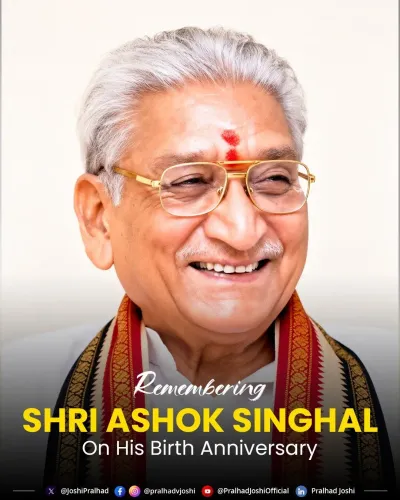
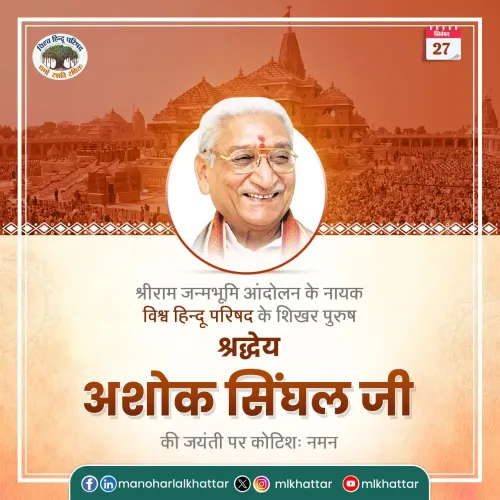
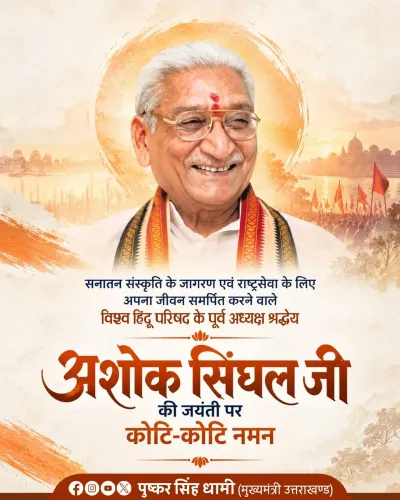
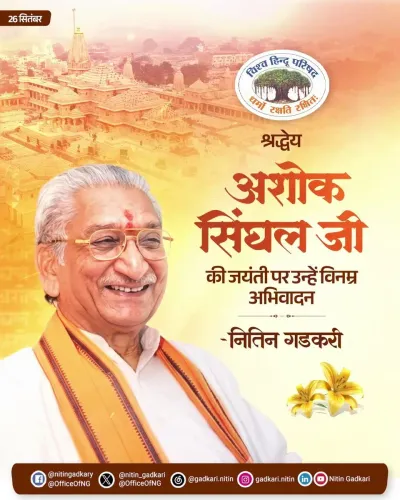
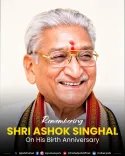
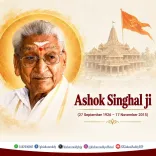
CM Mohan Yadav pays tribute to Ashok Singhal on birth anniversary
Synopsis
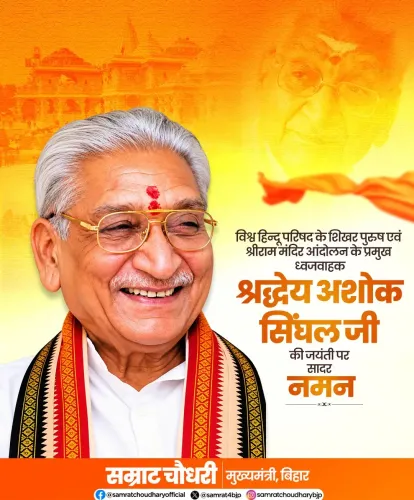
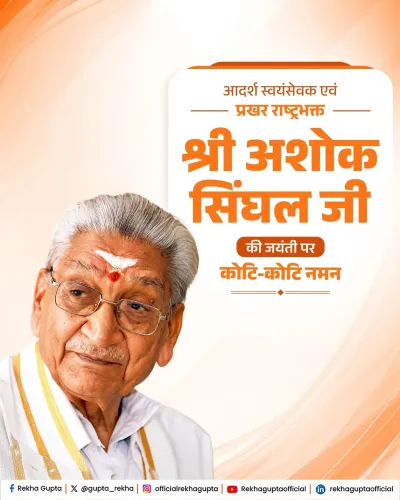
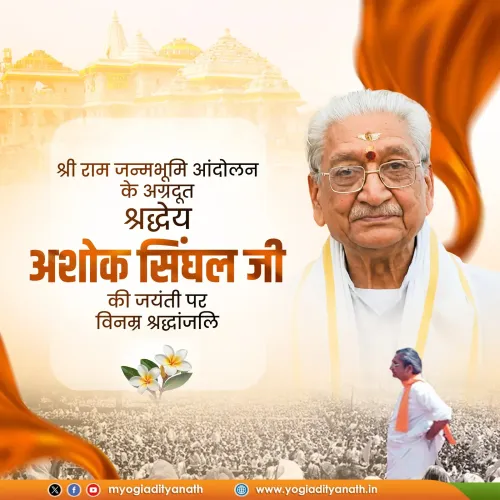
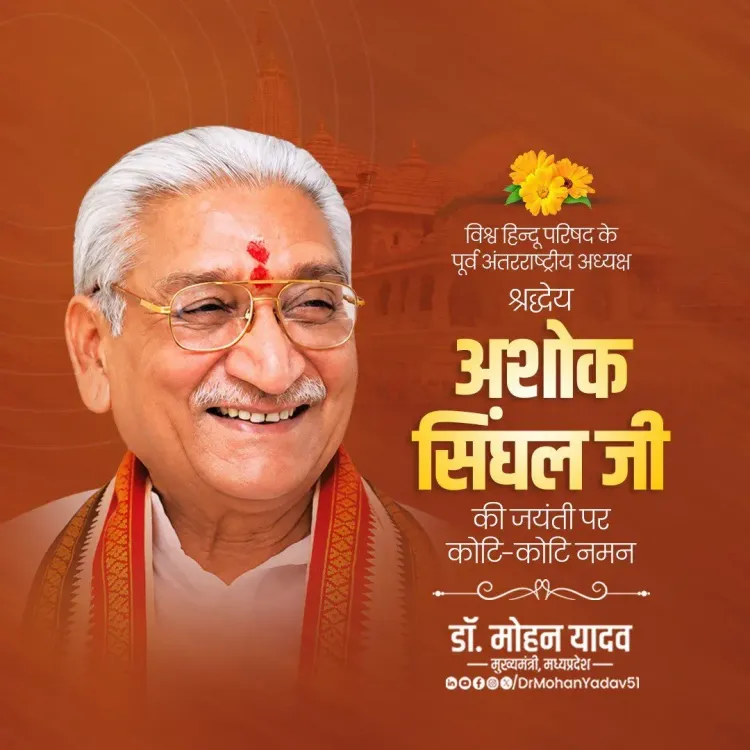
Madhya Pradesh Chief Minister Dr. Mohan Yadav paid tribute to Ashok Singhal, former VHP international president, on his birth anniversary, honouring his foundational role in the Ram Janmabhoomi movement and the cause of Sanatan Dharma.
Key Takeaways
Mohan Yadav , Chief Minister of Madhya Pradesh, offered tribute to Ashok Singhal on his birth anniversary on September 27, 2026 .
Ashok Singhal served as international president of the Vishva Hindu Parishad (VHP) and was a central figure in the Ram Janmabhoomi movement until his death in 2015 .
The VHP was founded in 1964 and intensified its Ayodhya campaign from the mid-1980s under Singhal's leadership.
The Ram Janmabhoomi Temple in Ayodhya was consecrated in January 2024 , following the Supreme Court's 2019 verdict .
Yadav described Singhal's life as an inspiration for India's cultural restoration and the advancement of Sanatan Dharma.
On the birth anniversary of Vishva Hindu Parishad's former international president, Madhya Pradesh Chief Minister Dr. Mohan Yadav offered a deeply reverential tribute on Sunday, September 27, 2026, honouring the man whose decades-long crusade helped shape one of independent India's most consequential cultural chapters.
In his post, Dr. Yadav wrote: 'Koti-koti naman' — meaning 'a hundred-million salutations' — to Ashok Singhal, describing his life as one 'refined by unwavering resolve' for the construction of the Shri Ram Janmabhoomi Temple, the restoration of India's glorious cultural history, and the cause of Sanatan Dharma.
Who Ashok Singhal was — and why the temple was his life's mission
Ashok Singhal served as the international president of the Vishva Hindu Parishad (VHP), the Hindu nationalist organisation founded in 1964 to consolidate Hindu unity and champion cultural causes. From the mid-1980s onward, Singhal became the single most recognisable face of the Ram Janmabhoomi movement, organising mass processions, rallies, and relentless legal efforts that kept the Ayodhya question at the centre of national discourse for three decades. He passed away in 2015, years before the Supreme Court's landmark 2019 verdict cleared the path for construction.
That temple — the Ram Janmabhoomi Temple in Ayodhya — was consecrated in January 2024, a moment his supporters widely framed as the fulfilment of the life's work he never lived to witness. For BJP leaders and VHP circles, Singhal's legacy and the completed temple are inseparable.
A ritual of remembrance BJP leaders mark annually
Dr. Yadav's tribute follows a well-established pattern: BJP chief ministers and central leaders routinely issue public commemorations for prominent VHP and RSS figures on their birth or death anniversaries, linking their legacies explicitly to the Ram Temple's completion and the broader theme of cultural restoration. The gesture is as much political affirmation as personal reverence — a public signal of ideological continuity.
For Dr. Yadav, who governs a state with a significant Hindu pilgrimage footprint and a BJP base deeply invested in the Ayodhya narrative, the tribute carries particular resonance. It arrives on a day when similar commemorative voices from across the saffron spectrum are likely to echo across platforms.
Singhal's birth anniversary has become a quiet but consistent marker on the BJP's cultural calendar — and in 2026, with the Ayodhya temple now a standing, consecrated reality rather than a distant aspiration, the tributes carry a note of completion that earlier anniversaries never could.
Point of View
Recurring practice by BJP chief ministers to publicly anchor their governance identity to the Hindu cultural-nationalist lineage that VHP figures like Singhal represent. With the Ayodhya temple now consecrated, these anniversaries serve a new function: cementing the narrative that the movement's foundational promises have been kept. For Yadav, a CM in a state with deep pilgrimage significance, the gesture reinforces his ideological credentials while maintaining alignment with the BJP's central cultural programme.
NationPress
27 Sept 2026
Frequently Asked Questions
Who was Ashok Singhal?
Ashok Singhal was the former international president of the Vishva Hindu Parishad (VHP) and one of the most prominent leaders of the Ram Janmabhoomi movement. He passed away in 2015 .
What is the Vishva Hindu Parishad (VHP)?
The Vishva Hindu Parishad is a Hindu nationalist organisation founded in 1964 with the aim of promoting Hindu unity and cultural causes. It played a central role in the decades-long campaign to build a Ram temple in Ayodhya.
What was Ashok Singhal's role in the Ram Janmabhoomi movement?
From the mid-1980s onward, Ashok Singhal led mass processions, rallies, and legal efforts as part of the Ram Janmabhoomi campaign, making the Ayodhya question central to national discourse for over three decades.
When was the Ram Janmabhoomi Temple consecrated?
The Ram Janmabhoomi Temple in Ayodhya was consecrated in January 2024 , following the Supreme Court's landmark verdict in 2019 that cleared the path for its construction.
Why did CM Mohan Yadav pay tribute to Ashok Singhal?
Dr. Mohan Yadav paid tribute on Singhal's birth anniversary, honouring his lifelong dedication to the Ram Janmabhoomi Temple, the restoration of India's cultural heritage, and the cause of Sanatan Dharma — themes central to the BJP's ideological identity.