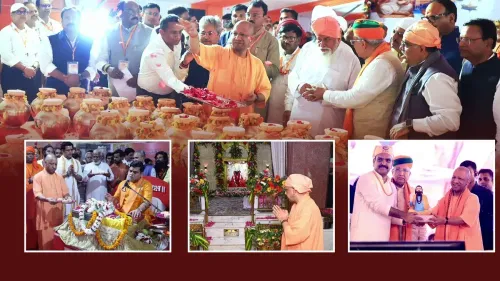
CM Yogi distributes 664 assistive devices to 509 divyangjan in Gorakhpur
Synopsis
Uttar Pradesh Chief Minister Yogi Adityanath announced on 30 September 2026 that 509 persons with disabilities in Gorakhpur would receive 664 assistive devices, calling inclusion of divyangjan into the mainstream a core resolve of the double-engine government.
Key Takeaways
509 divyangjan in Gorakhpur are set to receive assistive devices at an event on 30 September 2026 .
A total of 664 assistive devices will be distributed — more than one per person on average, reflecting multi-dimensional disability needs.
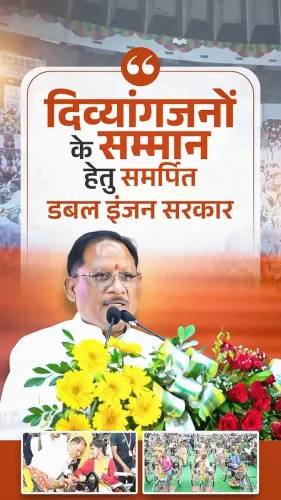
CM Yogi described the event as fulfilling the 'double engine government's' resolve to connect persons with disabilities to the social mainstream with self-reliance and dignity.
The distribution is held on the grounds associated with the Gorakhnath Math , the religious institution headed by CM Yogi in his spiritual capacity.
India's central ADIP scheme has supported similar assistive-device camps in Uttar Pradesh for over two decades, with Gorakhpur featuring as a recurring venue.
In the holy city of Gorakhpur — on the sacred ground of the Gorakhnath Math — Uttar Pradesh Chief Minister Yogi Adityanath announced on Wednesday, 30 September 2026, that 509 persons with disabilities would receive 664 assistive devices, a distribution he framed as a direct expression of the state's commitment to inclusion and self-reliance.
Posting in Hindi, CM Yogi declared: 'Connecting divyangjan (persons with disabilities) to the mainstream of society with self-reliance, dignity, and equal opportunities is the resolve of the double-engine government.' He described Gorakhpur as the sacred tapobhumi (land of spiritual discipline) of Shivavtari Mahayogi Guru Shri Gorakhnath Ji, invoking the site's spiritual weight to underscore the moral seriousness of the initiative.
664 devices, 509 lives — what the distribution means on the ground
The numbers themselves tell a compact story: with 664 devices going to 509 beneficiaries, some recipients are receiving more than one piece of equipment — an acknowledgement that disability rarely comes in a single dimension. CM Yogi said the devices would 'make daily life easier and give new strength to self-confidence,' so that every divyangjan can participate in the journey of development 'with their own capability.'
The choice of Gorakhpur is not incidental. The city is home to the Gorakhnath Math, the centuries-old religious institution headed by CM Yogi himself, making it both his political and spiritual heartland. Holding a welfare event here reinforces the Math's longstanding tradition of community service alongside the state government's delivery machinery.
The ADIP scheme and UP's record on assistive-device camps
India's central Assistive Devices for Persons with Disabilities (ADIP) scheme has bankrolled periodic device-distribution camps since the early 2000s, channelling aids ranging from wheelchairs and crutches to hearing aids and tricycles through state governments and implementing agencies. Uttar Pradesh has been a repeat venue for such camps, with Gorakhpur featuring prominently given its demographic size and the Math's organisational reach.
The 'double engine government' framing — a phrase BJP leaders use habitually to describe aligned central and state administrations — signals that both the Union government's ADIP funding and the state's own welfare apparatus are positioned as jointly driving this effort. It is a rhetorical device that also functions as a political accountability claim: credit for welfare delivery is tied explicitly to the party holding power at both levels.
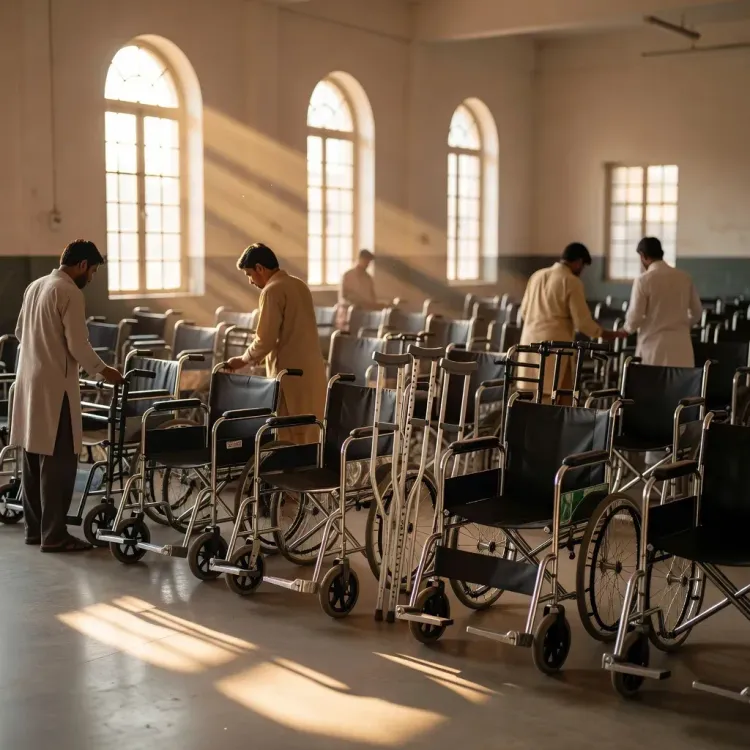
For the 509 beneficiaries in Gorakhpur today, the policy language matters far less than the equipment itself — a wheelchair that grants mobility, a hearing aid that restores connection, a white cane that restores independence. Those devices are the point. Everything else is the architecture that gets them there.
Point of View
Announced by a Chief Minister who also heads the local religious institution that gives the venue its moral authority. By explicitly invoking the 'double engine government' frame, CM Yogi ties disability welfare to BJP's broader electoral narrative of aligned Centre-state governance — making inclusion a political as much as a humanitarian argument. Repeated camps in Gorakhpur suggest the city functions as a preferred showcase for welfare delivery, concentrating visibility in the CM's home turf. The test of the initiative's depth will be whether device distribution is followed by sustained rehabilitation support, vocational training, and accessibility infrastructure for recipients beyond the event.
NationPress
30 Sept 2026
Frequently Asked Questions
What is the assistive device distribution announced by CM Yogi in Gorakhpur?
On 30 September 2026, Uttar Pradesh Chief Minister Yogi Adityanath announced that 509 persons with disabilities in Gorakhpur would receive 664 assistive devices to support their daily lives and self-confidence.
What is the ADIP scheme that funds assistive devices for divyangjan in India?
The Assistive Devices for Persons with Disabilities (ADIP) scheme is a central government programme that has funded distribution of aids such as wheelchairs, hearing aids, crutches, and tricycles through periodic camps across India since the early 2000s.
Why is the event being held at Gorakhpur?
Gorakhpur is the site of the Gorakhnath Math, a centuries-old religious institution headed by CM Yogi Adityanath, making it both his political heartland and a venue with strong organisational capacity for community welfare events.
What does 'double engine government' mean in CM Yogi's post?
'Double engine government' is a phrase commonly used by BJP leaders to describe coordinated welfare delivery when the same party is in power at both the central and state levels — in this case implying joint credit for the assistive device distribution.
How many devices are being given per person at the Gorakhpur camp?
With 664 devices distributed among 509 beneficiaries, the average works out to more than one device per person, indicating that some individuals with multiple or complex disabilities are receiving more than one type of assistive equipment.