CM Yogi Flags 770 Homes, Schools, Health Cover in UP Village
Synopsis
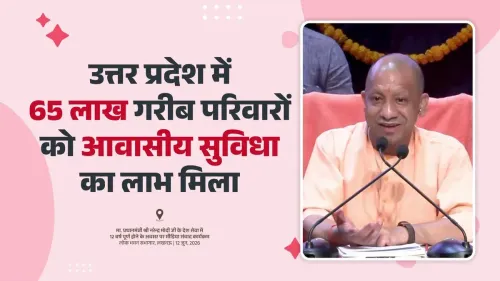
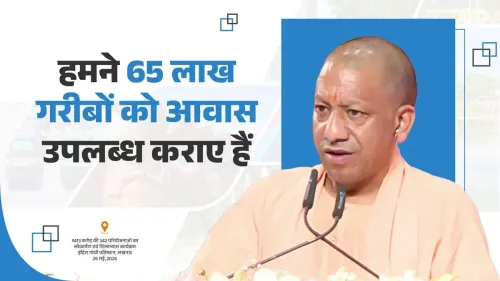
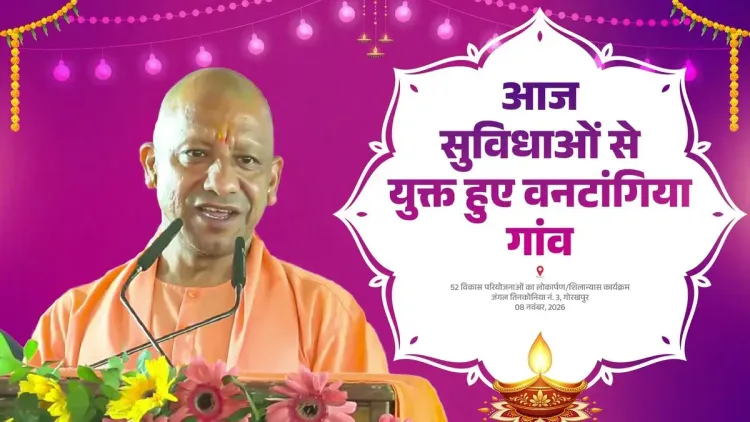
Chief Minister Yogi Adityanath on 8 November 2026 cited construction of 770 houses alongside schools, Anganwadi centres, roads, electricity, ration cards, Ayushman Bharat coverage and pensions at a Uttar Pradesh settlement, showcasing the state's concurrent welfare-saturation model.
Key Takeaways
770 pucca houses have been constructed at the settlement under Pradhan Mantri Awas Yojana-Gramin .
Anganwadi centres and Basic Shiksha Parishad primary schools have been built at the site.
Road connectivity and household electricity have been extended to the settlement.
Ayushman Bharat health insurance — providing up to Rs 5 lakh per family annually — and pension entitlements have been activated for residents.
Ration cards under the National Food Security Act have been issued to eligible households.
CM Yogi's remarks illustrate Uttar Pradesh's 'welfare-stack' saturation strategy of concurrent multi-scheme delivery during field visits.
Seven hundred and seventy houses built. Schools and Anganwadi centres constructed. Roads laid, electricity connected, ration cards issued, pensions activated — and Ayushman Bharat coverage extended to families who had none of it before. Chief Minister Yogi Adityanath, speaking on Sunday, 8 November 2026, laid out what the Chief Minister's Office of Uttar Pradesh described as the arc of transformation at a settlement whose exact location remains unspecified in the official communication.
In his own words: 'यहां 770 मकानों का निर्माण कराया गया है... आयुष्मान भारत योजना के साथ-साथ पेंशन की सुविधा भी उपलब्ध कराई गई है' — 'Here, 770 houses have been constructed... and along with the Ayushman Bharat scheme, pension facilities have also been made available.'770 Houses and the PMAY-G Push in Uttar Pradesh
The housing figure sits inside a much larger national story. Pradhan Mantri Awas Yojana-Gramin (PMAY-G), relaunched in 2016 with a target of 2.95 crore rural houses nationwide, has consistently counted Uttar Pradesh among its top-performing states. The 770 pucca houses cited by CM Yogi represent the kind of cluster-level saturation that state officials have prioritised during district tours — using concrete numbers to show that beneficiary lists have been cleared rather than merely approved.
Alongside housing, Anganwadi centres and Basic Shiksha Parishad schools have been commissioned at the site. The Basic Shiksha Parishad — the UP body governing government primary education — has been at the centre of a sustained school-infrastructure drive since 2017, with classroom construction, boundary walls, and toilet facilities forming a recurring budget commitment.
Ayushman Cards, Ration Cover, and the Social-Security Stack
Ayushman Bharat, launched in September 2018 as the world's largest government-funded health insurance programme, provides up to Rs 5 lakh per family per year for secondary and tertiary hospitalisation. CM Yogi's remarks signal that card saturation — ensuring every eligible family in the settlement actually holds an active card — has been achieved here, not merely announced. That gap between scheme launch and last-mile enrolment is exactly where state governments have faced the sharpest scrutiny.
Ration cards under the National Food Security Act and state-funded pension entitlements complete what officials call a 'welfare stack' — a simultaneous delivery of housing, health, food security, and social security to households that previously had access to none. Uttar Pradesh expanded ration-card drives from 2017 onward, aiming to close gaps inherited from earlier surveys.
Electricity and Roads: The Infrastructure Baseline
Power connectivity at the settlement links to the Saubhagya scheme for universal household electrification, declared complete across Uttar Pradesh by 2019. Road construction, while not scheme-specific in this communication, reflects the state's concurrent push on rural connectivity alongside social infrastructure. Together, these elements form the standard benchmark Chief Minister Yogi invokes during field visits to demonstrate that government reach has extended to previously underserved pockets.
The cumulative picture — roads, power, schools, health cover, food security, housing, pensions delivered together — is precisely the 'saturation model' that has defined the state government's communication strategy since 2017. Each visit becomes a checkpoint: not just a ribbon-cutting, but a reckoning with whether the full stack has actually landed.
Point of View
Health, food security, education, and infrastructure into one verifiable checklist that is both a governance report card and an electoral communication tool. The 'saturation model' — where no eligible household is left without a scheme benefit — has become the dominant governance narrative of the Uttar Pradesh government since 2017, designed to shift the conversation from scheme design to scheme delivery. The specificity of the 770-house figure signals an attempt to ground the narrative in auditable facts rather than broad promises. As Uttar Pradesh approaches future assembly cycles, the frequency and granularity of such field-visit communications will be a leading indicator of where the government believes its performance story is strongest.
NationPress
8 Nov 2026
Frequently Asked Questions
What welfare schemes did CM Yogi announce at the UP settlement?
CM Yogi Adityanath cited construction of 770 houses, Anganwadi centres, Basic Shiksha Parishad schools, roads, and electricity, along with issuance of ration cards, Ayushman Bharat health insurance coverage, and pension facilities for residents.
What is Ayushman Bharat and what does it offer?
Ayushman Bharat, launched in September 2018, is India's national health insurance scheme that provides up to Rs 5 lakh per family per year for secondary and tertiary hospitalisation at empanelled hospitals.
What is Pradhan Mantri Awas Yojana-Gramin?
PMAY-Gramin is a central government rural housing scheme relaunched in 2016 to provide pucca houses to eligible rural households; Uttar Pradesh has been among its top-performing states.
What is the Basic Shiksha Parishad in Uttar Pradesh?
The Basic Shiksha Parishad is the Uttar Pradesh government body responsible for administering and upgrading primary school infrastructure; school construction has been a recurring state priority since 2017.
What is the 'welfare saturation model' Yogi Adityanath promotes in UP?
The welfare saturation model refers to the simultaneous delivery of multiple central and state schemes — housing, health insurance, ration cards, pensions, schools, roads, and electricity — to every eligible household in a targeted settlement or village, rather than piecemeal rollout.