CM Yogi backs 'Law with Lab' to anchor forensics in UP justice
Synopsis
CM Yogi Adityanath has backed the 'Law with Lab' initiative of the UP State Forensic Science Institute, aiming to institutionally integrate forensic science with legal processes — a move aligned with the BNSS 2023 mandate for forensics in serious crimes.
Key Takeaways
CM Yogi Adityanath endorsed the 'Law with Lab' initiative on 24 October 2026 , framing it as institutional coordination between law and forensic science.
The Uttar Pradesh State Forensic Science Institute is the nodal body for the initiative.
The Bharatiya Nagarik Suraksha Sanhita, 2023 mandates forensic investigation for offences carrying a sentence of seven years or more , sharply raising demand on state forensic infrastructure.
UP Police , the state judiciary, and forensic scientists are the primary stakeholders in the rollout.
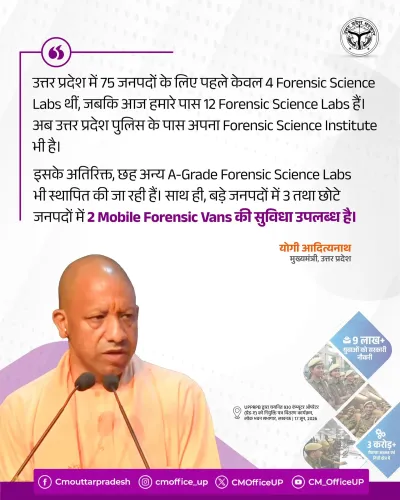
Uttar Pradesh has been expanding regional labs and mobile forensic units since 2017 as part of a technology-driven governance agenda.
The initiative could serve as a replicable model for other states navigating the same BNSS forensic mandate.
In a state that has long staked its political identity on law and order, Uttar Pradesh Chief Minister Yogi Adityanath is now pushing to wire the courtroom directly to the laboratory — arguing that justice without scientific evidence is justice half-delivered.
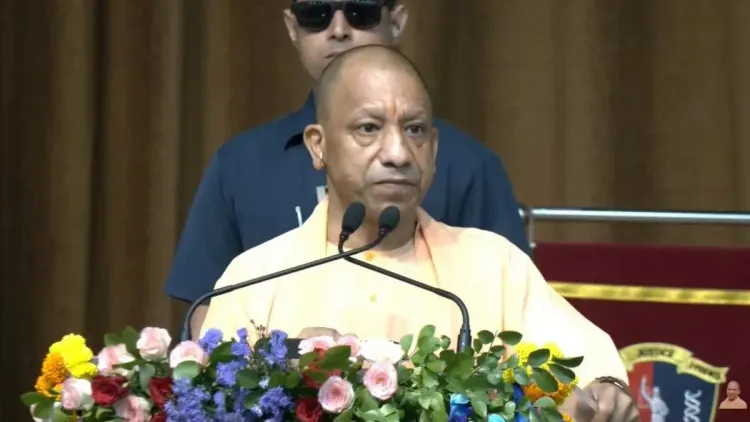
Posting on Saturday, 24 October 2026, CM Yogi framed the Uttar Pradesh State Forensic Science Institute's 'Law with Lab' initiative as an attempt to give institutional form to the coordination between legal processes and forensic laboratories — a gap that has historically slowed convictions in serious criminal cases across India.
What 'Law with Lab' is trying to fix
The premise is straightforward: police file chargesheets, courts demand evidence, but forensic reports — the bridge between the two — often arrive late, incomplete, or in formats that lawyers and judges struggle to act on. 'Law with Lab' is designed to close that gap institutionally, not just procedurally. The initiative positions the Uttar Pradesh State Forensic Science Institute as a coordinating body, not merely a testing facility sitting downstream of investigations.
The timing is deliberate. The Bharatiya Nagarik Suraksha Sanhita, 2023 — India's reformed criminal procedure code — mandates forensic investigation for all offences punishable by seven years or more. That single provision dramatically expanded the volume of cases that must now pass through forensic pipelines. States that cannot absorb that volume risk stalling their own courts.
UP's forensic infrastructure push in context
Uttar Pradesh has been expanding forensic capacity in parallel with the national push. The state has added regional labs, mobile forensic units, and trained investigators as part of a broader technology-driven governance agenda that CM Yogi has championed since 2017. The goal — higher conviction rates through scientific evidence — is as much a political signal as it is a policy objective: that the state's law-and-order record can be measured, not just asserted.
The key stakeholders watching the rollout are UP Police, the state's judiciary, and the forensic scientists who will have to operationalise whatever protocols emerge. Whether 'Law with Lab' delivers new case-handling workflows, joint training programmes, or dedicated liaison officers between labs and prosecution teams remains to be detailed publicly.
Why forensic integration matters for conviction rates
India's conviction rate in serious criminal cases has historically lagged behind comparable jurisdictions, partly because evidence chains break between investigation and trial. A forensic report that arrives after a bail hearing, or one that a public prosecutor cannot decode under cross-examination, is evidence that effectively doesn't exist. Institutionalising the vidhi aur prayogshala — law and laboratory — relationship is precisely the kind of systemic fix that determines whether a criminal justice reform on paper translates into outcomes in court.
If UP can demonstrate a replicable model, other large states facing the same BNSS mandate will be watching closely. The laboratory, it turns out, may be the most consequential room in the justice system that no one talks about.
Point of View
The state is also positioning itself ahead of a compliance curve that all large states must navigate. The political calculus is clear: scientific evidence trails are harder to challenge in court and harder to dismiss as partisan policing. Whether the initiative produces genuine workflow integration or remains a branding exercise will depend on the protocols and funding that follow this announcement.
NationPress
24 Oct 2026
Frequently Asked Questions
What is the 'Law with Lab' initiative in Uttar Pradesh?
'Law with Lab' is an initiative by the Uttar Pradesh State Forensic Science Institute aimed at institutionally coordinating forensic laboratory functions with legal and investigative processes to strengthen evidence-based prosecution.
Why is forensic science now mandatory in Indian criminal cases?
The Bharatiya Nagarik Suraksha Sanhita, 2023 mandates forensic investigation for all criminal offences punishable by seven years or more, making forensic evidence a legal requirement in serious cases across India.
What does the UP State Forensic Science Institute do?
The Uttar Pradesh State Forensic Science Institute is a state-level body responsible for forensic analysis that supports criminal investigations, providing scientific evidence to police and courts in UP.
How has Yogi Adityanath changed law and order in UP since 2017?
Since 2017, CM Yogi Adityanath has pursued police modernisation, expanded forensic infrastructure including regional labs and mobile units, and pushed for technology-driven governance to raise conviction rates in Uttar Pradesh.
How does forensic integration help improve conviction rates in India?
Timely and court-ready forensic reports close the evidence gap between investigation and trial; without institutional coordination, forensic findings often arrive late or in unusable formats, weakening prosecution cases and reducing conviction rates.