CM Yogi: Bundelkhand Now Has Tap Water, Not Tankers
Synopsis
Chief Minister Yogi Adityanath says Bundelkhand and Vindhya — once reliant on emergency water trains and tankers — are now experiencing the Har Ghar Jal scheme under the national Jal Jeevan Mission, marking a shift from crisis management to permanent piped water infrastructure.
Key Takeaways
CM Yogi Adityanath stated on 23 October 2026 that Bundelkhand and Vindhya in UP are seeing the Har Ghar Jal scheme become reality.
Bundelkhand and Vindhya historically required water delivery by train and tanker during drought seasons.
Har Ghar Jal is the household-level component of the Jal Jeevan Mission , a central scheme launched in 2019 .
Jal Jeevan Mission targeted functional tap water connections for all rural households, with UP holding one of the largest shares of that target.
The statement frames the change as a structural shift from emergency relief logistics to permanent piped water infrastructure.
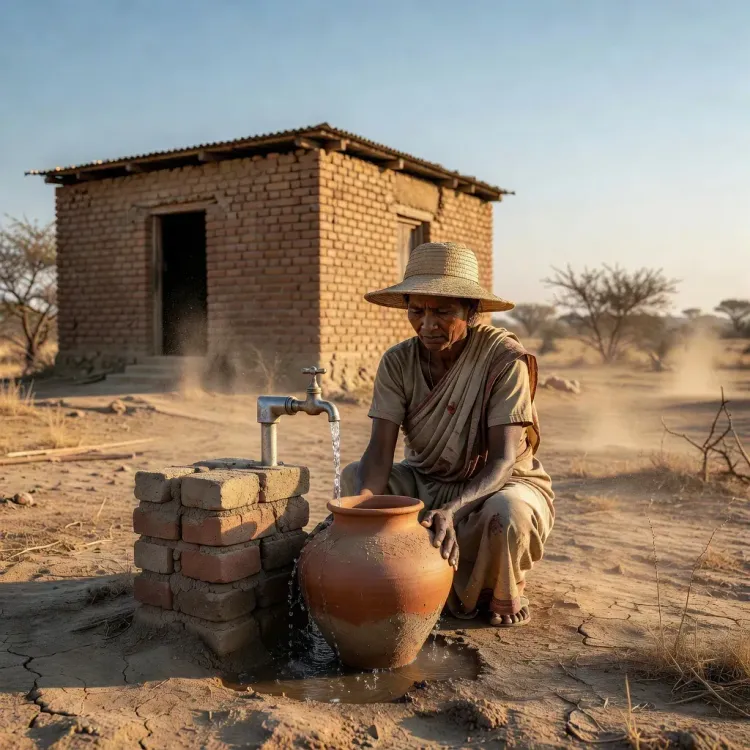
Where water trains and tankers once rolled in as emergency relief, household taps now run — that is the transformation Chief Minister Yogi Adityanath is pointing to across Bundelkhand and the Vindhya region of Uttar Pradesh on Friday, 23 October 2026. The Chief Minister's Office of Uttar Pradesh shared a statement underscoring how one of India's most chronically water-scarce belts is being reshaped by piped infrastructure.
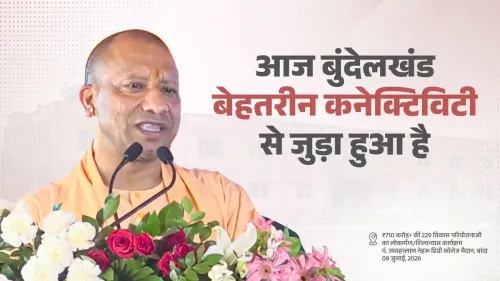
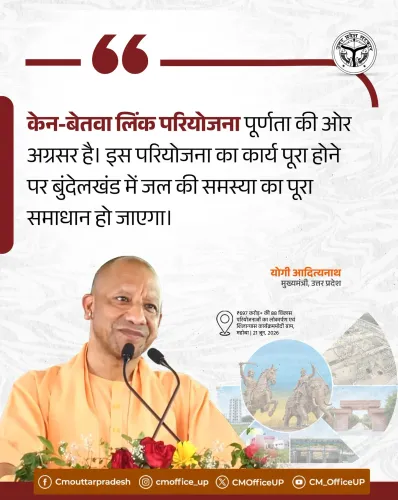
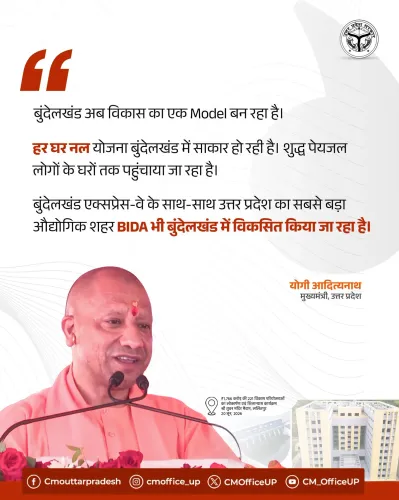
The post quotes CM Yogi Adityanath directly: 'याद कीजिए, उत्तर प्रदेश के बुंदेलखंड और विंध्य क्षेत्र में कभी ट्रेन और टैंकर से पानी पहुंचाया जाता था। आज वहां हर घर जल योजना साकार होती दिखाई दे रही है।' — 'Remember, water used to be delivered by train and tanker to Bundelkhand and Vindhya in Uttar Pradesh. Today, the Har Ghar Jal scheme is visibly becoming a reality there.'
From Emergency Tankers to Permanent Taps in Bundelkhand
Bundelkhand, a drought-prone plateau straddling Uttar Pradesh and Madhya Pradesh, and the Vindhya belt — encompassing districts such as Mirzapur and Sonbhadra in eastern UP — have historically ranked among India's most water-stressed territories. Recurrent drought cycles forced state authorities into reactive mode: water specials on the railways and fleets of tankers despatched as stop-gap measures every summer. It was a cycle that cost money, wore down administration, and delivered no permanent solution to millions of rural households.
The stated shift is from emergency logistics to durable plumbing — a fundamentally different kind of governance investment. The Chief Minister's framing is deliberate: the contrast between then and now is meant to land as proof-of-delivery, not aspiration.
Har Ghar Jal and the Jal Jeevan Mission Behind It
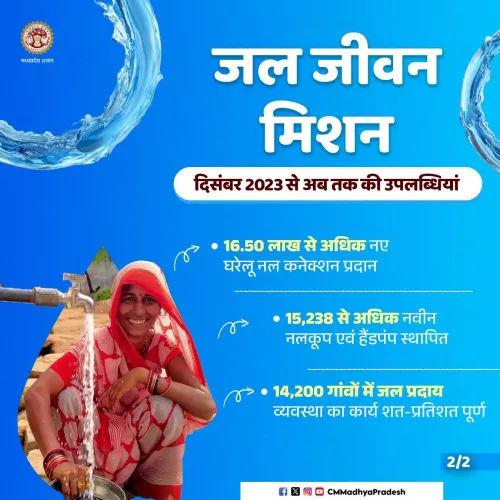
Har Ghar Jal is the state-level implementation arm of the Jal Jeevan Mission, the Government of India's flagship rural drinking-water programme launched in 2019 with a target of delivering functional household tap connections to every rural home. Uttar Pradesh, with one of the largest rural populations in the country, carries an outsize share of that national target — and Bundelkhand and Vindhya, given their history, represent its hardest test.
Progress in these districts would mark a genuine structural turnaround. Tanker relief is episodic and expensive; a piped connection is infrastructure that compounds — it changes what a family can do with its mornings, what a child's school attendance looks like, what a woman's daily burden is.
Why the Timing of This Statement Matters
Governments routinely invoke infrastructure delivery ahead of electoral cycles, and UP's political calendar makes the water story doubly significant. But beyond politics, the statement draws attention to a real, measurable question: how many households in these specific districts now have a functional tap connection? That number — not the announcement — will define the legacy of the programme in this region.
For now, CM Yogi is planting a flag in a place that once symbolised the state's most intractable failure. Whether every household in Bundelkhand and Vindhya has flowing water in its kitchen today remains the operative question — but the direction of travel, both in infrastructure and in political messaging, is unmistakable.
The tankers are no longer the story. The tap is.
Point of View
Kitchen-level achievement. Bundelkhand is a particularly resonant canvas: its drought identity was politically potent for opposition parties for decades, and any credible claim of transformation there chips away at a long-standing vulnerability. The statement also implicitly pressures the bureaucracy to close the last-mile gap, since the political capital invested in the claim now needs on-ground delivery to hold. Watch district-level tap-connection statistics from Bundelkhand and Vindhya for how fully the narrative is backed by verified numbers.
NationPress
23 Oct 2026
Frequently Asked Questions
What is the Har Ghar Jal scheme in Uttar Pradesh?
Har Ghar Jal is the household-level component of the central government's Jal Jeevan Mission, which aims to provide functional tap water connections to every rural home in India. In Uttar Pradesh, it is being implemented to bring piped drinking water to districts including those in Bundelkhand and the Vindhya region.
Why was water delivered by train to Bundelkhand?
Bundelkhand is a chronically drought-prone region spanning parts of Uttar Pradesh and Madhya Pradesh. During severe water shortages, the state government historically dispatched water trains and tankers as emergency relief measures to supply drinking water to the population.
What is the Jal Jeevan Mission and when was it launched?
The Jal Jeevan Mission is a central government scheme launched in 2019 with the goal of providing functional household tap connections for safe drinking water to every rural household in India. The state-level implementation in UP operates under the Har Ghar Jal programme.
Which districts in UP are part of the Vindhya region covered under Har Ghar Jal?
The Vindhya region of Uttar Pradesh includes districts such as Mirzapur and Sonbhadra, which are among the areas historically affected by water scarcity and are now targeted under the Har Ghar Jal scheme.
What did CM Yogi Adityanath say about water supply in Bundelkhand?
CM Yogi Adityanath said that while Bundelkhand and Vindhya once depended on water delivered by train and tanker, the Har Ghar Jal scheme is now visibly becoming a reality in these regions, signalling a shift to permanent piped water infrastructure.