CM Yogi Calls on Ayodhya's Critics to Return — With Apology
Synopsis
Uttar Pradesh Chief Minister Yogi Adityanath has challenged those he accused of firing on Ram devotees and ordering lathi charges on saints during the Ram Janmabhoomi movement to visit Ayodhya — only after publicly seeking forgiveness for their deeds.
Key Takeaways
CM Yogi Adityanath posted on 7 November 2026 challenging past perpetrators of violence against Ram devotees and saints to visit Ayodhya after seeking forgiveness.
The post evokes 1990s police firings and lathi charges on kar sevaks during the Ram Janmabhoomi movement under earlier Uttar Pradesh state administrations.
The Ram Temple at Ayodhya was inaugurated on 22 January 2024 following a Supreme Court verdict, after decades of legal and political struggle.
Yogi Adityanath, as head of the Gorakhnath Math , consistently frames the temple's construction as a moral and historical rectification.
No individual or party is named in the post, but the reference is widely understood in UP political discourse to target past Samajwadi Party and Congress-era administrations.
Opposition party responses are expected to sharpen the long-running political fault line over the Ram Janmabhoomi narrative.
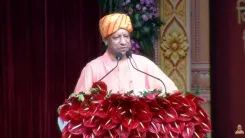
A city sacred to hundreds of millions of Hindus, and a political fault line that has defined Indian politics for decades — Uttar Pradesh Chief Minister Yogi Adityanath kept both realities in sharp focus on Saturday, 7 November 2026, when he posted a pointed message on X directed at those he accused of insulting Ayodhya, firing on Ram devotees, and carrying out lathi charges on saints.
Posting in Hindi, the Chief Minister said: 'Jin logon ne Shri Ayodhya Dham ko apmānit kiyā thā, Rāmbhakton par goliyān chalāī thīn, santoṃ ko apmānit kar un par lāṭhīchārj kie the, ve log Shri Ayodhya Dham zarūr āeṃ, lekin māfī māngkar āeṃ... apne kṛtyoṃ ke liye paścātāp kar leṃ...' — 'Those who had insulted Shri Ayodhya Dham, fired bullets at Ram devotees, humiliated saints and ordered lathi charges on them — such people must come to Shri Ayodhya Dham, but come seeking forgiveness... repent for their deeds.'
Bullets, Lathis, and a Wound That Never Closed
The imagery in Yogi Adityanath's message is not rhetorical decoration — it is a direct callback to the bloodiest chapters of the Ram Janmabhoomi movement of the 1990s. During that period, kar sevaks marching toward Ayodhya were met with police firing and batons under state administrations then in power in Uttar Pradesh. Saints and religious leaders who led processions were detained, dispersed, and in some cases injured. Those events hardened the movement's resolve and seared a collective grievance into the memory of a generation of Ram devotees.
Yogi Adityanath has invoked that memory consistently across his political career. As head of the Gorakhnath Math in Gorakhpur and as the longest-serving current Chief Minister of Uttar Pradesh, he frames the Ram Temple's inauguration on 22 January 2024 not merely as a legal or political outcome but as the moral redemption of a wrong committed decades ago. Saturday's post carries that same logic forward: the temple is built, the city is redeemed — but the reckoning, he argues, is incomplete without acknowledgement from those responsible.
Ayodhya's New Standing — and Old Politics
Since the Supreme Court's landmark verdict cleared the path for temple construction and the subsequent grand inauguration in early 2024, Ayodhya has undergone a sweeping transformation. The city has been expanded, beautified, and repositioned as one of India's foremost pilgrimage and tourism destinations. For the BJP, Ayodhya is simultaneously a sacred space and a supreme symbol of political achievement — the tangible proof of a promise kept after three decades.
Yogi Adityanath's choice to frame an invitation to Ayodhya around the condition of public apology is a pointed political move. It plants the site of triumph at the centre of a new accountability demand, daring opponents to either accept the framing or rebut it. Opposition parties have not historically accepted the BJP's narrative of victimhood surrounding the Ram Janmabhoomi movement, and responses to this post are likely to sharpen that fault line once again.
Who Is Being Asked to Seek Forgiveness
The Chief Minister does not name any individual or party in the post — but the reference to those who 'fired on Ram devotees' and 'humiliated saints' points unmistakably at past governments of Uttar Pradesh, widely understood in BJP political discourse to refer to Samajwadi Party and Congress-era administrations. By addressing them as 've log' — 'those people' — Yogi Adityanath keeps the accusation broad enough to encompass multiple decades of political opponents while maintaining the religious register of the message.
The tone is combative but calibrated: it is an invitation wrapped in a demand. Come to Ayodhya, he says — but the price of entry is contrition. That framing transforms the holiest site in his political universe into a court of moral reckoning, with Yogi Adityanath as its self-appointed interlocutor. Whether any opposition leader accepts the terms, rejects them, or simply ignores the challenge will define the next beat of this story.
Point of View
He keeps the Ram Janmabhoomi grievance politically alive even after its central demand — the temple — has been met. The move is designed to force opponents into a no-win choice: accept a humiliating framing or appear to dodge accountability for 1990s-era violence. With assembly election cycles always on the horizon in Uttar Pradesh, anchoring identity politics to Ayodhya remains the BJP's most durable electoral instrument.
NationPress
7 Nov 2026
Frequently Asked Questions
What did Yogi Adityanath say about Ayodhya on 7 November 2026?
CM Yogi Adityanath said that those who insulted Ayodhya, fired on Ram devotees, and ordered lathi charges on saints are welcome to visit Ayodhya — but must come seeking forgiveness and repenting for their deeds.
Who is Yogi Adityanath referring to in his Ayodhya apology post?
While no individual or party is named, the references to firings on kar sevaks and lathi charges on saints point to past Uttar Pradesh state governments, widely understood in BJP discourse to mean Samajwadi Party and Congress-era administrations of the 1990s.
When was the Ram Temple in Ayodhya inaugurated?
The Ram Temple at Ayodhya was inaugurated on 22 January 2024 , following a Supreme Court verdict that paved the way for its construction after decades of legal and political dispute.
What happened to kar sevaks and saints in Ayodhya in the 1990s?
During the Ram Janmabhoomi movement in the 1990s, kar sevaks marching toward Ayodhya faced police firing and lathi charges under state administrations then governing Uttar Pradesh; saints leading processions were also detained and reportedly humiliated.
What is the Gorakhnath Math and what is its connection to CM Yogi?
The Gorakhnath Math is a prominent Hindu monastery in Gorakhpur, Uttar Pradesh. Yogi Adityanath serves as its head priest, a position that underpins his religious authority and shapes his political identity as a champion of Hindu causes including the Ram Janmabhoomi movement.