CM Yogi Extends Social Security to UP Teachers, Shiksha Mitras
Synopsis
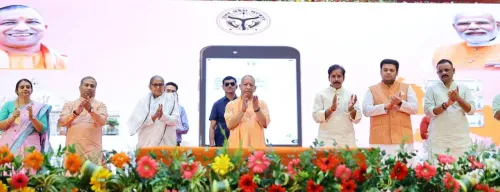
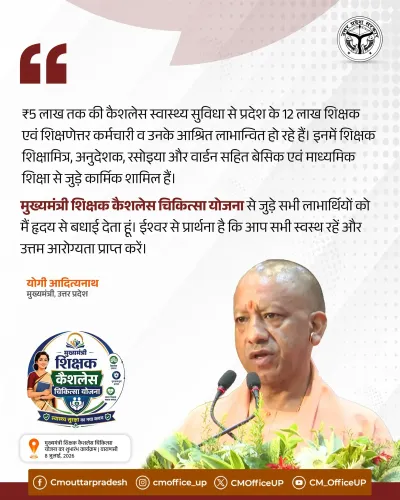
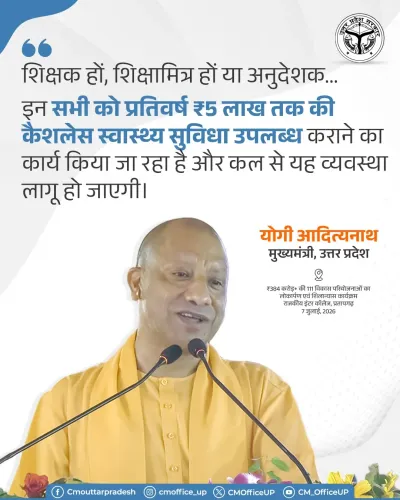
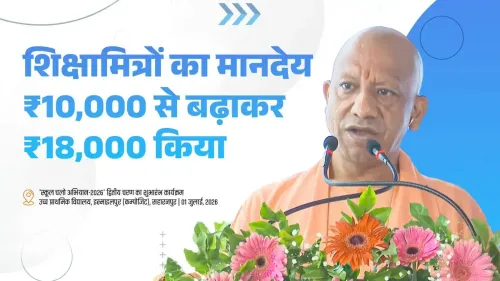
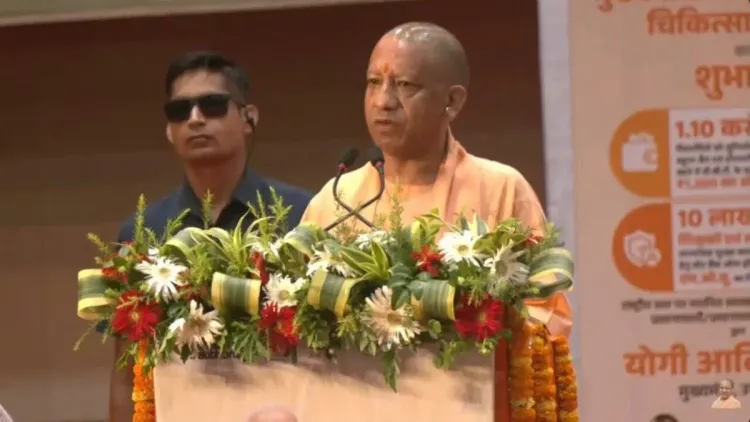
Uttar Pradesh Chief Minister Yogi Adityanath announced on 8 July 2026 that the state is guaranteeing social security to every teacher, Shiksha Mitra, and instructor — claiming UP is the first state in India to implement such a system for all three categories of education workers.
Key Takeaways
CM Yogi Adityanath announced on 8 July 2026 that Uttar Pradesh is guaranteeing social security to all teachers, Shiksha Mitras, and instructors in the state.
The government claims Uttar Pradesh is the first state in India to implement this social security arrangement for all three categories of education workers.
The Shiksha Mitra programme, launched around 1999 , deployed para-teachers in UP primary schools on contractual terms, leaving them without regular service protections for decades.
Since 2017 , the Yogi Adityanath government has taken steps to improve service conditions for Shiksha Mitras; Wednesday's announcement is the latest in that arc.
Specific scheme mechanics, coverage numbers, and budget allocations are yet to be formally notified by the state government.
The move could prompt other states to examine similar frameworks for contractual education staff.
Uttar Pradesh Chief Minister Yogi Adityanath on Wednesday, 8 July 2026, announced that the state government is guaranteeing social security coverage to every teacher, Shiksha Mitra, and instructor in Uttar Pradesh, describing the move as a first-of-its-kind initiative in the country.
Context
Posting on X, CM Yogi stated, 'हर शिक्षक, शिक्षामित्र और अनुदेशक को सामाजिक सुरक्षा की गारंटी हम दे रहे हैं' — 'We are guaranteeing social security to every teacher, Shiksha Mitra, and instructor.' He added that Uttar Pradesh is the first state in the country where this arrangement is being implemented. The announcement covers three distinct categories of education workers: regular teachers, para-teachers known as Shiksha Mitras, and contract instructors.
Policy Backdrop
The Shiksha Mitra programme was launched in Uttar Pradesh around 1999 to address acute teacher shortages in primary schools by deploying locally recruited para-teachers on contractual terms. For years, Shiksha Mitras operated without the service guarantees available to regular government employees, and their demands for regularisation led to prolonged legal and administrative proceedings. Since 2017, the Yogi Adityanath government has taken incremental steps to stabilise their service conditions, and Wednesday's announcement represents the latest — and, the government claims, the most comprehensive — extension of welfare protections to this group.
The broader pattern across India has seen state governments grapple with how to extend pension, insurance, and health coverage to contractual education staff without the fiscal weight of full regularisation. Uttar Pradesh's move, if fully implemented, could set a template that other large states examine closely.
Stakeholders and Impact
Uttar Pradesh is India's most populous state, with one of the largest elementary school systems in the country. The three categories mentioned — teachers, Shiksha Mitras, and instructors — together represent a significant workforce in the state's basic education apparatus. For Shiksha Mitras in particular, who have historically been the most vulnerable to service uncertainty, a formal social security guarantee would mark a substantive change in their employment standing. Families of these workers stand to gain access to protections such as insurance or pension-linked benefits, though the specific scheme mechanics are yet to be detailed publicly.
What's Next
Attention will now turn to the Uttar Pradesh government's formal policy notifications, budget allocations, and eligibility criteria that will define who qualifies and under what terms. The claim that UP is the first state to implement such a system will also invite scrutiny from other state administrations and education policy observers. Should the framework prove workable, announcements of replication by other states could follow, making this a significant moment in the national conversation around contractual worker welfare in public education.
Point of View
Politically significant workforce. By framing Uttar Pradesh as a national first, the government is also staking a reputational claim in the competitive space of state-level education governance ahead of future electoral cycles. The move carries real policy weight for Shiksha Mitras, who have been in a legal and administrative limbo for over two decades, but the credibility of the 'first in India' claim will depend on the specifics of the scheme once formally notified. For the broader national debate on contractual worker welfare, UP's framework — if implemented robustly — could shift the benchmark that other states are measured against.
NationPress
8 Jul 2026
Frequently Asked Questions
What did CM Yogi announce for UP teachers on 8 July 2026?
CM Yogi Adityanath announced that the Uttar Pradesh government is guaranteeing social security to every teacher, Shiksha Mitra, and instructor in the state, describing UP as the first state in India to implement such an arrangement.
Who are Shiksha Mitras in Uttar Pradesh?
Shiksha Mitras are para-teachers recruited locally under a programme launched in Uttar Pradesh around 1999 to address teacher shortages in primary schools. They have historically worked on contractual terms without the full service benefits available to regular government teachers.
Is UP really the first state in India to give social security to teachers and Shiksha Mitras?
The Yogi Adityanath government has made this claim, but the specific scheme mechanics and formal policy notification are yet to be released publicly, so independent verification of the 'first in India' assertion will depend on those details.
What benefits will Shiksha Mitras get under the new UP social security guarantee?
The government has not yet formally notified the specific benefits, eligibility rules, or scheme mechanics. The announcement indicates coverage will extend to teachers, Shiksha Mitras, and instructors, with further details expected through official policy notifications.
How many Shiksha Mitras are there in Uttar Pradesh?
Exact current figures have not been specified in the government's announcement. Uttar Pradesh has one of India's largest elementary school systems, and the Shiksha Mitra programme has historically involved a substantial number of para-teachers across the state.