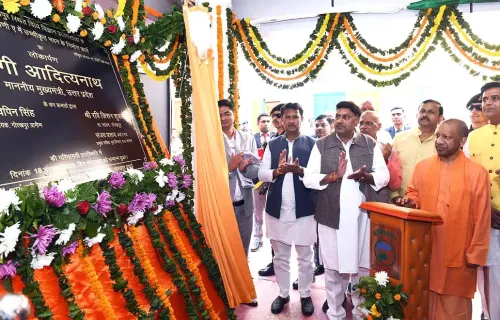
CM Yogi: Forensic Lab Now Active in Every UP Police Range

Synopsis
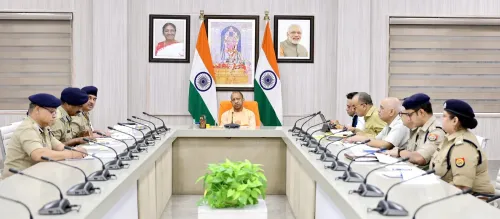
Chief Minister Yogi Adityanath announced that an operational forensic science laboratory now functions in every Uttar Pradesh police range, enabling investigators to produce court-ready evidence within days — a milestone in the state's decade-long push to modernise criminal justice infrastructure.
Key Takeaways
CM Yogi Adityanath confirmed on 24 October 2026 that a forensic lab is now actively operational in every police range in Uttar Pradesh .
Samples collected at crime scenes can be processed and submitted as court-admissible evidence within a few days , according to the Chief Minister.
The expansion covers every administrative range of the Uttar Pradesh Police , reducing dependence on distant central forensic facilities.
The initiative is part of a law-and-order modernisation drive that has been a policy priority since March 2017 .
The shift is designed to reduce reliance on witness-based prosecution and strengthen scientific, forensic-evidence-led cases in court.
Uttar Pradesh has quietly crossed a threshold in criminal justice infrastructure — every police range in the state now has an operational forensic science laboratory, Chief Minister Yogi Adityanath declared on Saturday, 24 October 2026. Samples collected at crime scenes can be processed and placed before any court as admissible evidence within days, he said, marking a concrete shift in how the state builds criminal cases.
Quoting the Chief Minister directly: 'आज हर रेंज में एक फॉरेंसिक लैब सक्रिय रूप से कार्य कर रही है। हम सैंपल लेते हैं और कुछ ही दिनों के अंदर उसे साक्ष्य के रूप में किसी भी न्यायालय के समक्ष प्रस्तुत करने में सक्षम हैं।' — 'Today a forensic lab is actively functioning in every range. We collect samples and are able to present them as evidence before any court within just a few days.'
One lab per range — what that means on the ground
Uttar Pradesh Police is organised into multiple administrative ranges, each covering several districts. Placing a fully active forensic lab in each range means investigators no longer need to route biological, chemical, or digital samples to a distant central facility — the processing happens closer to the crime scene and the court. Shorter transit, faster turnaround, and a tighter chain of custody are the immediate operational gains.
The significance for the state judiciary is direct: scientific evidence that arrives quickly is evidence that can anchor a trial calendar. Delays in forensic reports have historically been one of the leading causes of prolonged bail hearings and stalled prosecutions in high-volume criminal courts across Uttar Pradesh.
A decade-long modernisation push reaches a milestone
Since March 2017, the Yogi Adityanath government has made police modernisation a centrepiece of its law-and-order agenda. Forensic capacity expansion has been a running thread — the goal being to shift prosecution from a witness-dependent model, which is vulnerable to intimidation and retraction, toward a science-dependent one that can stand independently in court.
The broader logic is about conviction rates. A case built on forensic evidence — DNA, toxicology, digital forensics, ballistics — is structurally harder to dismantle than one resting on eyewitness testimony alone. Expanding lab reach to the range level compresses the window between a crime and a court-ready evidence file.
What police investigators and crime victims now gain
For investigators, range-level labs mean faster decisions on bail opposition and charge-sheets. For victims and their families — particularly in cases involving serious crimes — it means the evidentiary clock starts running from the moment of sample collection, not from the day a backlogged central lab gets to their case. That is a substantive change in how justice feels on the ground.
Uttar Pradesh, as India's most populous state, runs one of the country's highest-volume criminal justice systems. Incremental improvements in forensic throughput here carry outsized national weight in any conversation about judicial reform and case-clearance rates.
The forensic lab network is now a live asset — the test will be whether conviction data, in the months and years ahead, confirms what the infrastructure now promises.
Point of View
Not a standalone headline. By compressing the gap between evidence collection and court submission, the Yogi government is attempting to structurally reduce two long-standing vulnerabilities in UP's criminal justice system: forensic backlog and witness-retraction risk. The political calculus is clear — conviction rates are a visible governance metric, and a science-backed prosecution chain is far harder for defence counsel to dismantle than a witness lineup. The announcement also signals that UP is consciously aligning its policing model with national forensic reform trends, though whether the lab network translates into measurable improvements in conviction and case-clearance data will be the real test of the initiative's durability.
NationPress
24 Oct 2026
Frequently Asked Questions
How many forensic labs does Uttar Pradesh have now?
Chief Minister Yogi Adityanath announced that one forensic science laboratory is now actively operational in every police range in Uttar Pradesh, meaning the network covers all administrative ranges of the state police.
How fast can UP police prepare forensic evidence for court?
According to CM Yogi Adityanath's statement, samples collected at crime scenes can be processed and presented as admissible evidence before any court within a few days of collection.
What is the purpose of range-level forensic labs in Uttar Pradesh?
Range-level labs allow investigators to process evidence closer to the crime scene, shortening turnaround times, tightening the chain of custody, and reducing the prosecution's dependence on witness testimony in criminal trials.
When did Uttar Pradesh start expanding its forensic infrastructure?
Uttar Pradesh's push to expand forensic capacity and modernise its police force has been a priority since March 2017, when the Yogi Adityanath government came to power with a strong law-and-order mandate.
Why does forensic evidence matter more than witness testimony in court?
Forensic evidence — such as DNA, toxicology, or digital records — is more resistant to intimidation and retraction than eyewitness accounts, making it a structurally stronger foundation for prosecution in high-stakes criminal cases.