CM Yogi Marks 12 Years of Modi's Leadership With Tribute
Synopsis
Uttar Pradesh Chief Minister Yogi Adityanath marked Prime Minister Narendra Modi's 12th anniversary in office with a detailed tribute on X, crediting schemes like Jan Dhan, Ayushman Bharat, Ujjwala, and SVANidhi with delivering development to ordinary citizens and positioning India as a confident global power.
Key Takeaways
CM Yogi Adityanath posted a tribute on 26 May 2026 marking PM Modi's 12 years as Prime Minister.
The post praised Modi as 'Pradhan Sevak' and cited welfare, national security, and global standing as key achievements.
Five schemes were named: PM Awas Yojana, Jan Dhan, Ayushman Bharat, Ujjwala , and SVANidhi .
The tribute invoked Viksit Bharat 2047 and the 'trinity' of Digital, Demography, and Democracy as pillars of future progress.
The governing slogan 'Sabka Saath, Sabka Vikas, Sabka Vishwas, Sabka Prayas' was cited as the unifying framework of the Modi era.
India's border resolve and counter-terror posture were highlighted as markers of assertive foreign and security policy.
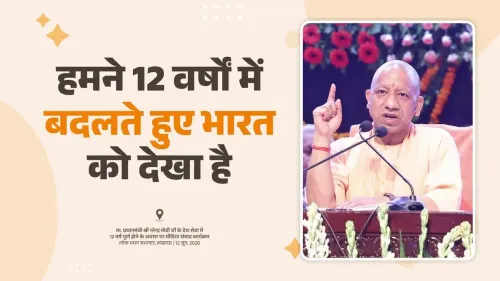
Uttar Pradesh Chief Minister Yogi Adityanath on Tuesday, 26 May 2026 congratulated Prime Minister Narendra Modi on completing 12 years in office, hailing him as the world's most popular leader and crediting his tenure with transforming welfare governance, national security, and India's global standing.
Context
Narendra Modi was sworn in as Prime Minister on 26 May 2014, marking the beginning of a tenure that has now stretched across two full terms. CM Yogi, writing in Hindi on X, described Modi as 'Pradhan Sevak' — 'the principal servant' — a self-description Modi has used to frame his role as one of public service rather than political authority.
The post offered an expansive tribute, stating that in these years 'garib kalyan shasan ki prathamikta bana' — 'welfare of the poor became the priority of governance' — and that 'antyodaya atmanirbharta ki shakti mein badla', meaning 'Antyodaya was transformed into the strength of self-reliance.'
Policy Backdrop
CM Yogi specifically named five flagship central government schemes as evidence of development reaching ordinary citizens: Pradhan Mantri Awas Yojana (housing), Jan Dhan (financial inclusion), Ayushman Bharat (health coverage), Ujjwala (LPG connections for women), and SVANidhi (micro-credit for street vendors).
Pradhan Mantri Jan Dhan Yojana was launched in August 2014 to bring unbanked households into the formal financial system. Pradhan Mantri Ujjwala Yojana, inaugurated in May 2016, extended clean cooking fuel access to women from below-poverty-line households, while Ayushman Bharat, announced in the 2018 Union Budget, created a national health insurance framework for economically weaker families. PM SVANidhi was launched in 2020 to support street vendors impacted by the pandemic.
The tribute also invoked the governing slogan 'Sabka Saath, Sabka Vikas, Sabka Vishwas, Sabka Prayas' — 'Together with all, development for all, trust of all, effort of all' — and the long-term national vision of Viksit Bharat 2047, which aims for developed-nation status by India's independence centenary.
Stakeholders and Impact
The schemes cited by CM Yogi collectively target poor households, women beneficiaries, rural families, and street vendors — constituencies that have been central to the BJP's political and welfare messaging since 2014. The post frames these groups not merely as recipients of government aid but as active participants in a broader national movement.
On foreign policy and security, CM Yogi described India as 'seemaon par adig, aatank ke viruddh nirnayak' — 'unwavering at borders, decisive against terror' — and said the country now stands as a 'strong, credible leadership' on the world stage. He also invoked the 'trinity' of 'Digital, Demography aur Democracy' as the driving force accelerating India toward Viksit Bharat 2047.
What's Next
The anniversary of Modi's swearing-in on 26 May has become a recurring moment for senior BJP leaders and allied chief ministers to articulate the government's governance record and reinforce its welfare narrative. Budget allocations and scheme expansions under the 2026-27 Union Budget, along with forthcoming NITI Aayog reviews of Viksit Bharat 2047 targets, will be closely watched as benchmarks against the claims of progress made in tributes such as this one. The language of 'Nation First' and Atmanirbhar Bharat signals that these themes will continue to anchor the ruling party's communication in the months ahead.
Point of View
The post moves beyond ceremonial congratulation into a structured defence of the government's policy record. The framing of 'Nation First' and Atmanirbhar Bharat alongside border resolve and anti-terror resolve signals that the party intends to contest both the economic and security dimensions of the public discourse simultaneously. For Yogi Adityanath, who governs India's most populous state, aligning publicly and effusively with Modi's legacy also reinforces his own political positioning within the BJP's national hierarchy.
NationPress
9 Oct 2026
Frequently Asked Questions
When did Narendra Modi complete 12 years as Prime Minister?
Narendra Modi completed 12 years as Prime Minister on 26 May 2026 , having first been sworn in on 26 May 2014 .
What did CM Yogi say about PM Modi's 12 years?
CM Yogi Adityanath called Modi the world's most popular leader and credited his tenure with prioritising welfare of the poor, strengthening national security, and elevating India's global standing, specifically naming schemes like Jan Dhan, Ayushman Bharat, and Ujjwala.
What is Viksit Bharat 2047?
Viksit Bharat 2047 is the central government's long-term vision to achieve developed-nation status for India by 2047 , the centenary of its independence.
What schemes did CM Yogi mention in his tribute to Modi?
CM Yogi named Pradhan Mantri Awas Yojana, Jan Dhan, Ayushman Bharat, Ujjwala , and SVANidhi as flagship programmes that brought development to ordinary citizens.
What does 'Pradhan Sevak' mean?
'Pradhan Sevak' translates to 'the principal servant' in English. It is a term Prime Minister Modi has used to describe his own role, framing his position as one of service to the people rather than political authority.