CM Yogi Credits ODOP for Banda Shajar Stone's Global Rise

Synopsis
Chief Minister Yogi Adityanath has credited PM Modi's One District One Product scheme for transforming Banda's Shajar stone into a globally recognised precious gem, now attracting orders from major companies in India and abroad.
Key Takeaways
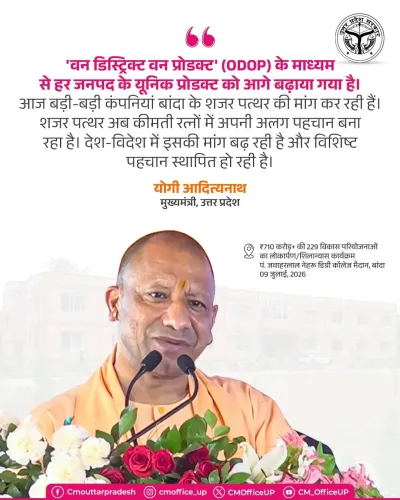
The Chief Minister's Office of Uttar Pradesh posted on 9 July 2026 that major companies are now sourcing Banda's Shajar stone .
CM Yogi Adityanath attributed this commercial rise directly to PM Narendra Modi 's One District One Product (ODOP) scheme.
The Shajar stone , a fossilised wood variety unique to Banda district , is now being counted among precious gems in domestic and international markets.
ODOP was launched by the Uttar Pradesh government in January 2018 to identify and scale one signature product from each of the state's 75 districts .
Local artisans and gem and jewellery exporters are the primary stakeholders benefiting from the scheme's market linkages.
A possible GI tag for Banda's Shajar stone and new common facility centres in the district are being watched as next steps.
The Chief Minister's Office of Uttar Pradesh on Thursday, 9 July 2026 shared a statement from Chief Minister Yogi Adityanath highlighting how Banda district's rare Shajar stone is now being sourced by major companies and gaining recognition as a precious gem both within India and internationally, attributing this transformation to Prime Minister Narendra Modi's One District One Product (ODOP) scheme.
Context
The statement, posted in Hindi on the official CMO account, quotes CM Yogi Adityanath as saying: 'Aaj badi companies Banda ke Shajar patthar ko manga rahi hain, desh-videsh mein iski ginati keemti ratan ke roop mein ho rahi hai' — 'Today, major companies are placing orders for Banda's Shajar stone; it is being counted among precious gems both at home and abroad.' He directly credits this to Prime Minister Modi's vision of 'One District One Product' (ODOP).
The Shajar stone, a variety of fossilised wood found in the Banda district of Uttar Pradesh, is prized for its natural, tree-like patterns embedded within the stone. It has traditionally been used in jewellery, decorative items, and craft work by local artisans.
Policy Backdrop
The One District One Product scheme was launched by the Uttar Pradesh government in January 2018 to identify and scale one signature product from each of the state's 75 districts, providing targeted support in the form of branding, credit access, and market linkages. The initiative was later adopted as a central government programme to replicate the model across all states.
Under ODOP, district-specific products receive assistance ranging from MSME credit facilitation and e-commerce onboarding to representation at national and international trade expos. The programme is designed to formalise traditional craft economies and integrate them into global supply chains, building on earlier geographical indication (GI) and craft promotion efforts.
Banda's Shajar stone was identified as the district's ODOP product, making it eligible for this ecosystem of promotional and financial support — a step widely seen as key to unlocking its commercial potential beyond local markets.
Stakeholders and Impact
The primary beneficiaries of this growth are local artisans and stone-craft workers in Banda, many of whom depend on the Shajar stone trade for their livelihoods. Formal market linkages created under ODOP have opened channels to larger buyers, including organised gem and jewellery exporters who were previously not engaged with the district's output.
The broader gem and jewellery export sector also stands to benefit as Shajar stone gains a distinct identity in domestic and international markets. Policymakers view such district-level success stories as proof-of-concept for scaling the ODOP model to other underexplored natural and craft resources across Uttar Pradesh and the country.
What's Next
Observers will watch whether Banda's Shajar stone is added to India's Geographical Indication (GI) registry, a move that would provide legal protection for the product's identity and further strengthen its premium positioning in international markets. The establishment of common facility centres in Banda — providing shared processing and finishing infrastructure to artisans — is another possibility being tracked by industry stakeholders.
More broadly, the UP government's continued emphasis on ODOP milestones ahead of key trade events signals that district-level product promotion will remain a central plank of the state's economic outreach, with Banda's Shajar stone now serving as a flagship example of what the scheme can achieve.
Point of View
Banda's Shajar stone represents the scheme's strongest argument: that targeted branding and market access can commercialise resources that were previously confined to informal, low-value local trade. The longer-term test will be whether GI protection and infrastructure investment follow, converting a political highlight into a durable economic asset for Banda's artisans.
NationPress
8 Oct 2026
Frequently Asked Questions
What is Banda Shajar stone?
Banda Shajar stone is a variety of fossilised wood found in the Banda district of Uttar Pradesh , prized for its natural tree-like patterns. It is used in jewellery, decorative crafts, and is now gaining recognition as a precious gem in Indian and international markets.
What is the One District One Product (ODOP) scheme?
The One District One Product (ODOP) scheme was launched by the Uttar Pradesh government in January 2018 to identify one signature product per district and support it with branding, credit, and market linkages. It was later adopted as a central government initiative.
Why is CM Yogi talking about Banda Shajar stone?
CM Yogi Adityanath highlighted Banda's Shajar stone on 9 July 2026 to showcase the success of the ODOP scheme, noting that major companies are now placing orders for the stone and that it is being recognised as a precious gem domestically and globally.
Does Banda Shajar stone have a GI tag?
As of the information available, Banda's Shajar stone does not yet have a confirmed Geographical Indication (GI) tag . Inclusion in the GI registry is one of the developments being watched as a potential next step to protect and promote the product's identity.
Who benefits from the ODOP scheme in Banda?
The primary beneficiaries are local artisans and stone-craft workers in Banda , who gain access to formal markets and larger buyers. Gem and jewellery exporters also benefit as the Shajar stone develops a distinct commercial identity.