CM Yogi orders modernisation push for UP's Mati Kala artisans
Synopsis
Chief Minister Yogi Adityanath has ordered a time-bound departmental plan to modernise Uttar Pradesh's Mati Kala sector, equipping clay-craft artisans with solar chaaks, modern design training, bank credit and marketing support to create self-employment for rural youth and women.
Key Takeaways
CM Yogi Adityanath reviewed the Mati Kala sector and issued directives for its comprehensive modernisation on 8 June 2026 .
Artisans are to be linked to solar chaaks , modern design inputs, improved tools, financial assistance and expanded marketing facilities.
Departments have been ordered to prepare a time-bound action plan covering training, bank coordination, technical upgrades and employment generation.
The initiative targets rural youth, women and traditional artisans as primary beneficiaries under an Atmanirbhar Bharat framework.
The push extends the state's ODOP programme (launched 2018), which already identifies pottery and terracotta as district-specific crafts for scaling.
Bank-linkage camps in identified Mati Kala clusters are expected as the next concrete implementation step.
The Chief Minister's Office of Uttar Pradesh announced on Monday, 8 June 2026 that Chief Minister Yogi Adityanath has directed state departments to prepare a time-bound action plan to modernise the Mati Kala (clay craft) sector, linking artisans to solar-powered equipment, modern design training, financial assistance and expanded marketing channels.
Context
Reviewing the state of the Mati Kala sector, CM Yogi observed that the craft is 'prदेश की सांस्कृतिक विरासत, पर्यावरण संरक्षण और ग्रामीण रोजगार से सीधे जुड़ा हुआ' — directly linked to Uttar Pradesh's cultural heritage, environmental conservation and rural employment. The review underscored the state's intent to treat clay crafts not merely as a heritage activity but as a viable livelihood engine for rural communities.
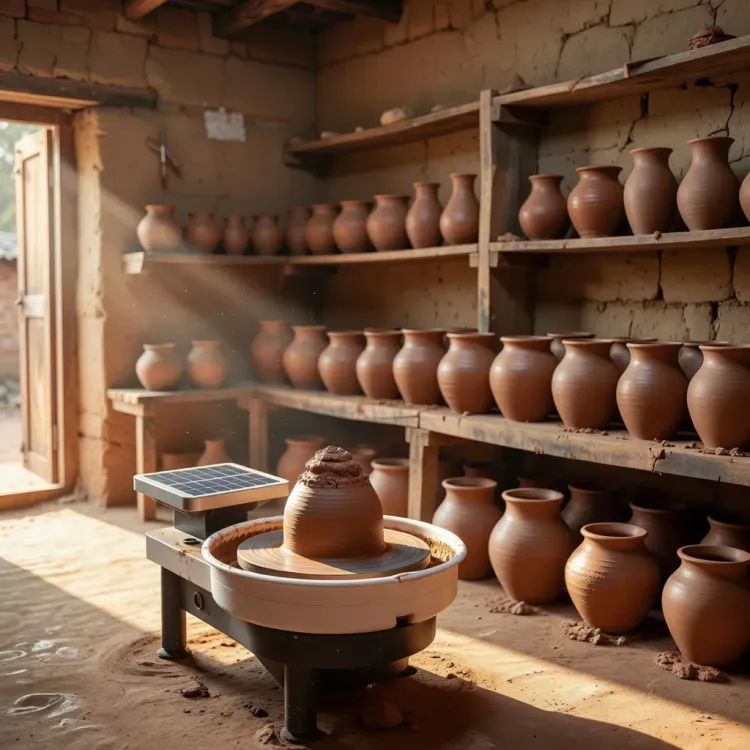
The Chief Minister specifically directed that artisans be equipped with solar chaaks (solar-powered potter's wheels), better tools, modern design inputs, financial support and marketing facilities. Departments were told to coordinate with banks to ensure credit reaches working artisans without delay.
Policy backdrop
The directive builds on a consistent policy thread in Uttar Pradesh. The state's One District One Product (ODOP) programme, launched in 2018, identified pottery and terracotta as district-specific crafts to be scaled through dedicated branding, credit and market linkages. Between 2020 and 2023, several state orders integrated solar-powered equipment and design training into handicraft clusters under the Deendayal Antyodaya Yojana–National Rural Livelihoods Mission.
The renewed push aligns with the national Atmanirbhar Bharat framework, which encourages self-reliance through technology-assisted upgrades to traditional industries. Uttar Pradesh has repeatedly paired cultural-heritage preservation with formal credit access and technology adoption to generate non-farm rural employment, particularly in clusters with established artisan communities and raw-material availability.
Stakeholders and impact
The intervention is explicitly aimed at rural youth, women and traditional artisans — groups that the Chief Minister's Office identified as the primary beneficiaries of the planned action plan. By routing support through bank coordination and time-bound departmental targets, the government aims to move beyond ad-hoc assistance toward a structured pipeline of training, credit, technology and markets.
Clay-craft clusters across Uttar Pradesh have historically faced challenges including limited access to formal credit, outdated production equipment and weak market linkages outside local fairs. The introduction of solar chaaks, in particular, addresses both the energy cost burden on artisans and the state's broader environmental commitments.
What's next
Departments have been instructed to produce a time-bound action plan covering training, bank linkage camps, technical upgrades, marketing support and employment generation. The release of that plan and the subsequent rollout of bank-coordination camps in identified Mati Kala clusters will be the immediate milestones to watch.
If implemented at scale, the initiative could expand self-employment opportunities for artisans in one of India's most craft-dense states, while reinforcing Uttar Pradesh's positioning of its GI-tagged and traditional crafts as competitive products in domestic and export markets.
Point of View
The government is signalling a shift from symbolic support to measurable delivery metrics. The explicit naming of rural youth and women as beneficiaries also fits a broader electoral calculus in a state where non-farm rural livelihoods remain a persistent policy and political challenge. Whether the action plan translates into ground-level credit disbursal and equipment distribution will determine whether this review meeting becomes a genuine inflection point or another well-intentioned directive.
NationPress
24 Oct 2026
Frequently Asked Questions
What is Mati Kala and why is UP focusing on it?
Mati Kala refers to traditional clay and terracotta craftsmanship practised across Uttar Pradesh. The state is focusing on it because it links cultural heritage, environmental sustainability and rural livelihoods, making it a natural vehicle for non-farm employment generation.
What is a solar chaak and how will it help potters?
A solar chaak is a solar-powered potter's wheel that reduces dependence on manual effort and conventional electricity, cutting production costs for artisans. CM Yogi's directive includes distributing solar chaaks to Mati Kala artisans as part of a broader technology upgrade.
How does this relate to the One District One Product scheme?
The ODOP scheme, launched in 2018, already identifies pottery and terracotta as district-specific crafts in Uttar Pradesh and provides branding, credit and market-linkage support. The new Mati Kala directive deepens that framework by adding solar equipment, modern design training and time-bound departmental accountability.
Who are the main beneficiaries of the Mati Kala modernisation plan?
The Chief Minister's Office has specifically named rural youth, women and traditional artisans as the primary beneficiaries, with the goal of creating new self-employment opportunities under the Atmanirbhar Bharat framework.
What happens next after CM Yogi's Mati Kala review?
State departments are required to submit a time-bound action plan covering training, bank coordination for financial assistance, technical upgrades and marketing support. Bank-linkage camps in identified Mati Kala clusters are expected to follow as the first concrete implementation step.