CM Yogi pays tribute to Vinoba Bhave on his death anniversary
Synopsis
On Vinoba Bhave's death anniversary, UP CM Yogi Adityanath honoured the Bharat Ratna-winning freedom fighter and Bhoodan Movement founder, linking his ideals of non-violence and Sarvodaya to the concept of Antyodaya.
Key Takeaways
UP CM Yogi Adityanath posted a tribute to Acharya Vinoba Bhave on his death anniversary on 15 November 2026 .
Vinoba Bhave launched the Bhoodan Movement in 1951 , walking across India to collect voluntary land donations for the landless poor.
Bhave was awarded the Bharat Ratna in 1983 , India's highest civilian honour.
CM Yogi linked Bhave's philosophy of Sarvodaya (welfare of all) to the BJP's ideological concept of Antyodaya (upliftment of the last person).
The tribute reflects a broader pattern of Indian political leaders connecting Gandhian independence-era thought to contemporary welfare frameworks.
Seven decades after a soft-spoken saint walked from village to village asking landlords to give away their land, Uttar Pradesh Chief Minister Yogi Adityanath paused on Sunday, 15 November 2026, to honour the man who made that extraordinary journey — Acharya Vinoba Bhave — on his death anniversary.
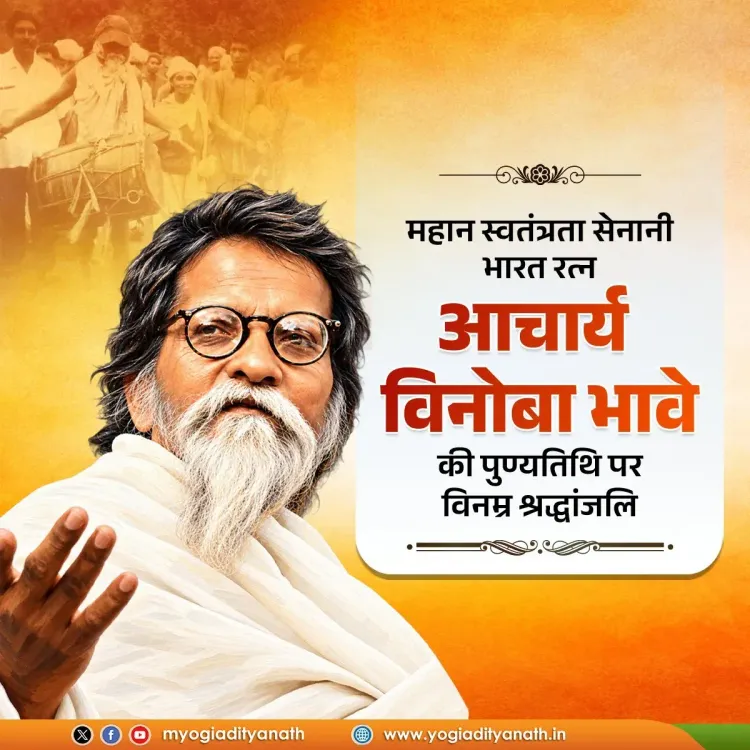
Posting on X in Hindi, CM Yogi offered his tribute: 'Mahan swatantrata senani evam Bhoodan Andolan ke praneta, Bharat Ratna Acharya Vinoba Bhave ki punyatithi par vinamra shraddhanjali.' ('Humble homage on the death anniversary of great freedom fighter and founder of the Bhoodan Movement, Bharat Ratna Acharya Vinoba Bhave.') He described Bhave's life — devoted to non-violence, Gram Swaraj, and Sarvodaya — as a living example of the ideals of Antyodaya, the principle of upliftment of the last person in line.
The man who asked for land — and received it
Acharya Vinoba Bhave, one of Mahatma Gandhi's closest disciples, launched the Bhoodan Movement in 1951 in the Telangana region, walking across the country to persuade landowners to voluntarily donate a portion of their land to the landless poor. It was an audacious act of moral persuasion on a national scale — no legislation, no coercion, just conscience. At its peak, the movement collected millions of acres in pledges, reshaping how post-Independence India thought about rural equity.
Bhave was awarded the Bharat Ratna, India's highest civilian honour, in 1983 — posthumously recognised for a life that fused Gandhian philosophy with ground-level social action. His concept of Sarvodaya (welfare of all) sat alongside Gram Swaraj (village self-rule) as twin pillars of an India-first development vision that predated modern welfare architecture.
Why Antyodaya remains the bridge between then and now
CM Yogi's specific invocation of Antyodaya — the idea of prioritising those at the very bottom of the social ladder — is deliberate and pointed. The term, coined by Pandit Deendayal Upadhyaya and central to the BJP's ideological vocabulary, finds a natural kinship with Bhave's Sarvodaya. By linking the two, the tribute draws a philosophical line from India's Gandhian independence movement to present-day welfare policy, suggesting continuity rather than rupture.
Indian political leaders across the spectrum routinely mark the death anniversaries of independence-era icons through such public remembrances. What gives this one texture is the deliberate pairing of three distinct Bhavean concepts — non-violence, village self-rule, and universal welfare — with the contemporary Antyodaya framework, grounding a ceremonial tribute in an ongoing ideological conversation.
Point of View
The Chief Minister maps a Gandhian saint onto the BJP's own welfare vocabulary, suggesting a philosophical lineage that transcends party lines. This is a recurring tactic in Indian political communication: appropriating the moral authority of universally respected independence-era figures to lend depth and historical legitimacy to present-day policy positions. The absence of any new policy announcement keeps this firmly in the commemorative register, but the ideological signalling is deliberate and consistent with the BJP's long-running effort to claim the full spectrum of India's freedom-movement heritage.
NationPress
15 Nov 2026
Frequently Asked Questions
Who was Acharya Vinoba Bhave?
Acharya Vinoba Bhave was a prominent Indian freedom fighter, Gandhian philosopher, and social reformer best known for founding the Bhoodan Movement in 1951. He was awarded the Bharat Ratna, India's highest civilian honour, in 1983.
What was the Bhoodan Movement?
The Bhoodan Movement, launched by Vinoba Bhave in 1951, was a voluntary land-donation campaign in which Bhave walked across India persuading landowners to donate a share of their land to the rural landless poor, without any legislation or coercion.
What is the difference between Sarvodaya and Antyodaya?
Sarvodaya, associated with Vinoba Bhave and Mahatma Gandhi, means 'welfare of all.' Antyodaya, coined by Pandit Deendayal Upadhyaya and central to the BJP's ideology, means 'upliftment of the last person.' Both concepts prioritise the most marginalised, though they originate from different philosophical traditions.
Why did CM Yogi Adityanath pay tribute to Vinoba Bhave?
15 November is observed as the death anniversary of Acharya Vinoba Bhave. CM Yogi posted a tribute on X honouring Bhave's contributions to non-violence, Gram Swaraj, and Sarvodaya, linking his legacy to the ideal of Antyodaya.
When did Vinoba Bhave receive the Bharat Ratna?
Acharya Vinoba Bhave was awarded the Bharat Ratna in 1983, recognising his lifelong contributions to Indian social and political life.