CM Yogi Launches Phase 2 of School Chalo Abhiyan in UP
Synopsis
Uttar Pradesh CM Yogi Adityanath has announced Phase 2 of the 'School Chalo Abhiyan' from 1 July 2026, urging teachers to make classrooms engaging and parents to prioritise regular school attendance over marks, calling it a people's movement for the state's future.
Key Takeaways
Phase 2 of School Chalo Abhiyan will begin across Uttar Pradesh on 1 July 2026 .
CM Yogi Adityanath made the announcement via a Hindi post on 29 June 2026 , addressing teachers, parents, and citizens directly.
Teachers have been asked to use sports and extracurricular activities to make school attendance genuinely appealing to children.
Parents are urged to judge their children by spirit and dedication — hausle aur lagan — rather than exam scores.
The Chief Minister called for the campaign to be converted into a janandolan (people's movement) beyond a government-led exercise.
The campaign targets out-of-school and irregularly attending children in Uttar Pradesh 's government primary and upper-primary schools.
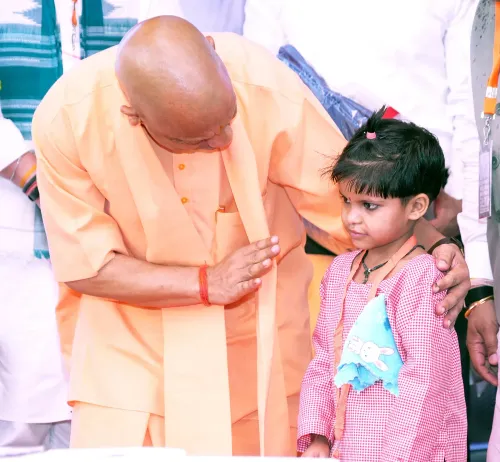
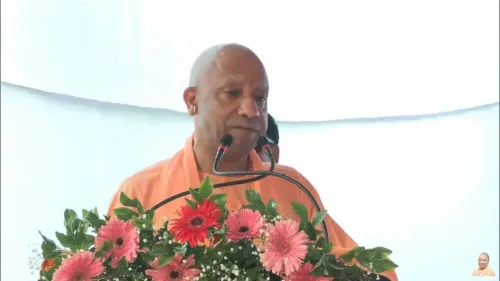
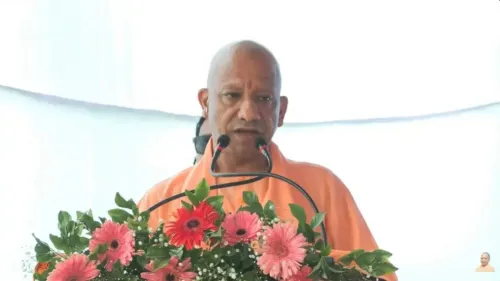
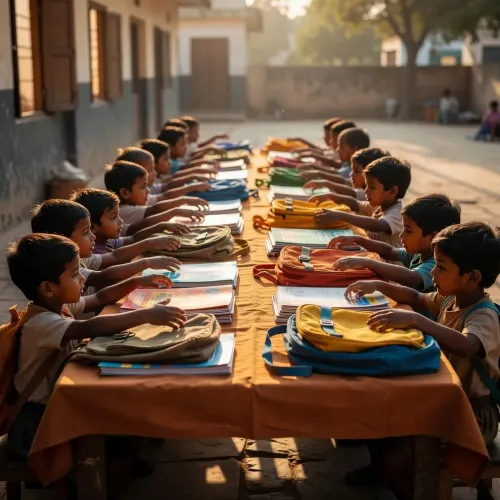
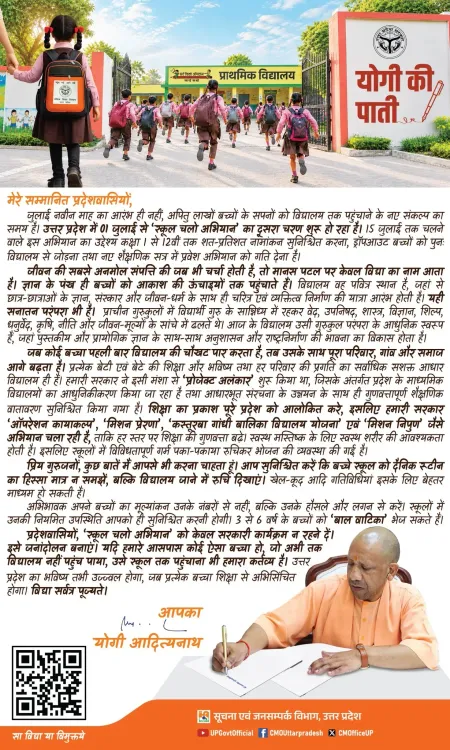
Uttar Pradesh Chief Minister Yogi Adityanath on Monday, 29 June 2026 called on teachers, parents, and citizens across the state to transform the 'School Chalo Abhiyan' into a mass movement, announcing that the campaign's second phase will begin on 1 July 2026. The Chief Minister urged that every child in Uttar Pradesh must be brought within the fold of formal education, framing school enrolment as a collective social responsibility rather than a government exercise alone.
Context
Posting in Hindi on 29 June 2026, CM Yogi Adityanath addressed his message directly to residents of the state — 'मेरे सम्मानित प्रदेशवासियों' ('My respected fellow residents of the state') — signalling an appeal that goes beyond administrative channels. He declared: 'July is not merely the start of a new month, but a time for a new resolve to bring the dreams of lakhs of children to school.' The post marks the formal countdown to the second phase of the School Chalo Abhiyan, one of the state government's flagship education campaigns aimed at improving enrolment and attendance in government primary and upper-primary schools.
The Chief Minister's message carried a dual audience: teachers and parents. He asked gurujan (teachers) to ensure children develop a genuine interest in attending school — through sports and extracurricular activities — rather than treating it as a daily routine obligation. To parents, he said children should be evaluated not by their marks but by their 'hausle aur lagan' — spirit and dedication.
Policy Backdrop
The School Chalo Abhiyan has been a recurring annual campaign in Uttar Pradesh, typically launched at the start of the academic year to drive enrolment in state-run schools. The campaign targets out-of-school children, particularly in rural and semi-urban areas, and involves community outreach by teachers, local bodies, and elected representatives. The first phase of the current cycle preceded this second phase, suggesting a structured, multi-stage approach to sustaining enrolment momentum through the academic year.
Uttar Pradesh, with a school-age population running into crores, has historically faced challenges around dropout rates, irregular attendance, and the gap between enrolment figures and actual classroom presence. State-level campaigns such as this one are designed to bridge that gap by mobilising community pressure alongside government infrastructure investment in schools.
Stakeholders and Impact
The direct beneficiaries are children — particularly those from economically weaker sections — who remain outside the formal schooling system or attend irregularly. CM Yogi explicitly placed the burden of ensuring regular attendance on parents, stating: 'You will have to ensure their regular presence in schools.' This framing shifts the campaign's accountability from the state machinery to the family unit, complementing government-side efforts.
Teachers are positioned as frontline mobilisers, expected to make classrooms engaging enough that attendance becomes self-sustaining. The emphasis on sports and activity-based learning as tools for retention reflects a pedagogical nudge embedded within what is otherwise an administrative enrolment drive. Local bodies, panchayat representatives, and community leaders are implicitly part of the janandolan — people's movement — that CM Yogi has called for.
What's Next
With the second phase of School Chalo Abhiyan set to roll out from 1 July 2026, district administrations and school management committees across Uttar Pradesh are expected to activate outreach drives in the coming days. The Chief Minister's closing line — 'उत्तर प्रदेश का भविष्य तभी उज्ज्वल होगा, जब प्रत्येक बच्चा शिक्षा से अभिसिंचित होगा' ('Uttar Pradesh's future will be bright only when every child is nourished by education') — sets an aspirational benchmark that will likely be measured against attendance and enrolment data when the phase concludes. The success of the campaign's second phase will be a visible indicator of the state government's education delivery ahead of future policy reviews.
Point of View
The campaign also serves as a visible demonstration of the BJP government's commitment to foundational education in India's most populous state. Whether the second phase translates into measurable gains in net enrolment ratios will be the real test of the movement rhetoric.
NationPress
27 Sept 2026
Frequently Asked Questions
What is School Chalo Abhiyan in Uttar Pradesh?
School Chalo Abhiyan is a state government campaign in Uttar Pradesh aimed at enrolling out-of-school children in government primary and upper-primary schools and improving regular attendance. It is typically run at the start of the academic year through community outreach involving teachers, parents, and local bodies.
When does Phase 2 of School Chalo Abhiyan 2026 start?
Phase 2 of School Chalo Abhiyan 2026 begins on 1 July 2026 in Uttar Pradesh, as announced by Chief Minister Yogi Adityanath on 29 June 2026.
What did CM Yogi say to parents about School Chalo Abhiyan?
CM Yogi Adityanath urged parents not to evaluate their children by exam marks alone, but by their spirit and dedication. He also made clear that ensuring regular school attendance is the responsibility of parents, not just the school or government.
What role do teachers play in School Chalo Abhiyan?
Teachers — referred to as 'gurujan' by CM Yogi — are expected to make school genuinely interesting for children through sports, games, and activity-based learning, so that attendance becomes a matter of interest rather than obligation.
Why is CM Yogi calling School Chalo Abhiyan a janandolan?
CM Yogi used the term 'janandolan' (people's movement) to signal that the campaign must be driven by community participation — parents, teachers, and citizens — and not remain a top-down government exercise, in order to achieve lasting improvements in school enrolment and attendance.