CM Yogi: No Disrespect to Any Daughter Is Acceptable
Synopsis
Chief Minister Yogi Adityanath's office pinned a statement on 13 June 2026 declaring no derogatory remark against any daughter is acceptable, invoking the cultural idiom that the village daughter belongs to everyone — a message aligned with UP's Mission Shakti women's safety framework.
Key Takeaways
The Chief Minister's Office of Uttar Pradesh pinned a statement by CM Yogi Adityanath on 13 June 2026 declaring no derogatory remark against any daughter is acceptable.
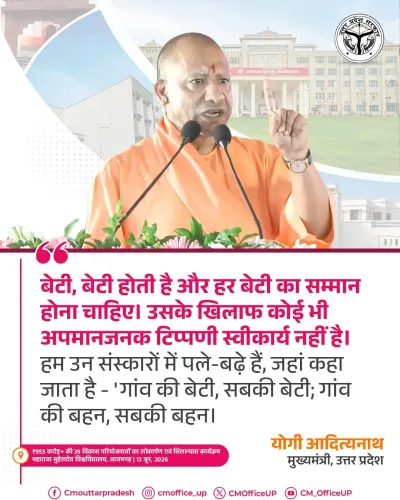
The statement invokes the cultural idiom: 'the village daughter is everyone's daughter, the village sister is everyone's sister.' The post was pinned, making it the top public message of the official CMO account.
Mission Shakti , launched in 2017 , remains the flagship UP government programme for women's safety across 75 districts.
The government has a track record of combining cultural messaging with institutional enforcement such as fast-track courts and anti-eve teasing drives.
Follow-up administrative directives on social media monitoring or awareness campaigns are possible.
The Chief Minister's Office of Uttar Pradesh on Saturday, 13 June 2026, pinned a statement by Chief Minister Yogi Adityanath asserting that no derogatory remark against any daughter is acceptable, invoking a traditional cultural value of collective village responsibility for women.
Context
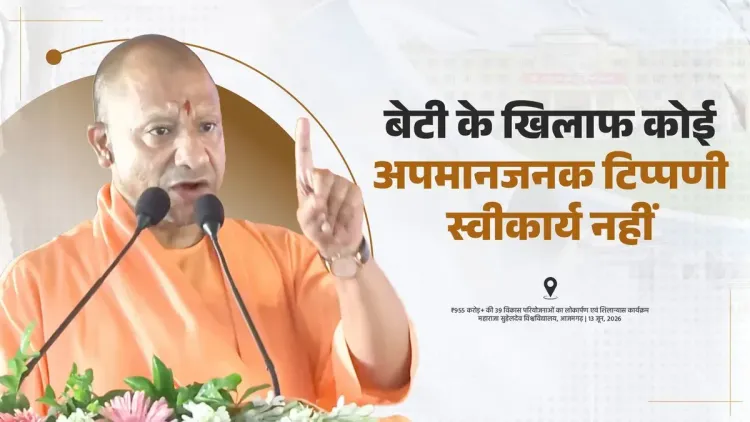
The pinned post quotes CM Yogi Adityanath directly: 'बेटी के खिलाफ कोई भी अपमानजनक टिप्पणी स्वीकार्य नहीं' ('No derogatory remark against a daughter is acceptable'). The statement continues by invoking a deeply rooted cultural idiom: 'गांव की बेटी सबकी बेटी, गांव की बहन सबकी बहन' — meaning, 'the village daughter is everyone's daughter, the village sister is everyone's sister.' By pinning the post, the Chief Minister's Office has elevated it as the office's top public message, signalling its priority.
The statement appears to respond to a broader climate of online and public commentary that the administration considers disrespectful toward women. While the precise immediate trigger for this post cannot be independently verified, the language and framing are consistent with the Uttar Pradesh government's repeated use of cultural idioms to reinforce social norms around the dignity of women.
Policy Backdrop
Since 2017, the Yogi Adityanath-led government in Uttar Pradesh has pursued a dual-track approach to women's safety: cultural messaging rooted in traditional values alongside institutional enforcement mechanisms. The flagship Mission Shakti programme, launched in 2017, was designed to prevent crimes against women and promote their safety across the state's 75 districts.
The administration also expanded anti-eve teasing drives and fast-track courts for sexual offences during its first term, building a framework that combines community awareness with legal deterrence. Invoking the idiom of collective village guardianship fits squarely within this established communication strategy, which frames women's safety as a shared social obligation rather than a purely administrative matter.
Stakeholders and Impact
The statement is directed most immediately at Uttar Pradesh's vast rural population, where village-based social structures still carry significant normative weight. By framing the daughter of one village as the daughter of all, CM Yogi is appealing to a sense of collective honour and responsibility that resonates strongly in semi-urban and rural communities across the state.
Women's rights advocates and rural communities alike stand as key stakeholders. For village women and their families, such a public declaration from the highest executive office of the state carries both symbolic and practical significance — it signals that derogatory speech targeting women will not be tolerated at any level. The statement also places social media users and public figures on notice that the administration is watching the discourse around women.
What's Next
The pinning of this statement suggests the Chief Minister's Office intends it to serve as a sustained public reference point rather than a one-time reaction. Observers will watch for follow-up government orders around social media monitoring or fresh awareness drives tied to existing schemes such as Mission Shakti.
The broader pattern in Uttar Pradesh indicates that such statements from the Chief Minister's Office are often precursors to administrative directives — whether targeted enforcement actions, community-level sensitisation programmes, or digital content guidelines. The government's track record suggests this declaration is unlikely to remain rhetorical alone.
Point of View
CM Yogi Adityanath's office is doing more than issuing a cultural reminder — it is staking out a public posture that derogatory speech targeting women will be treated as a matter of state concern. The invocation of village-based collective responsibility is a deliberate rhetorical choice, designed to activate community-level social norms rather than rely solely on policing. This fits a consistent pattern in Uttar Pradesh since 2017, where the administration has sought to fuse traditional cultural idioms with institutional women's safety architecture. The pinning of the post signals that this message is intended to endure as policy direction, not dissolve as a passing comment.
NationPress
22 Sept 2026
Frequently Asked Questions
What did CM Yogi Adityanath say about derogatory remarks against daughters?
CM Yogi Adityanath stated that no derogatory remark against any daughter is acceptable, invoking the cultural value that the village daughter is everyone's daughter and the village sister is everyone's sister.
Why did the UP Chief Minister's Office pin this post?
Pinning the post elevates it as the top public message on the official CMO account, signalling that the administration treats this as a priority statement of policy and social values rather than a routine remark.
What is Mission Shakti in Uttar Pradesh?
Mission Shakti is a flagship programme launched by the Uttar Pradesh government in 2017 to prevent crimes against women and promote their safety across all 75 districts of the state.
How has the Yogi government addressed women's safety in UP?
The Yogi Adityanath government has combined cultural messaging with institutional measures including Mission Shakti, anti-eve teasing drives, and fast-track courts for sexual offences since 2017.
What follow-up action could come after CM Yogi's statement on women's dignity?
Based on past patterns, the statement could be followed by government orders on social media monitoring, fresh awareness drives under Mission Shakti, or community-level sensitisation programmes across Uttar Pradesh.