CM Yogi pays tribute on Partition Horrors Remembrance Day
Synopsis
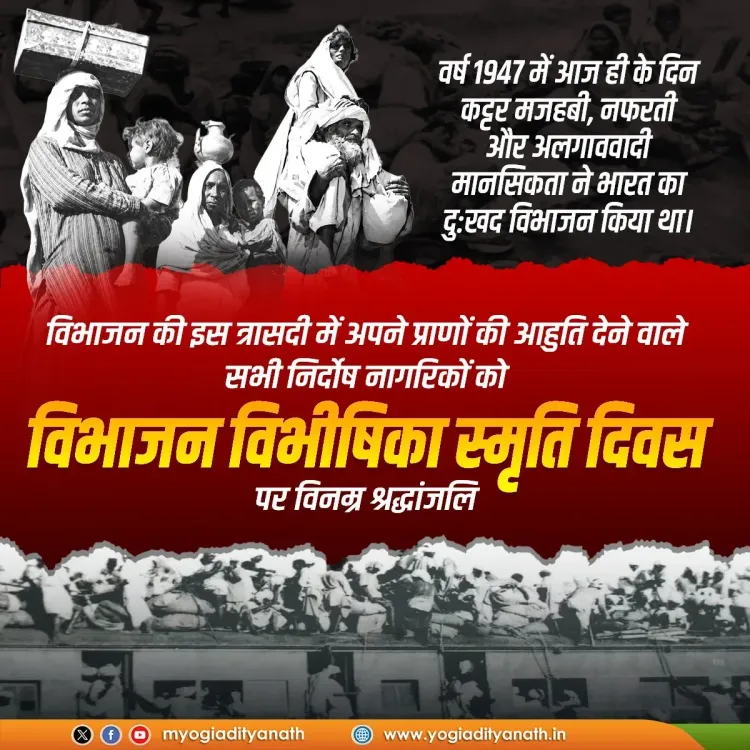
On Partition Horrors Remembrance Day, UP Chief Minister Yogi Adityanath honoured the victims of the 1947 Partition, calling it a shattering of dreams and relationships — not just borders — and urging the nation toward unity and integrity.
Key Takeaways
CM Yogi Adityanath posted a tribute on 14 August 2026 marking Partition Horrors Remembrance Day .
He described the 1947 Partition as a scattering of the dreams, relationships, and sensibilities of countless families — beyond a mere border division.
He offered homage to innocent citizens who lost their lives in the 'catastrophe of fragmentation' and called their memory an inspiration for building an undivided India.
Partition Horrors Remembrance Day was instituted by the Government of India in 2021 on PM Narendra Modi's announcement, observed annually on 14 August .
The 1947 Partition displaced an estimated 10 to 20 million people and caused hundreds of thousands of deaths in communal violence.
Seventy-nine years after one of history's most violent mass displacements, Uttar Pradesh Chief Minister Yogi Adityanath paused on 14 August 2026 to honour the millions whose lives were torn apart — not just by a redrawn border, but by the collapse of everything familiar. His tribute, posted on X in the early hours of the morning, carried the weight of a wound that independent India has never fully closed.
Writing in Hindi, CM Yogi stated that the 1947 Partition was not merely a division of boundaries — 'matra seemaon ka hi nahin hua tha' — but the scattering of the dreams, relationships, and sensibilities of countless families. He offered humble homage to the innocent citizens who lost their lives in what he called the 'catastrophe of fragmentation', and said their memories would forever inspire the building of a 'powerful, united, and undivided India.'
A day born from unacknowledged grief
The observance CM Yogi was marking — Partition Horrors Remembrance Day (Vibhajan Vibhishika Smriti Diwas) — was instituted by the Government of India in 2021, when Prime Minister Narendra Modi declared 14 August as the annual date of remembrance. The choice of date is deliberate: the eve of Independence Day, so that the joy of freedom is always held alongside the memory of its cost.
Historians estimate that the Partition triggered one of the largest forced migrations in human history, displacing between 10 and 20 million people and killing hundreds of thousands in communal violence across Punjab, Bengal, and beyond. Families were separated overnight. Villages emptied. The trauma passed silently through generations, largely without formal state acknowledgement — until 2021.
BJP leadership's recurring invocation of 1947
CM Yogi's post fits a consistent pattern among senior BJP figures: using the Partition's memory as a moral anchor for arguments about national unity and territorial integrity. The message is calibrated — grief for the past, resolve for the present. By linking historical suffering to the imperative of an 'undivided India', the framing connects personal loss to political principle.
For the families of Partition survivors — many of whom still live in Uttar Pradesh, Punjab, Delhi, and West Bengal — the annual observance offers something that decades of silence did not: official recognition that their loss was real, and that the nation remembers.
Remembrance without reckoning is incomplete. But reckoning, at least, has now begun.
Point of View
The date has become a fixture in the party's annual calendar. The framing — suffering as a lesson, unity as the answer — serves both as genuine remembrance and as a soft ideological signal. For a state like Uttar Pradesh, home to millions of Partition-era descendants, it also carries an electoral resonance that is impossible to separate from the moral one.
NationPress
14 Aug 2026
Frequently Asked Questions
What is Partition Horrors Remembrance Day?
Partition Horrors Remembrance Day, or Vibhajan Vibhishika Smriti Diwas, is observed every year on 14 August to honour the victims of the 1947 Partition of India. It was announced by Prime Minister Narendra Modi in 2021.
Why is 14 August chosen for Partition Remembrance Day?
14 August is the eve of India's Independence Day, making it a deliberate pairing: the nation marks freedom on 15 August while acknowledging the immense human cost of that freedom on 14 August.
What did CM Yogi Adityanath say on Partition Remembrance Day 2026?
CM Yogi said the 1947 Partition was not just a division of borders but a scattering of the dreams, relationships, and sensibilities of countless families. He paid homage to innocent victims and said their memory would inspire the building of a powerful, united, and undivided India.
How many people were displaced in the 1947 Partition of India?
Historians estimate that the 1947 Partition displaced between 10 and 20 million people and caused the deaths of hundreds of thousands in communal violence across Punjab, Bengal, and other regions.
When did India officially start observing Partition Horrors Remembrance Day?
The Government of India officially declared 14 August as Partition Horrors Remembrance Day in 2021, following an announcement by Prime Minister Narendra Modi.