Nvidia Welcomes LG Chairman for AI and Robotics Push
Synopsis
Nvidia welcomed LG Group Chairman Kwang-mo Koo to its headquarters on August 14, 2026, announcing an expanded collaboration spanning AI infrastructure, physical AI, and robotics — a high-profile signal of deepening ties between two of the world's most consequential technology companies.
Key Takeaways
Nvidia hosted LG Group Chairman Kwang-mo Koo and senior LG leaders at its headquarters on August 14, 2026 .
Both companies are expanding collaboration across three domains: AI infrastructure , physical AI , and robotics .
Kwang-mo Koo has led LG Group since 2018 , steering it toward robotics and smart-device AI.
Nvidia's Jetson platform , launched in 2016 , provides the edge AI and robotics foundation underpinning such partnerships.
Industry watchers expect future joint announcements at events such as Nvidia GTC or CES .
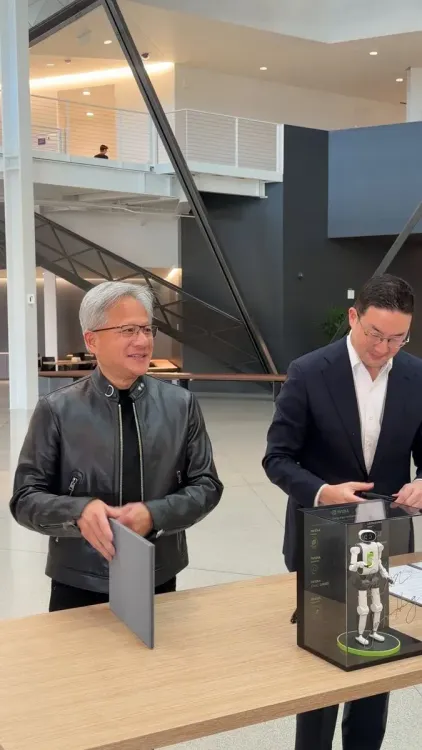
A high-profile visit to Nvidia's headquarters on Friday, August 14, 2026, signals that two of the world's most consequential technology companies are deepening their alliance — and the terrain they are staking out spans AI infrastructure, physical AI, and robotics.
Chip giant Nvidia announced it welcomed LG Group Chairman Kwang-mo Koo and senior LG leaders to its campus, describing the meeting as the opening of 'the next chapter of our collaboration.' The post, shared on Nvidia's official corporate account, named three specific domains of joint work: AI infrastructure, physical AI, and robotics — a trio that maps almost exactly onto where the global hardware industry is placing its biggest bets right now.
Kwang-mo Koo's Visit and What It Signals
Kwang-mo Koo has chaired LG Group since 2018, steering the South Korean multinational conglomerate through a period of aggressive technology repositioning. Under his watch, LG has pushed into robotics and smart-device AI well beyond its traditional consumer electronics base. That a chairman-level visit to Nvidia — not a working-level meeting — was publicly announced speaks to the strategic weight both sides are placing on this relationship.
Nvidia, led by chief executive Jensen Huang, has spent years building exactly the kind of ecosystem that makes such partnerships valuable. Its Jetson platform, introduced in 2016 for edge AI and robotics, gave hardware makers a proven on-ramp to accelerated computing at the device level. That foundation now sits beneath a far larger ambition: scaling physical AI — the ability of machines to perceive, reason, and act in the real world — across consumer, industrial, and enterprise hardware.
Where AI Infrastructure Meets the Physical World
The phrase 'physical AI' is doing a lot of work in this announcement. It is the industry's shorthand for AI that does not merely process data in a data centre but operates in and on physical objects — robots on factory floors, appliances that adapt to their environment, autonomous systems that navigate real space. LG's manufacturing scale and device footprint make it a natural partner for a company trying to push that capability into mass-market hardware.
Nvidia has pursued a widening circle of alliances with global electronics and manufacturing firms precisely to scale this infrastructure. The demand surge for AI training systems and autonomous machines since the early 2020s has made these partnerships commercially urgent, not merely strategic. For LG, embedding Nvidia's accelerated computing into its hardware products positions it ahead of rivals in a market where the gap between AI-capable and AI-absent devices is becoming a decisive competitive variable.
Industry watchers will now look to major technology showcases — events like Nvidia GTC or CES — for concrete joint product announcements or demonstrations that give this collaboration a tangible face. The handshake has been made public. The products are what come next.
Point of View
With physical AI and robotics as the next frontier. For LG, the partnership is a hedge against commoditisation — embedding Nvidia's accelerated computing into devices before rivals do. The explicit naming of 'physical AI' as a collaboration pillar is notable; it signals that both firms see the real-world deployment of AI agents and autonomous systems as a near-term commercial priority, not a distant research goal. Watch this pairing as a bellwether for how the broader electronics industry migrates from AI-adjacent to AI-native hardware.
NationPress
29 Sept 2026
Frequently Asked Questions
What did Nvidia and LG Group announce in August 2026?
Nvidia announced it welcomed LG Group Chairman Kwang-mo Koo and LG leaders to its headquarters, marking the expansion of their collaboration across AI infrastructure, physical AI, and robotics.
Who is Kwang-mo Koo?
Kwang-mo Koo is the chairman of LG Group, the South Korean multinational conglomerate, a role he has held since 2018 where he has guided the company's technology strategy including its push into robotics and smart-device AI.
What is Nvidia's Jetson platform?
Nvidia's Jetson platform, introduced in 2016, is an edge AI and robotics computing platform that allows hardware manufacturers to embed accelerated AI processing directly into devices and machines.
What is 'physical AI' and why does it matter?
Physical AI refers to artificial intelligence that operates in and on physical objects — such as robots, industrial machines, and smart appliances — rather than purely in data centres. It is seen as the next major frontier for AI commercialisation.
Where can I watch for future Nvidia and LG joint announcements?
Industry events such as Nvidia GTC and CES are the most likely venues for concrete joint product announcements or technology demonstrations from the Nvidia-LG collaboration.