CM Yogi: Shravasti Airport Ready, Air Link Coming Soon
Synopsis
Chief Minister Yogi Adityanath announced on 21 July 2026 that Shravasti now has a completed airport and will soon be connected to air services, following the Ayodhya model. He also thanked PM Modi for approving the Bahraich-Shravasti-Balrampur-Khalilabad railway line, with work progressing rapidly.
Key Takeaways
An airport has been completed in Shravasti , Uttar Pradesh, as announced by CM Yogi Adityanath on 21 July 2026 .
Air services to Shravasti are expected to begin soon, following the model of Ayodhya Dham , which is already connected via the UDAN regional air connectivity scheme .
PM Narendra Modi has approved the Bahraich-Shravasti-Balrampur-Khalilabad Railway Line , providing surface connectivity across multiple underserved eastern UP districts.
Construction work on the railway line is already underway and advancing at pace, according to CM Yogi.
The projects are part of a broader multimodal connectivity push for the Buddhist Circuit, alongside earlier investments at Kushinagar and Varanasi.
Key beneficiaries include Buddhist pilgrims from India and abroad, and local communities in the Terai belt of eastern Uttar Pradesh.
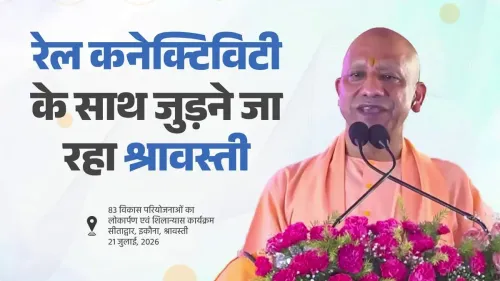
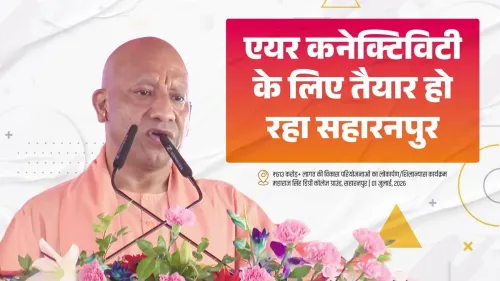
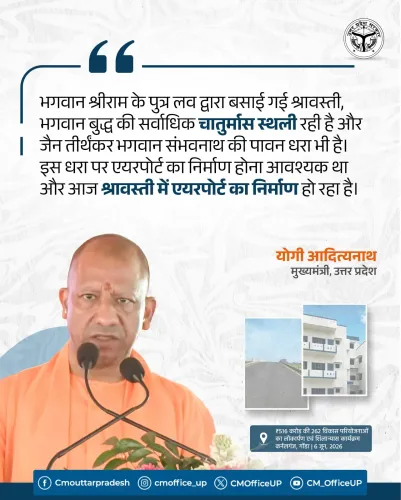
The Chief Minister's Office of Uttar Pradesh announced on Tuesday, 21 July 2026 that an airport has been completed in Shravasti, with Chief Minister Yogi Adityanath stating that the ancient Buddhist pilgrimage city will soon be connected to air services, mirroring the air connectivity already established at Ayodhya Dham.
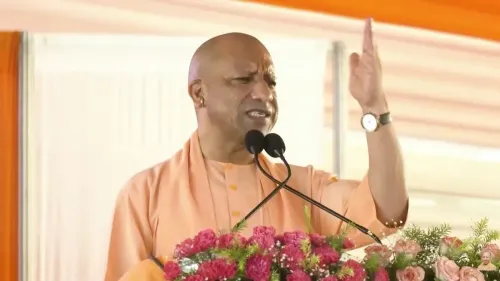
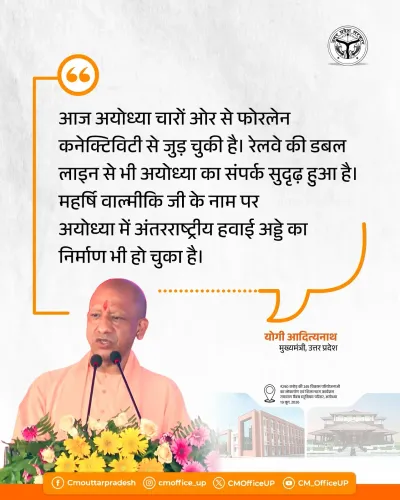
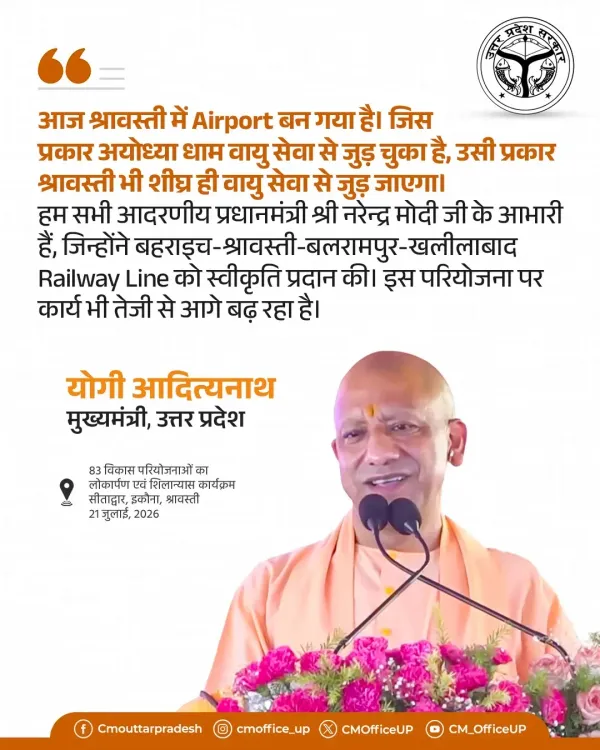
Addressing the development, CM Yogi said: 'आज श्रावस्ती में Airport बन गया है' ('Today, an airport has been built in Shravasti'), adding that just as Ayodhya Dham has been connected to air services, Shravasti will also be linked to air services shortly. He expressed gratitude to Prime Minister Narendra Modi for approving the Bahraich-Shravasti-Balrampur-Khalilabad Railway Line, noting that work on the project is advancing rapidly.
Context
Shravasti holds deep significance as one of the most sacred sites in Buddhism — it is where the Buddha is said to have spent many monsoon retreats and performed miracles. The district lies in the Terai belt of eastern Uttar Pradesh, bordering Nepal, and has historically been underserved in terms of transport infrastructure. The completion of an airport there marks a notable milestone in the state's push to open up pilgrimage destinations to domestic and international visitors.
Ayodhya, cited by CM Yogi as the benchmark, was connected to the central government's UDAN (Ude Desh ka Aam Naagrik) regional air connectivity scheme, which was launched in 2016 to operationalise airports in underserved cities, including religious tourism centres. Shravasti is expected to follow a similar trajectory under the same framework.
Policy Backdrop
The UDAN scheme has been the primary instrument for extending air connectivity to smaller Indian cities and pilgrimage sites since its launch. Under it, airlines receive viability-gap funding to operate routes that would otherwise be commercially unviable, making tickets affordable for ordinary travellers. Sites on the Buddhist Circuit — including Kushinagar, which received an international airport in 2021, and Varanasi — have seen accelerated infrastructure investment under this policy direction.
The approved Bahraich-Shravasti-Balrampur-Khalilabad Railway Line complements the airport by addressing surface connectivity across several districts of eastern Uttar Pradesh that currently lack direct rail links. CM Yogi confirmed that construction work on this line is progressing at pace, crediting PM Modi with sanctioning the project. Together, the rail and air projects represent a multimodal connectivity push for a region that has long depended on road travel alone.
Stakeholders and Impact
The primary beneficiaries are Buddhist pilgrims from across India and abroad — particularly from Sri Lanka, Thailand, Japan, South Korea, and other countries with large Buddhist populations — who travel the Buddhist Circuit annually. Easier access to Shravasti is expected to increase footfall at the site and generate economic activity for local residents, hoteliers, and traders in the surrounding districts of Shravasti, Bahraich, Balrampur, and Siddharthnagar.
Local communities in the Terai region, which has some of the highest poverty rates in Uttar Pradesh, stand to gain from tourism-linked employment and improved access to markets and services that better rail and air connectivity would bring. The railway line in particular would connect several district headquarters that currently have no direct rail route between them.
What's Next
The key milestones to watch are the commencement of commercial flight operations from Shravasti Airport — including which airlines and routes will be approved under the UDAN framework — and the completion timeline for the Bahraich-Shravasti-Balrampur-Khalilabad Railway Line. If Shravasti follows the Ayodhya model, route allocations and inaugural flight announcements could follow in the coming months. A fully multimodal Buddhist Circuit — with air, rail, and road connectivity linking Shravasti, Kushinagar, Sarnath, and Bodh Gaya — would represent one of the most significant religious-tourism infrastructure buildouts in South Asia in recent decades.
Point of View
CM Yogi is positioning Shravasti within a broader 'pilgrimage connectivity' arc that has become a signature of the Modi-Yogi partnership. The Buddhist Circuit focus also carries a diplomatic dimension, as improved access to these sites strengthens India's soft power with Buddhist-majority nations in Southeast and East Asia. The real test will be the speed at which commercial flights and railway construction milestones are delivered, converting political announcements into tangible outcomes for one of UP's most economically marginalised regions.
NationPress
22 Jul 2026
Frequently Asked Questions
Has Shravasti airport been completed?
According to an announcement by Chief Minister Yogi Adityanath on 21 July 2026 , the airport in Shravasti has been built. The commencement of commercial air services is expected to follow, though a specific launch date has not yet been announced.
What is the Bahraich-Shravasti-Balrampur-Khalilabad railway line?
It is a new railway line approved by Prime Minister Narendra Modi that will connect the districts of Bahraich, Shravasti, Balrampur , and Khalilabad in eastern Uttar Pradesh. CM Yogi has confirmed that construction is progressing rapidly.
How will Shravasti be connected by air?
CM Yogi stated that Shravasti will be connected to air services in the same manner as Ayodhya Dham , which was linked under the central government's UDAN regional air connectivity scheme that subsidises flights to underserved cities.
Why is Shravasti important for tourism?
Shravasti is one of the most sacred sites in Buddhism, believed to be where the Buddha spent numerous monsoon retreats and performed miracles. It attracts pilgrims from across India and from countries such as Sri Lanka, Thailand, Japan, and South Korea.
What is the UDAN scheme?
The UDAN (Ude Desh ka Aam Naagrik) scheme is a central government programme launched in 2016 to provide affordable air connectivity to smaller Indian cities and religious sites by offering viability-gap funding to airlines operating on these routes.