CM Yogi: UP Adds 24 Lakh Hectare Irrigation via Canal Projects
Synopsis
The Chief Minister's Office of Uttar Pradesh said CM Yogi Adityanath has completed the Bansagar Canal, Saryu Canal National Project and Bundelkhand irrigation works, adding 24 lakh hectare of land to the state's assured irrigation network and targeting farmers in eastern UP and the drought-prone Bundelkhand belt.
Key Takeaways
CM Yogi Adityanath claims completion of Bansagar , Saryu and Bundelkhand irrigation projects.
State government cites 24 lakh hectare of additional irrigated land as a result.
Saryu Canal National Project serves eastern UP districts including Gorakhpur , Basti and Siddharthnagar .
Bansagar is a multi-state scheme involving Uttar Pradesh , Madhya Pradesh and Bihar on the Sone river .
Push aligns with central PMKSY focus on finishing stalled medium and major irrigation works.
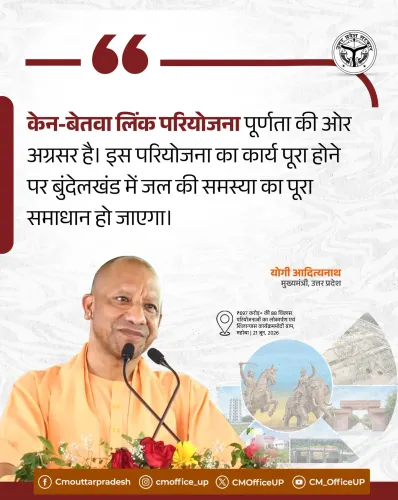
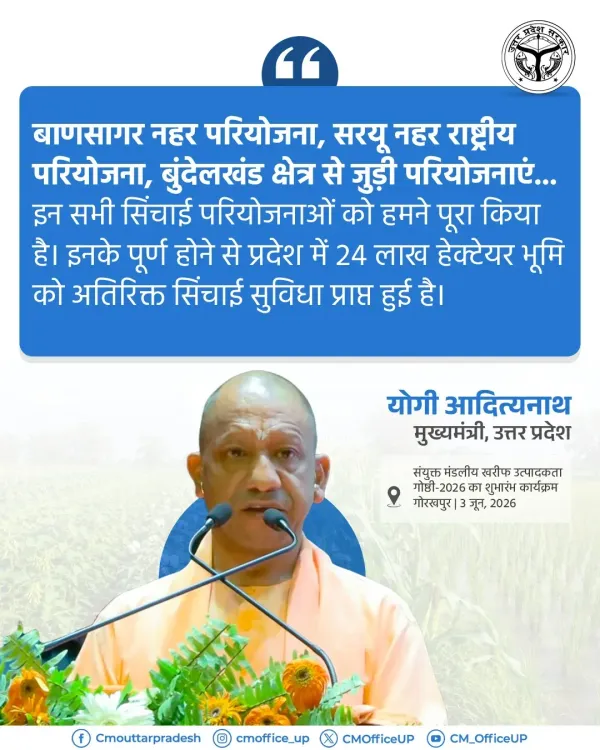
The Chief Minister's Office of Uttar Pradesh on June 3, 2026 highlighted Chief Minister Yogi Adityanath's claim that the state has completed a clutch of long-pending irrigation projects, including the Bansagar Canal Project, the Saryu Canal National Project and schemes linked to the Bundelkhand region. The post, issued from Lucknow, asserts that the completion of these works has brought an additional 24 lakh hectare of land under assured irrigation in Uttar Pradesh.
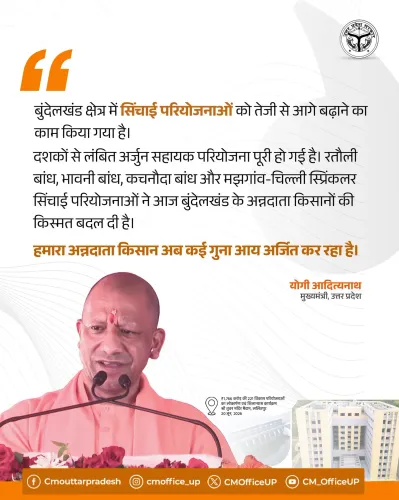
Quoting the Chief Minister, the post said in Hindi, 'Baansagar nahar pariyojana, Saryu nahar rashtriya pariyojana, Bundelkhand kshetra se judi pariyojanaayein… in sabhi sinchai pariyojanaon ko humne poora kiya hai.' Translated, the statement reads: 'The Bansagar Canal Project, the Saryu Canal National Project, projects linked to the Bundelkhand region — we have completed all these irrigation projects. Their completion has provided additional irrigation facility to 24 lakh hectare of land in the state.'
Context
The three project clusters cited by the Chief Minister are among the oldest pending irrigation works in northern India. The Bansagar scheme is a multi-state arrangement on the Sone river basin involving Uttar Pradesh, Madhya Pradesh and Bihar, designed to share storage and canal benefits across the three states.
The Saryu Canal National Project, covering districts in eastern Uttar Pradesh such as Gorakhpur, Basti and Siddharthnagar, received national project status with central funding support to accelerate completion. The Bundelkhand cluster traces back to a special irrigation package announced by the central government in 2008 to tackle recurrent drought in the region spanning parts of Uttar Pradesh and Madhya Pradesh.
Policy backdrop
Since taking office in 2017, Chief Minister Yogi Adityanath has repeatedly placed the completion of legacy canal projects among the top development priorities of his administration. The approach dovetails with the central Pradhan Mantri Krishi Sinchayee Yojana (PMKSY), which emphasises finishing stalled medium and major irrigation works rather than launching new ones.
The political messaging is consistent: framing decades-old projects as having been brought to closure under the current dispensation, while linking new command-area coverage to farm incomes. The headline claim of 24 lakh hectare of additional irrigated land is a cumulative figure the state government has used in earlier briefings as well.
Stakeholders and impact
The primary beneficiaries cited in state communications are farmers in eastern Uttar Pradesh and Bundelkhand, two regions historically marked by lower agricultural productivity and higher distress migration. Assured canal irrigation typically allows a shift from single-crop rainfed cultivation to double-cropping, particularly of paddy and wheat in the east and pulses and oilseeds in Bundelkhand.
For the state exchequer, completed canal networks shift expenditure from capital construction to operations and maintenance — a transition that brings its own fiscal demands. Local water user associations and panchayats are expected to play a larger role in last-mile distribution as command areas expand.
What's next
Attention will turn to state budget allocations for maintenance of the newly commissioned canal systems and to any official impact assessment validating the 24 lakh hectare claim. The performance of the kharif and rabi cycles in the expanded command areas will offer an early signal of whether the infrastructure translates into measurable gains in cropping intensity and yields.
If sustained, the irrigation push could reshape the political economy of eastern Uttar Pradesh and Bundelkhand by narrowing the agricultural gap with the state's more prosperous western belt — a long-standing policy ambition that has eluded successive governments.
Point of View
Saryu and Bundelkhand together signals an attempt to address regional imbalances within Uttar Pradesh, particularly the productivity gap between the western and eastern belts. The 24 lakh hectare figure, while politically potent, will invite scrutiny on command-area utilisation and water delivery efficiency. The broader arc tracks national policy under PMKSY, where completion has replaced greenfield ambition as the dominant frame.
NationPress
19 Sept 2026
Frequently Asked Questions
What did CM Yogi Adityanath say about irrigation projects?
He said the Bansagar Canal Project, Saryu Canal National Project and Bundelkhand-linked irrigation projects have all been completed, adding 24 lakh hectare of land to Uttar Pradesh's irrigation coverage.
What is the Saryu Canal National Project?
The Saryu Canal National Project is a major canal-irrigation scheme in eastern Uttar Pradesh covering districts such as Gorakhpur, Basti and Siddharthnagar, which received national project status with central funding support.
Which states are part of the Bansagar Canal Project?
The Bansagar Canal Project is a multi-state irrigation arrangement on the Sone river basin involving Uttar Pradesh, Madhya Pradesh and Bihar.
How much extra land is now irrigated in Uttar Pradesh?
According to the Chief Minister's Office, an additional 24 lakh hectare of land in Uttar Pradesh now has access to irrigation facilities following the completion of these projects.
Why is Bundelkhand a focus for irrigation projects?
Bundelkhand is a drought-prone region spanning parts of Uttar Pradesh and Madhya Pradesh, and has been the focus of successive state and central irrigation packages, including a special package announced in 2008.